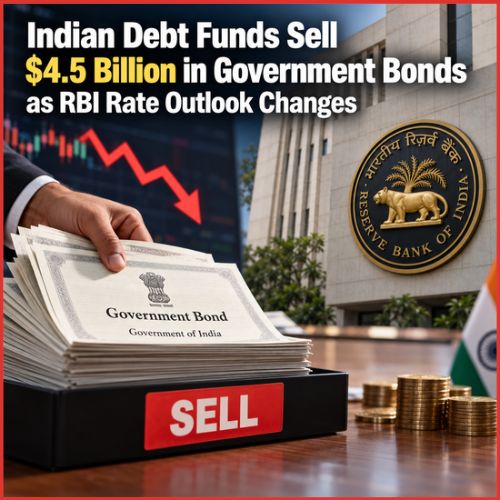
Indian mutual funds are pulling away from long-dated government bonds after a sudden change in the interest-rate outlook turned one of the market’s favourite trades into a much less comfortable place to be.
Fund houses have sold about $4.5 billion worth of government securities since July. The selling accelerated after the Reserve Bank of India raised interest rates for the first time in nearly four years and signalled that more increases could follow.
That has pushed bond yields higher and forced debt-fund managers to reconsider how much interest-rate risk they want to carry.
For investors in Indian debt funds, the shift matters because long-duration bond prices are particularly sensitive when rates start moving up.
Funds Sold ₹51 Billion in Just Three Sessions
The reaction after the RBI decision was quick.
Mutual funds sold a net ₹51 billion of government bonds in the three trading sessions following the rate increase.
That came on top of roughly ₹378 billion sold between July and September.
The numbers show that the move away from government bonds was already under way before the latest policy decision. The RBI action simply gave fund managers another reason to shorten their portfolios.
Managers are becoming more cautious because the market now expects interest rates to remain higher for longer than previously assumed.
That changes the calculation for anyone holding a bond that will not mature for many years.
Why Rising Rates Hurt Existing Bonds
The mechanics can be confusing, but the basic relationship is simple.
Bond prices and yields move in opposite directions.
Suppose an investor owns a government bond paying a fixed coupon. If newly issued bonds suddenly offer a higher yield because interest rates have risen, the old bond becomes less attractive.
Its market price needs to fall until the effective return becomes competitive.
Longer-dated bonds usually move more sharply because investors are locked into the older rate for a longer period.
That is why funds carrying high bond duration risk can suffer noticeable mark-to-market losses when the rate outlook changes quickly.
The current selloff is largely about reducing that exposure.
The Five-Year Yield Has Jumped Almost 70 Basis Points
The repricing is already visible.
India’s five-year government bond yield has moved above 7.05%, rising almost 70 basis points in roughly two months.
The benchmark 10-year yield has been trading close to 7.35%, its highest level in nearly three years.
Some fund managers now see longer-term yields moving into the 7.20%-7.40% range.
That does not mean yields will travel there in a straight line.
Bond markets react continuously to inflation, liquidity, central-bank operations, global rates and government borrowing.
But the direction of expectations has clearly changed.
A few months ago, investors were more comfortable owning duration. Now many are being paid to wait in much shorter maturities.
The RBI’s Tone Changed the Market
The rate increase itself mattered, but so did the message around it.
Fund managers interpreted the RBI’s latest stance as more concerned about inflation becoming broad-based.
That raised the possibility that the tightening cycle could last longer than previously expected.
A single rate hike is manageable for bond investors if they believe it will be quickly reversed.
A sequence of hikes is different.
Each additional increase can put more pressure on existing fixed-rate bonds, particularly at the long end of the market.
That explains why the RBI rate hike impact on bonds has continued beyond the day of the policy announcement.
Investors are not reacting only to what the RBI did. They are trying to price what it might do next.
RBI Bond Sales Have Added Another Pressure Point
The central bank has also been selling government bonds in the open market.
The RBI sold roughly ₹1 trillion of bonds last month, its largest net sale for any financial year in more than a decade.
When a large seller adds supply to the market, demand has to absorb it.
If buyers are already nervous about rising interest rates, that additional supply can put more upward pressure on yields.
Fund managers are therefore dealing with two issues at once: a less friendly rate outlook and the possibility of more central-bank bond sales.
Neither makes aggressive long-duration positioning particularly appealing.
Global Bond Yields Are Not Helping
India is not operating in isolation.
Fund managers are also watching higher global rates and elevated bond yields in major markets.
When overseas yields rise, domestic debt has to remain attractive enough to compete for capital.
Global energy uncertainty adds another complication because higher fuel costs can feed into domestic inflation.
That combination has pushed many managers towards a defensive stance.
Instead of trying to predict exactly where long-term yields peak, they are reducing exposure and moving into securities where the impact of additional rate increases should be smaller.
Short-Term Debt Is Suddenly More Attractive
This is the other side of the selloff.
Money is not simply leaving fixed income. It is moving.
Axis Mutual Fund has indicated a preference for high-quality corporate bonds in roughly the one- to three-year maturity range.
Aditya Birla Sun Life Asset Management has also shown interest in ultra-short-term debt.
Bandhan Asset Management has made an even more dramatic change, cutting the weighted average duration of part of its portfolio to less than one year from around 12 years.
That is a major shift in interest-rate exposure.
The appeal of short duration debt funds is straightforward when yields are rising: investors can earn relatively attractive carry without taking as much price risk if rates climb again.
Longer Bonds Could Become Interesting Later
The move into shorter assets does not mean fund managers will avoid long bonds forever.
In fact, higher yields eventually make longer maturities more attractive.
The difficulty is timing. Buying too early in a rate-hiking cycle can mean enduring more price declines before yields finally peak.
Some managers therefore prefer to wait until the tightening process has progressed further before adding duration again.
If yields rise enough, the extra income available on long bonds may eventually compensate investors for the interest-rate risk.
That point may come later. Many funds do not appear to believe it has arrived yet.
What Does This Mean for Debt-Fund Investors?
Investors need to look beyond the word “debt” and check what their fund actually owns.
An overnight or liquid fund behaves very differently from a long-duration government-securities fund.
Someone holding a long-duration portfolio because they expected falling interest rates may see more volatility if yields continue rising.
Short-duration funds should generally experience smaller price swings, although they carry their own credit and reinvestment risks depending on what they own.
The current Indian government bond selloff is therefore a reminder that debt funds are not fixed deposits.
Their net asset values move with the market.
The Rate Cycle Has Changed the Trade
The $4.5 billion selloff is ultimately the result of a market changing its mind.
When investors expected easier monetary policy, holding long government bonds offered a way to benefit if yields fell and prices rose.
That trade looks very different once the central bank starts raising rates instead.
Mutual funds are responding by cutting duration, holding shorter securities and waiting for better entry points further along the rate cycle.
The next question is how far yields have to rise before those same fund managers decide long bonds look attractive again.
For now, they appear more interested in protecting portfolios from the next rate move than betting that the current one is already over.
Source
Reuters: Indian debt funds set to extend $4.5 billion bond selloff after RBI policy shift