Google’s artificial-intelligence push is usually discussed through Gemini, Search and Alphabet shares. The less obvious part of the story sits behind the software.
Every new AI model needs specialised chips, printed circuit boards, networking gear and server infrastructure. Google can design a large part of that system itself, particularly through its Tensor Processing Units, but it still relies on outside suppliers to turn those designs into working data centres.
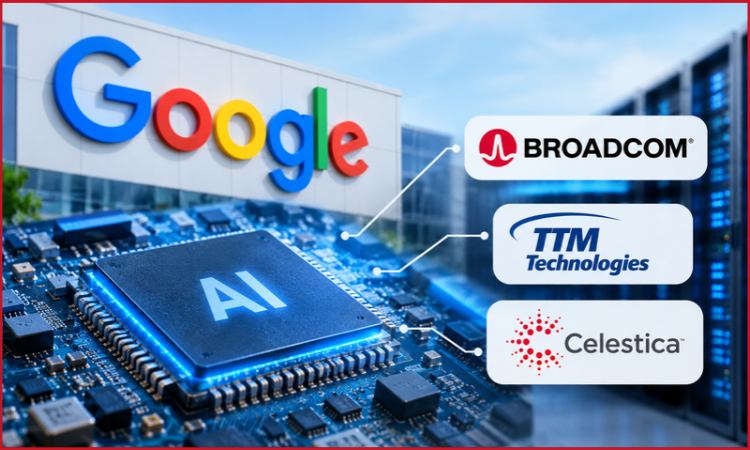
That has brought Broadcom, TTM Technologies and Celestica into the conversation around companies that could benefit if Google keeps increasing AI infrastructure spending.
The attraction is simple. They do not need Gemini to become the only successful AI model. They need Google to continue building.
Broadcom Has the Closest Link to Google’s Custom AI Chips
Broadcom is probably the most direct name in the group.
Google designs its own Tensor Processing Units, or TPUs, rather than relying entirely on off-the-shelf graphics processors for its AI workloads. That gives Alphabet more control over cost and performance inside its data centres.
Designing a chip is only part of the job, though.
Broadcom has become an important partner in turning Google’s custom silicon into hardware that can actually be deployed at scale. Its work extends into high-speed networking as well, which becomes increasingly important when thousands of AI accelerators need to communicate with each other.
That makes Broadcom AI revenue less dependent on selling one conventional processor.
The company participates in the custom accelerator market and in the networking layer around those accelerators.
Broadcom’s AI business has already grown sharply. Its fiscal first-quarter 2026 revenue reached about $19.3 billion, while AI-related revenue came in at roughly $8.4 billion.
That is no longer a small side business.
Google’s TPUs Are Becoming a Bigger Part of the AI Race
For years, Nvidia GPUs were the default shorthand for AI infrastructure.
They still dominate much of the market, but hyperscalers increasingly want alternatives.
Google’s answer is the TPU.
A custom accelerator can be optimised around the workloads a company actually runs instead of being designed to serve every possible computing use case.
For Google, that means hardware built specifically around machine learning, Gemini and the company’s cloud infrastructure.
The attraction is not only speed.
A chip that delivers better performance for each dollar or watt can have an enormous financial effect when deployed across huge data-centre fleets.
That is why the Google TPU ecosystem matters to suppliers.
If Alphabet continues using more of its own silicon, the companies helping manufacture, connect and package those systems can grow alongside it.
TTM Technologies Sits Deeper Inside the Hardware
TTM Technologies is a very different business.
Its role is less visible because it makes printed circuit boards and related components rather than the headline AI chip.
Those boards are easy to overlook until a data centre begins operating at AI scale.
High-density computing systems generate large amounts of heat and move huge amounts of data. The boards connecting those systems have to handle demanding electrical, thermal and reliability requirements.
TTM has been benefiting from stronger demand in data-centre and networking applications.
The company reported second-quarter 2026 sales of roughly $846 million, with management pointing to artificial intelligence and defence as major contributors.
That helps explain why TTM Technologies AI exposure has attracted more investor attention.
The company does not need to invent a new chatbot. It needs hyperscalers to keep installing increasingly complicated hardware.
The Opportunity Comes With a Different Kind of Risk
That does not make TTM a simple AI proxy.
Component suppliers live with their own problems.
Manufacturing expansion costs money. Margins can move around as new factories ramp up, customers can change designs and a large customer order can make one quarter look much stronger than another.
AI demand can also be lumpy.
A hyperscaler may spend aggressively during one capacity build-out and then pause before the next phase.
So while TTM offers exposure to physical AI infrastructure, that exposure comes through a manufacturing business rather than a software platform with recurring subscriptions.
Investors looking at the name need to understand that distinction.
Celestica Is Selling the Racks and Networking Around the Chips
Celestica sits further up the system.
The company manufactures customised computing hardware, server racks and networking equipment used by large cloud customers.
Its Connectivity and Cloud Solutions business has expanded quickly as hyperscalers spend more on AI computing and high-speed networking.
The company has worked on systems connected with Google’s TPU infrastructure, including rack-level hardware designed to house large clusters of accelerators.
That makes Celestica AI infrastructure a different bet from either Broadcom or TTM.
Broadcom helps with the chips and networking technology. TTM supplies critical boards. Celestica helps turn the pieces into complete computing systems that can be installed inside a data centre.
Its cloud-related business has been growing rapidly as 800-gigabit networking and custom AI compute programmes ramp.
Google Does Not Build AI in Isolation
The larger investment idea behind all three companies is that Alphabet’s AI spending spreads well beyond Alphabet itself.
A modern AI data centre needs far more than processors.
It needs advanced boards, switches, cables, cooling, power systems, racks, storage and networking.
Every time Google increases the number of TPU clusters it deploys, an entire chain of suppliers can see additional demand.
That is why infrastructure companies are often described as the “picks and shovels” of AI.
They may benefit regardless of which individual chatbot wins the most consumer attention, provided overall computing demand continues rising.
Alphabet Is Spending Heavily on AI Infrastructure
That assumption matters because the entire case weakens if hyperscaler spending slows.
Alphabet has already been increasing capital expenditure aggressively as it builds out Google Cloud and Gemini infrastructure.
Its AI strategy is no longer centred only on model development.
Google is commercialising AI through Cloud, Search, Workspace and developer services while continuing to develop its own silicon.
That requires expensive physical capacity.
The more workloads Google brings onto TPUs, the more relevant suppliers around Google AI infrastructure become.
Still, investors should separate structural demand from guaranteed stock returns.
A good industry can still contain overpriced shares.
The Real Story Is Behind Gemini
Gemini may be the product consumers recognise, but the infrastructure underneath it is where enormous amounts of money are being spent.
That makes Broadcom, TTM Technologies and Celestica worth watching for a different reason from Alphabet.
They sit at separate points in the physical chain required to make Google’s AI ambitions work.
Broadcom brings custom silicon and networking expertise. TTM supplies the advanced boards connecting high-density systems. Celestica helps assemble the server and networking infrastructure around them.
If Google keeps expanding its TPU footprint, all three could see more work.
Whether that translates into attractive investment returns is a separate question involving valuation, margins and execution.
The AI boom may begin with a model on a screen. Behind it sits a lot of hardware.