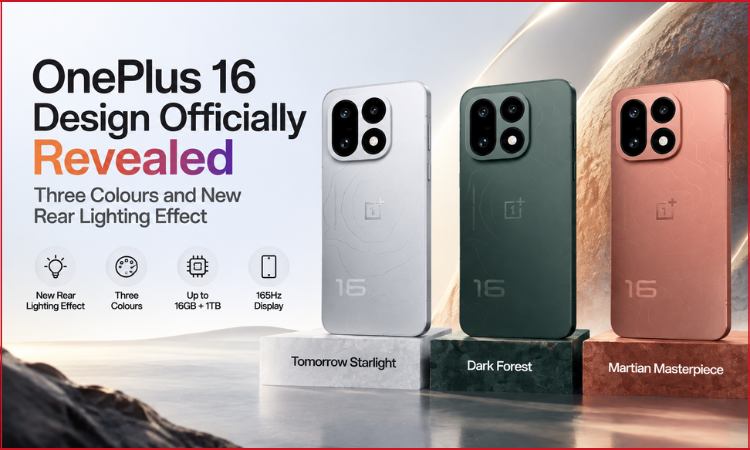
OnePlus has given its upcoming flagship an official reveal ahead of launch, showing off the OnePlus 16 design, three colour options and a new lighting effect built into one version of the rear panel.
The phone will arrive in Tomorrow Starlight, Dark Forest and Martian Masterpiece finishes. Of the three, Tomorrow Starlight is clearly the one OnePlus wants people talking about. It uses an interactive lighting system across the back, while the other two take a more conventional approach.
The company has also confirmed several RAM and storage combinations, including a top-end model with 16GB of RAM and 1TB of storage. A full launch date has not yet been announced, although the phone is expected to make its official debut in China soon.
Tomorrow Starlight Gets the Standout Treatment
The most unusual OnePlus 16 colour is Tomorrow Starlight.
Instead of simply giving the glass back a different shade, OnePlus has added what it calls an Interstellar Light Effect. The rear surface can produce subtle lighting patterns that react to different activities on the phone.
Calls, notifications, charging, music and gaming can trigger different effects. The idea seems to be less about turning the phone into a bright gaming handset and more about adding a low-key visual element to the back.
During the day, the finish looks relatively restrained. In lower light, the illuminated details become more noticeable.
OnePlus has also used a nano-grating texture beneath the surface. That allows the panel to shift its appearance slightly as light hits it from different angles.
The result gives Tomorrow Starlight more character than a standard glossy or matte back without completely changing the overall shape of the phone.
Dark Forest and Martian Masterpiece Keep Things Simpler
Buyers who do not want lighting effects will have two other finishes.
Dark Forest is the more traditional option. It uses a very dark tone and should appeal to people who prefer understated flagship phones rather than brighter colours.
Martian Masterpiece takes the opposite direction. It has a warmer reddish-pink appearance that gives the device a noticeably different look from the darker variant.
Having three visually distinct finishes makes sense for a flagship device. The phone itself keeps the same basic hardware design, but each colour creates a fairly different impression.
OnePlus has often experimented with materials and finishes on its premium models. The OnePlus 16 colours continue that approach rather than offering three minor variations of black, grey and silver.
Silk Glass Is Designed to Reduce Fingerprints
The company is also changing how the back feels.
OnePlus says the phone uses a new silk glass process intended to create a softer, smoother texture while making fingerprints less noticeable.
That sounds like a small detail, but it matters on a device that is handled constantly throughout the day.
Glossy glass can look excellent when clean but quickly collects smudges. Heavy matte finishes solve that problem but sometimes feel rougher or less premium.
The new treatment appears to sit somewhere between the two.
Actual grip and fingerprint resistance will only become clear once the retail phone is available, but the design direction suggests OnePlus is paying closer attention to how the device feels rather than concentrating only on its appearance.
Camera Module Keeps a Square Layout
The back of the phone features a large square camera island positioned towards the upper-left side.
It continues the flatter design language OnePlus has been moving towards rather than bringing back the large circular camera housing seen on some earlier flagships.
The camera block itself has rounded corners, helping it match the softer edges of the rest of the handset.
A relatively clean rear panel leaves most of the visual attention on the camera module and, in the Tomorrow Starlight edition, the lighting effects underneath the glass.
The front continues the familiar modern flagship approach with a large flat display and narrow bezels.
OnePlus Keeps a Customisable AI Key
Another visible part of the OnePlus 16 design is the button on the left side of the handset.
OnePlus is continuing with its customisable AI key, giving users a physical shortcut that can be assigned to different functions.
Physical buttons are becoming an interesting battleground on smartphones again.
For years, manufacturers were removing buttons and moving functions into software. More recently, brands have begun adding dedicated camera controls, action buttons and AI shortcuts.
The benefit depends heavily on whether the button can be configured around a user’s routine. A shortcut that launches something useful every day can become convenient very quickly. A button locked to a rarely used feature tends to become forgotten.
OnePlus giving users some control over the key should make it more useful.
Four RAM and Storage Options Confirmed
The Chinese pre-order listing has also revealed four memory configurations.
The range begins with 12GB of RAM and 256GB of storage. A second version keeps 12GB of RAM but increases storage to 512GB.
Above those sit a 16GB RAM and 512GB storage model, followed by the top configuration with 16GB of RAM and 1TB of internal storage.
That gives buyers plenty of room at the high end, particularly people who store large games, videos or offline media directly on their phones.
The OnePlus 16 storage options are:
- 12GB RAM + 256GB storage
- 12GB RAM + 512GB storage
- 16GB RAM + 512GB storage
- 16GB RAM + 1TB storage
Whether every configuration will eventually be offered outside China remains unknown.
OnePlus often adjusts memory options depending on the market, so global and Indian buyers may receive a slightly different lineup.
165Hz Display Is Already Confirmed
OnePlus has started revealing more than just the appearance of the phone.
The company has confirmed that the OnePlus 16 will use a display capable of reaching a 165Hz refresh rate.
That keeps the focus on smoothness and gaming performance.
A 165Hz panel can refresh the image up to 165 times per second when supported, making animations and compatible games appear smoother than on conventional 60Hz or 120Hz screens.
The practical difference depends on the software and content being used, but it gives OnePlus another flagship-level number to highlight.
The phone will also ship with ColorOS 17 in China, based on Android 17.
International versions are likely to follow OnePlus’ usual software strategy, although the company has not yet detailed every regional configuration.
More Details Should Arrive Around the Launch
OnePlus has still left several important questions unanswered.
Pricing remains unknown, as does the exact launch date. The company has also not fully detailed the global rollout.
Camera hardware, battery specifications and chipset information have appeared in leaks, but those details should remain separate from what OnePlus has officially confirmed so far.
That distinction matters because flagship phones often go through months of leaks before launch, and not every early specification survives unchanged.
For now, the official story is mainly about design.
The OnePlus 16 design keeps the clean, flat look of recent models while introducing enough visual changes to make the new flagship recognisable. Tomorrow Starlight provides the more experimental option, Dark Forest keeps things conservative and Martian Masterpiece gives buyers a warmer alternative.
Add the new glass treatment, customisable key, four memory configurations and confirmed 165Hz display, and OnePlus has already revealed a fair amount before the formal launch.
The next announcement should fill in the parts buyers care about most: complete specifications, pricing and when the OnePlus 16 will actually reach stores outside China.