On August 5, the Reserve Bank of India’s Monetary Policy Committee held the repo rate at 5.25% for the fourth straight meeting, unanimous call, neutral stance intact. Governor Sanjay Malhotra even nudged the FY27 growth forecast up to 6.7% while trimming the inflation estimate to 5.0%. Uneventful policy, on paper.
For a borrower filling out paperwork that same week, the number on the sanction letter matters more than any commentary around it. Home loan interest rates 2026 span from close to 7.10% at the cheapest public-sector counters to north of 9% at some private banks and housing finance companies a gap wide enough to change total repayment by several lakh rupees on an ordinary ₹50 lakh loan.
That spread is why home loan comparison has stopped being a courtesy check before signing and become the single biggest lever a buyer actually controls. Property price and tenure are largely fixed by the time you reach the bank. The rate isn’t.
What Is A Home Loan Interest Rate?
A home loan interest rate is the annual cost a lender charges on the amount you still owe against your property. It recalculates every month against whatever principal remains, not once at sanction.
Take a typical case. A ₹50 lakh loan over 20 years, priced at 8.5%, works out to an EMI of roughly ₹43,391. Shave that same loan to 7.10%, the kind of rate a well-qualified borrower can get from a handful of public-sector lenders, and the EMI drops to about ₹39,066, a saving of close to ₹10.38 lakh across the tenure (MoneyKarma, 2026). Nobody hands you that difference in cash. It just compounds, invisible, for two decades. That’s the entire case for shopping around before signing anything.
How Home Loan Interest Rates Work
The Repo Rate Sets The Floor
Since October 2019, nearly every floating-rate home loan in India has been tied to an External Benchmark Lending Rate, and for most banks that benchmark is the RBI’s repo rate. When the central bank moves, EBLR-linked loans move too, at each lender’s reset date, typically once a quarter. With the repo rate frozen at 5.25% since February, floating EMIs have stayed unusually stable through 2026 a signal rates aren’t falling further soon, so waiting for a “better moment” carries its own cost.
Your Credit Profile Decides The Spread
Banks don’t lend everyone at the advertised headline rate. That figure is reserved for borrowers with a CIBIL score of 750 or higher. Drop below 700, and most lenders quietly add 25 to 75 basis points, regardless of what the homepage says. The rate in an advertisement and the rate on your sanction letter can be two different numbers.
Fixed Versus Floating
Fixed-rate loans lock the interest for a set period; floating loans move with the benchmark. With the RBI signalling it wants “greater clarity” before its next move, floating remains popular for long tenures, since any future cut passes through automatically. Fixed rates suit borrowers who want payment certainty over flexibility.
Home Loan Interest Rates 2026 By Bank
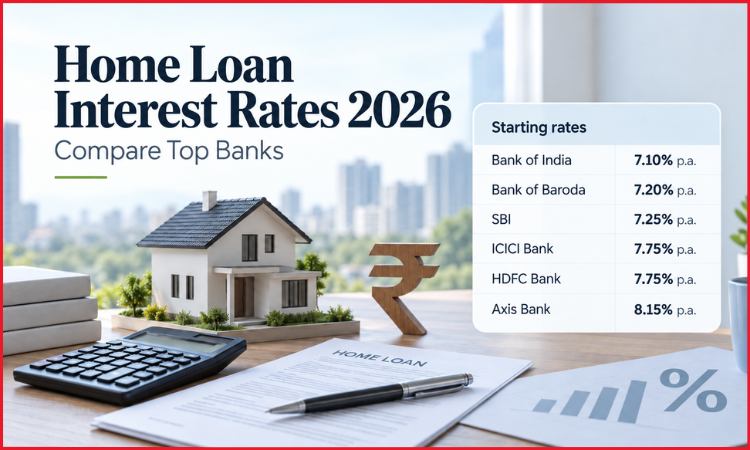
| Bank / Lender | Starting Home Loan Interest Rate 2026 |
| Bank of India | 7.10% p.a. onwards |
| Bank of Baroda | 7.20% p.a. onwards |
| State Bank of India (SBI) | 7.25% p.a. onwards |
| Bajaj Housing Finance | 7.25% p.a. onwards |
| ICICI Bank | 7.75% p.a. onwards |
| HDFC Bank | 7.75% p.a. onwards |
| Axis Bank | 8.15% p.a. onwards |
Rates compiled from bank disclosures and lending platforms as of August 2026; final pricing depends on credit score, loan amount and tenure. (best banks for home loans)
Key Types, Players And Options
Public Sector Banks
SBI, Bank of Baroda, PNB and Bank of India dominate the lower end of the home loan interest rates India table. Their edge is structural: early movers on repo-linking, so cuts show up in EMIs faster. The trade-off is paperwork; PSU banks still take longer to sanction.
Private Banks
HDFC Bank and ICICI Bank sit a little higher on price but win on speed. HDFC can return an in-principle sanction within 24 to 48 hours for a strong profile; ICICI’s pre-approved digital journey runs on a similar clock, useful when a seller wants certainty fast.
Housing Finance Companies
Bajaj Housing Finance and a handful of NBFCs now quote rates competitive with PSU banks, unthinkable five years ago, and tend to be more flexible on income documentation for self-employed applicants.
Real-World Examples
Go back to May 2017, when HDFC and ICICI Bank cut rates by up to 0.3 percentage points on loans up to ₹30 lakh within hours of each other, both landing at 8.35% for affordable housing, with SBI following almost immediately (Business Standard, 2017). Nobody coordinated that. It happened because home loans are a volume business with thin margins, and one lender moving first forces the rest to match. The lesson hasn’t changed: the “best” rate quoted last month is a snapshot, not a promise.
SBI offers the cleaner modern example. Because its floating-rate book is almost entirely EBLR-linked, rate holds and prior cuts show up in borrowers’ EMIs within a quarter, no paperwork required. An old fixed-rate HFC loan taken a few years back, by contrast, is still paying a rate locked in before the market softened. Loan structure can matter as much as the headline number.
Benefits And Opportunities
A stable repo rate, unusual for India over the past decade, has created a genuine planning window. Borrowers aren’t chasing a moving target this year; the best home loan rates available in August are close to what they were in February, which makes comparison shopping a rational use of time rather than a race.
Balance transfer facilities have also matured. A borrower sitting on an old 9%-plus loan can shift the outstanding balance to a lender offering 7.5%, and several banks apply the new EBLR-linked rate to the transferred balance from day one, passing on the benefit of prior cuts immediately (Ruloans, 2026), a pattern that shows up too in how borrowers now use personal loan apps for urgent, unrelated costs once a home loan frees up monthly cash flow. PMAY’s credit-linked subsidy adds another layer of relief for eligible first-time buyers, though the eligibility bands are narrow.
Factors To Consider
Processing fees usually run 0.25% to 0.5% of the loan amount; a “zero processing fee” campaign can quietly shift cost elsewhere. Loan-to-value ratio decides your down payment, with most lenders capping financing at 75-90% of property value. Prepayment charges matter more than they look on day one. Reset frequency on floating loans is now typically quarterly; confirm it, since a slower reset delays how fast cuts reach you. Tenure length changes total interest paid far more than a fractional rate difference does.
Common Mistakes And Risks
The most expensive mistake is anchoring to the advertised “starting from” rate without checking what your own credit score qualifies for. A borrower with a 680 CIBIL score who assumes they’ll get SBI’s headline rate is often off by a full percentage point once risk-based pricing kicks in, discovered only after paying a non-refundable processing fee.
The second risk sits in balance transfers done without the full math. Switching lenders isn’t free; fresh processing fees and paperwork are involved. If the rate gap is under 0.5% and you’re more than halfway through your tenure, the switch often costs more than it saves, since interest on a long amortising loan is front-loaded into the early years.
How To Choose The Right Home Loan In 2026
Check your CIBIL score first; it decides which end of the rate table you’ll actually be quoted from. Get in-principle offers from at least three lenders: one PSU bank, one private bank, one HFC, so you’re comparing real numbers, not homepage claims. Compare total cost, not just rate: add processing fees, bundled insurance and prepayment terms into the calculation. Ask whether the loan is EBLR-linked and how often it resets. Negotiate using competing offers; banks routinely shave a few basis points for a borrower holding a rival’s written offer. Revisit the loan annually even after disbursal; checking costs nothing.
Conclusion
Rate comparison used to be an afterthought squeezed between choosing a builder and signing a sale deed. It shouldn’t be. With the spread between the cheapest and most expensive lenders sitting close to two full percentage points, a properly compared application can save several lakh rupees over a loan’s lifetime money that never shows up as one dramatic number, only as a slightly smaller EMI, quietly, for twenty years. The same discipline applies whether you’re comparing home loan rates or picking between the credit cards Indian banks push hardest during a festive sale the advertised number is a starting point, not the final word. Treat the best home loan rates available to you the way you’d treat any other large financial decision: get real quotes, read the fine print, and don’t assume last month’s headline still applies. The lowest home loan rates on a bank’s website are an invitation to negotiate, not a guarantee.
Frequently Asked Questions
1. What are the current home loan interest rates in India for 2026?
The interest rates on home loans in 2026 begin from 7.10% p.a. at some PSU banks and HFCs, and from 7.75% p.a. in private banks. The price varies based on the credit score, loan amount, and profile.
2. Which bank offers the lowest home loan rates right now?
PSU banks like Bank of India and Bank of Baroda boast about lending at near the lowest rates for home loans, which is close to 7.10%-7.20% p.a. with a strong credit profile.
3. Is it better to choose a fixed or floating rate in 2026?
With the repo rate steady for four meetings, floating rates remain popular for long tenures, since future cuts pass through automatically. Fixed rates suit borrowers who prioritise predictable EMIs.
4. What credit score do I need for the best home loan rates India offers?
Most lenders reserve their lowest rates for a CIBIL score of 750 or above. A score between 700 and 749 may still get approved, typically at a higher rate.
5. Does a home loan balance transfer actually save money?
Only when the rate gap is meaningful and a substantial part of the tenure remains, since interest on a long loan is front-loaded into the early years.