Poco has expanded its mid-range smartphone range in India with the launch of the Poco X8 and Poco X8 Power, two devices built around unusually large silicon-carbon batteries, 1.5K AMOLED displays and Qualcomm processors.
Prices start at ₹29,999 for the Poco X8 and ₹35,999 for the Poco X8 Power. Both phones will go on sale exclusively through Flipkart at noon on September 11.
Poco is offering a ₹2,000 coupon and an additional ₹1,000 bank discount or exchange bonus. If buyers meet the relevant conditions, the effective starting prices fall to ₹26,999 and ₹32,999, respectively. These are promotional figures rather than permanent reductions and depend on eligibility and availability.
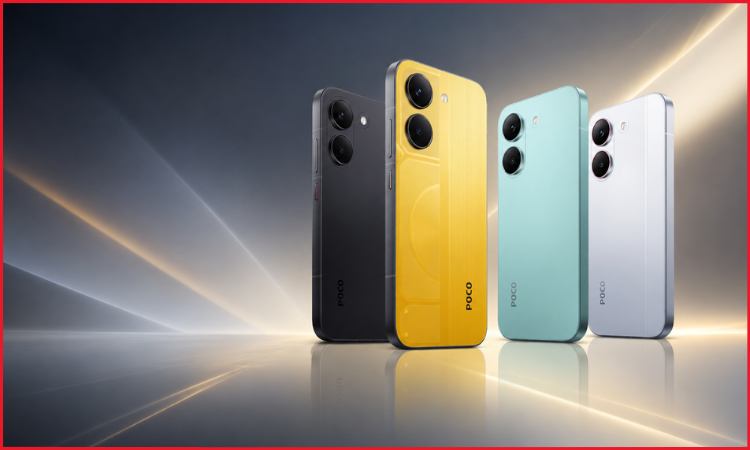
The X8 will be sold in Black, Fiery Orange and Frost White, while the Power model comes in Black and Yellow.
Large Batteries Define the Two Phones
Battery capacity is the clearest point of difference between the new models and many conventional mid-range smartphones.
The standard X8 carries a 9,000mAh silicon-carbon battery and supports 67W wired HyperCharge. It can also supply up to 22.5W of power to another compatible device through reverse wired charging.
The Poco X8 Power increases capacity to 10,000mAh, with 100W wired charging and 27W reverse charging. Poco includes a 100W adapter in the box with the Power model.
Silicon-carbon chemistry allows manufacturers to place greater energy capacity inside a given physical volume than traditional graphite-based battery designs. It does not, however, guarantee a fixed number of hours between charges. Actual endurance will depend on signal strength, display settings, gaming, camera use, background applications and battery ageing.
The extra capacity also affects size and weight. The X8 is approximately 8.6mm thick and weighs about 226 grams, while the X8 Power measures 8.65mm and weighs about 229 grams. Buyers gain a much larger battery, but neither handset is especially light.
AMOLED Display and Different Snapdragon Chips
The two models share a 6.83-inch flat AMOLED screen with a 2,772 × 1,280-pixel resolution and a refresh rate of up to 120Hz.
Poco claims peak brightness of as much as 3,500 nits, along with 12-bit colour, HDR10+, Dolby Vision and full coverage of the DCI-P3 colour range. Peak-brightness figures generally apply to limited portions of the panel under particular conditions and should not be read as sustained full-screen output.
The display also offers an instantaneous touch-sampling rate of up to 3,200Hz in supported gaming scenarios, Wet Touch 2.0 and Corning Gorilla Glass Victus 2 protection. Stereo speakers support Dolby Atmos and Hi-Res Audio.
Performance differs between the two phones. The X8 uses Qualcomm’s 4nm Snapdragon 6s Gen 4, with CPU speeds reaching 2.4GHz. The X8 Power receives the newer Snapdragon 6 Gen 5, clocked at up to 2.6GHz, and Poco says this is the chipset’s first appearance in an Indian smartphone.
The standard model uses LPDDR4X memory. Its 128GB storage version uses UFS 2.2, while the 256GB model moves to UFS 3.1. The Power phone uses faster LPDDR5X memory; its 128GB version also has UFS 2.2 storage, while higher-storage configurations use UFS 4.1.
These specifications position the Power version as more than a battery upgrade. Faster memory and storage should help application loading and data transfer, although everyday performance will also depend on software optimisation and thermal management.
Cameras, Software and Durability
Both phones have an optically stabilised 50-megapixel main rear camera, but their secondary cameras differ.
The X8 pairs its primary sensor with a 2-megapixel depth camera and includes a 16-megapixel front camera. The X8 Power adds a more useful 8-megapixel ultrawide camera and a 32-megapixel selfie camera. The Power model supports 4K video recording at 30 frames per second from both its main rear and front cameras.
The devices ship with Xiaomi HyperOS 3 based on Android 16. Poco has promised four operating-system upgrades and six years of security updates. That commitment extends the useful software life of the phones, although the timing of individual releases can vary by model and region.
An in-display fingerprint reader, NFC, an infrared transmitter and 5G connectivity are included. The phones also carry IP66, IP68, IP69 and IP69K protection ratings, covering different controlled tests involving dust, immersion and pressurised water.
Those certifications strengthen the durability claim but do not make a phone permanently waterproof. Resistance can decline through wear or physical damage, and buyers should check Poco’s warranty terms before intentionally exposing either device to water.
Poco is making battery capacity the centre of its latest X-series pitch while retaining features normally expected in this price segment, including a high-resolution AMOLED display, optical camera stabilisation and long software support.
When sales begin on September 11, the main choice will be between the lower-priced X8 and the Power model’s larger battery, faster charging, newer processor and stronger camera arrangement.