India’s energy story is changing fast, and Adani Green Energy Limited (AGEL) sits right at the centre of it. As the country leans harder into clean power and pulls away from coal and oil, a handful of companies are shaping what that shift actually looks like on the ground. AGEL is one of the biggest names among them.
What makes AGEL’s story worth telling is the pace. A company that started out with small solar and wind projects has, in just over a decade, built one of the largest renewable energy portfolios anywhere in the world. Solar, wind, hybrid plants, battery storage, and pumped-hydro: AGEL has pushed into nearly every corner of India’s clean-energy space.
By July 2026, the company had crossed 20 GW of operational renewable capacity, the first Indian renewable energy player to get there mostly through greenfield projects it built from scratch, rather than through acquisitions alone.
So how did Gautam Adani’s green energy business turn into such a major force? Here’s how it happened.
Quick Glance
| Founder | Gautam Adani |
| Company | Adani Green Energy Limited (AGEL) |
| Founded | January 23, 2015, Ahmedabad, Gujarat |
| Sector | Renewable energy – solar, wind, hybrid, battery storage |
| Key Stat | Over 20 GW operational capacity, generating more than 52 billion units of clean electricity a year (Adani Green Energy, 2026) |
| Current Status | India’s largest pure-play renewable energy company, targeting 50 GW by 2030 |
The Early Journey
Gautam Adani’s business career began in 1988 with a commodity trading firm that later became Adani Enterprises. Power entered the picture through Mundra, where the group built a port and then a thermal plant, and coal trading funded the group’s early expansion.
AGEL itself started small. Incorporated as a subsidiary of Adani Enterprises, its first project was a modest 20 MW wind installation built with Inox Wind at Lahori in Madhya Pradesh, followed by the purchase of a 50 MW wind asset at Dayapar in Kutch. There was no venture round, no marquee seed investor. Early capital came from internal group accruals and debt, at a time when solar tariffs were falling through aggressive reverse auctions, and margins were thin.
The India renewable energy company that AGEL wanted to become still had to prove it could execute at a scale banks and regulators would trust. That credibility took years, not months, to build.
Building The Business
Revenue Model
AGEL earns through 25-year power purchase agreements (PPAs) signed with state distribution utilities, the Solar Energy Corporation of India, and large commercial and industrial buyers. Fixed tariffs locked in early give predictable cash flows even as input costs shift, underpinning the broader Adani Group renewable energy strategy.
Business Model and Financial Growth
Scale is only half the story – the numbers behind FY26 (the year ended March 31, 2026) show how that scale is translating into earnings. AGEL’s revenue from power supply rose 22 percent year-on-year to ₹11,602 crore, while core EBITDA climbed 23 percent to ₹10,865 crore, holding an EBITDA margin of around 91 percent – among the highest in the global utility-scale renewables sector. Cash profit grew 11 percent to ₹5,399 crore, and energy sales rose 34 percent year-on-year to 37,567 million units, driven by newly commissioned capacity at Khavda and Rajasthan (SolarQuarter, AGEL FY26 results, April 2026; AGEL Q4 FY26 investor release (PDF)).
That combination – rising revenue, rising margins, and capacity growing faster than either — is what lets AGEL keep funding new greenfield builds largely off its own balance sheet rather than diluting equity further.
Acquisition-Led Scale
Organic construction alone would not have delivered the current Adani Green Energy growth story. The company bought Essel Group’s 205 MW solar portfolio for roughly ₹1,300 crore in 2019, then acquired SB Energy’s Indian renewable business for $3.5 billion in 2021, at the time the largest acquisition in India’s renewable energy sector (Adani Green Energy media release, October 2021). TotalEnergies took a stake in AGEL the same year – reported at 20 percent for roughly $2 billion at the time, since adjusted through subsequent share movements – giving AGEL a strategic partner with deep balance-sheet support (TotalEnergies press release, January 2021).
Generation Plus Storage
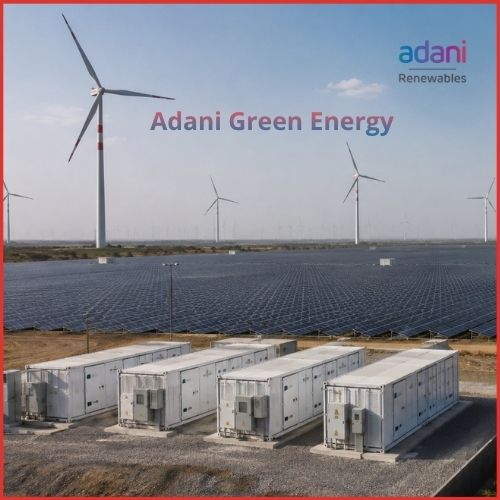
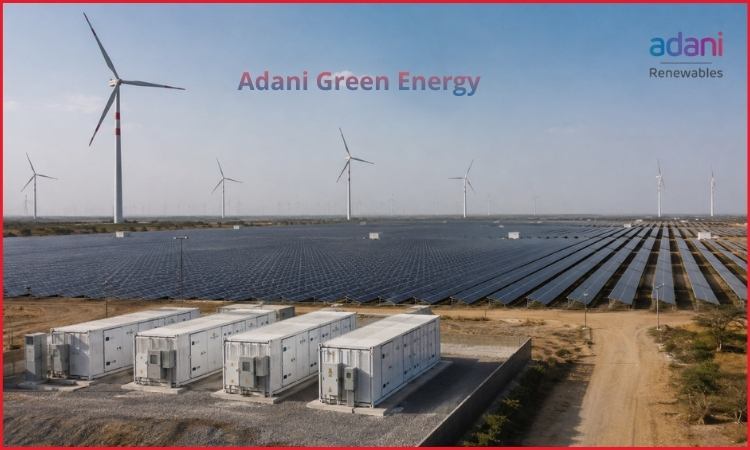
The flagship Khavda site in Kutch is planned at 30 GW across 538 square kilometers, roughly five times the area of Paris. AGEL has paired the solar and wind blocks there with battery energy storage systems, moving beyond pure generation toward round-the-clock, dispatchable clean power. This generation-plus-storage model sits at the core of the Adani Green Energy strategy at Khavda.
Battery Storage and Green-Energy Expansion
Storage has moved from a side project to a stated priority. By July 2026, AGEL had commissioned 3.55 GWh of battery energy storage systems (BESS), largely at Khavda (ANI, via aninews. in, 1 July 2026). The company has said it plans to add roughly 10 GWh of storage capacity in FY27 alone, with an ambition to scale its total storage portfolio beyond 50 GWh over the next five years in support of the 50 GW generation target for 2030 (SolarQuarter, July 2026). One single-location BESS deployment at Khavda, completed within eight months of the start of construction, is already described as one of the largest of its kind in the world.
The shift matters commercially: storage turns AGEL’s revenue conversation from “tariff per unit generated” to “reliability per hour supplied,” which is a different (and typically stickier) kind of contract with buyers.
The World’s Largest Renewable Energy Portfolio
Adani Green Energy’s claim to running the world’s largest renewable energy portfolio needs unpacking. AGEL’s most literal claim to the title sits at Khavda, where the planned 30 GW installation is on track to become the largest single-location renewable energy plant on the planet – larger than any other clean-power site under construction anywhere, and visible from space once complete. No other developer is attempting a single, contiguous renewable park at this scale.
That is a different claim from being the world’s biggest renewable energy business overall. By other yardsticks, competitors still lead: NextEra Energy Resources remains the world’s largest generator of wind and solar power by output, and its parent NextEra Energy is among the most valuable utility holding companies globally, with a market capitalization above $177 billion as of August 2026. Iberdrola tops the sector by revenue and reported total installed capacity of 58 GW at the end of 2025, of which more than 46 GW is renewable (Enerdata, February 2026). Brookfield Renewable runs one of the most diversified renewable portfolios in the world, spanning hydro, wind, solar and storage across multiple continents, a reminder that the wider Adani Group renewable energy push is still catching up on some fronts even as it leads on others.
| Adani Green Energy (AGEL) | Building the world’s largest single-location renewable energy plant at Khavda; added the most greenfield capacity globally outside China in FY26 (IBEF, 2026) |
| NextEra Energy Resources | World’s largest generator of wind and solar power; largest renewable company by market capitalization |
| Iberdrola | World’s largest renewable energy company by revenue, with over 40 GW of installed capacity |
| Brookfield Renewable | One of the world’s most diversified renewable portfolios, spanning hydro, wind, solar and storage |
Where AGEL genuinely stands apart is speed and concentration. Its operational portfolio comprises roughly 14.2 GW of solar, 2.7 GW of wind, and 3.3 GW of wind-solar hybrid capacity crossed within a decade of commissioning its first project at Kamuthi, Tamil Nadu, in 2016. Its FY26 addition of 5,051 MW was the largest annual greenfield build recorded by any company outside China. For a company still younger than most global utilities it competes with, that pace is the real story behind the India renewable energy company narrative AGEL has built for itself.
Growth & Turning Points
The timeline below traces the Adani Green Energy history from a single wind project to a multi-gigawatt renewable energy company.
| January 2015 | AGEL incorporated in Ahmedabad as an Adani Enterprises subsidiary |
| 2018 | Lists on the NSE and BSE through an IPO |
| 2019 | Acquires Essel Group’s 205 MW solar portfolio |
| 2021 | TotalEnergies buys a 20% stake; AGEL acquires SB Energy for $3.5 billion |
| 2023–24 | Crosses 15 GW operational capacity; Khavda begins commercial generation |
| April 2026 | Portfolio reaches 19.3 GW after adding over 5 GW in FY26, the largest single-year greenfield addition globally outside China (IBEF, 2026) |
| July 2026 | Crosses 20 GW, the first Indian renewable company to do so mainly through greenfield builds (Adani Green Energy, 2026) |
Challenges
Two setbacks stand out. In January 2023, US short-seller Hindenburg Research published allegations of stock manipulation and accounting irregularities against the Adani Group; the group denied the claims and called the report “malicious” and “baseless” (Adani Group media statement, 25 January 2023). AGEL’s borrowing costs and share price both took a hit in the months that followed, forcing the company to slow some fundraising plans until investor confidence stabilized. India’s securities regulator SEBI later found no basis for penalizing Adani entities on the allegations (SEBI clearance report, via All India Radio).
Building at Khavda also meant operating a few kilometers from an international border in a defense-sensitive, ecologically fragile desert zone. Clearances from the defense ministry, water scarcity, and the sheer difficulty of retaining workers on a site with patchy mobile coverage added real execution risk that a less capitalized developer might not have absorbed.
Conclusion
AGEL’s trajectory says less about solar panels and more about balance-sheet architecture, land strategy and political timing inside India’s energy transition. The Adani Group renewable energy bet succeeded because it combined patient promoter capital, an early move into a difficult but under-contested site, and acquisitions timed to periods when rivals were retrenching. Whether the company reaches its 50 GW target by 2030 will depend less on solar irradiation data and more on continued access to cheap capital and steady regulatory support the same variables that have shaped the Adani Green Energy growth story since its first decade.
Frequently Asked Questions
1. Who founded Adani Green Energy and when?
Adani Green Energy Limited was established in Ahmedabad on 23 January 2015 by Gautam Adani, who has spearheaded the entire renewable energy initiative of the Adani Group.
2. What is the basic business model of Adani Green Energy?
AGEL constructs, owns, and manages utility-scale solar, wind, hybrid, and battery storage facilities, generating revenue via long-term power purchase agreements with state utilities and large commercial customers.
3. What is the area of the Khavda renewable energy park?
Khavda is a 30 GW project in Gujarat’s Kutch district and will span 538 sq.km. Once completed, it will be one of the world’s biggest single-location clean energy projects.
4. What is AGEL’s target for 2030?
The company has set a goal of 50 GW of renewable energy to be running by 2030, following a milestone of 20 GW of renewable energy in operation by mid-2026.
5. How is the Adani Green Energy story unique compared to other renewable energy company stories in India?
Unlike other start-ups in the clean energy space that have been funded via private equity from outside the group, AGEL went through virtually no other external private equity rounds, instead scaling almost exclusively through group capital, debt and strategic partnerships such as the TotalEnergies investment.
Read also: Top 10 Renewable Energy Companies in India