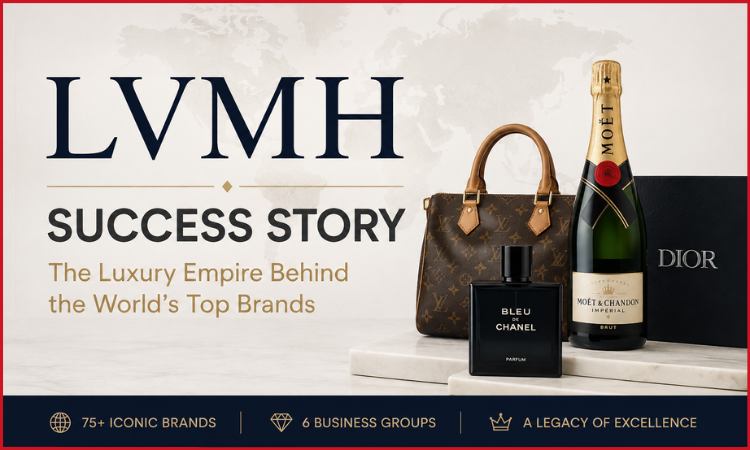
Does LVMH make handbags? Of course not. What they do make is desire, and they do so well that they have created one of the biggest empires in the luxury world. And we’re not talking about just handbags.
With 75 maisons covering everything from Louis Vuitton to Dior, Tiffany & Co., Sephora, Moët, Hennessy, etc. (different centuries, different countries, different crafts), LVMH is nothing short of a fascinating case study.
If you are looking to learn more about the workings of this company, be it for educational purposes, as an investor, or if you just want to know why a champagne house and a fashion label have been grouped for such a long time, then this will help you get closer to understanding their strategy.
How LVMH Was Built: A 1987 Merger That Started an Empire
Moët Hennessy’s story isn’t about fashion. It starts with drinks. Founded in 1971 by merging the venerable champagne house Moët & Chandon with the equally revered cognac producer Hennessy, this conglomerate of old-French-heroes had little in common besides their mutual obsession with scarcity and status. Then, in 1987, it merged with another giant, this time of the leather-goods set, namely Louis Vuitton and became LVMH Moët Hennessy Louis Vuitton (LVMH).
On paper, the company was a curious mix—a beverage manufacturer joined at the hip with a luggage-maker. Yet, from its inception, there was a clear intention behind the unionization of these otherwise disparate industries: That if you can successfully merge disparate but similar luxury lines into one entity, they’ll actually bolster each other’s reputation. And this was just the first step of many. Shortly thereafter, Bernard Arnault—who built up his stake in the business over time—was appointed chairman and CEO in 1989 and has held both positions ever since, orchestrating what turned out to be one of the most aggressive acquisition campaigns in the history of consumer goods.
The Acquisition Machine: Buy, Elevate, Repeat
LVMH’s approach to growth might be best summed up as ‘buy, elevate, repeat’. Over the course of more than three decades, Arnault has bought many heritage brands that had fallen out of fashion – brands such as Dior, Fendi, Celine, and Loewe – and invested in them until they were once again relevant. Most recently, he purchased the jewelry house Tiffany & Co., spending some $16 billion for the brand, which was the biggest deal in LVMH’s history.
In most cases, those acquisitions followed the same trajectory. A company would be acquired, and after an initial period of aggressive reinvestment, it would be repositioned through the hiring of a high-profile creative director and a flurry of new stores opened up around the world. While this strategy doesn’t apply uniformly to every brand within LVMH (some houses just take longer to see results), nor does it occur quickly (Loewe spent over a decade under one creative director before its recent resurgence), the philosophy of seeking out heritage brands that have lost their way but still have strong craft credentials and buying them at prices reflecting that mismanagement remains central to the group’s business plan dating back to the ’80s.
The strategy is still active. Following the death of Giorgio Armani in September 2025, his will named LVMH — alongside L’Oréal and EssilorLuxottica as a preferred buyer for an initial stake in the Armani business, with a path to a much larger stake over the following three to five years. Three decades after the original playbook was written, LVMH is still running it.
Why the Portfolio Model Works: Diversification as a Weapon
A single luxury brand lives and dies by its own moment. A single bad collection, one uninspired creative director, one shift in cultural relevance, and revenue can collapse quickly. LVMH’s insight was structural: if you own enough different brands across enough different categories, no single house’s bad year can meaningfully damage the group.
That’s not theoretical. It’s exactly what 2025 demonstrated. LVMH’s largest division, Fashion & Leather Goods, the home of Louis Vuitton and Dior — declined on a reported basis for the year, part of a broader luxury slowdown. But Watches & Jewelry grew organically, lifted by Bulgari and a resurgent Tiffany. Selective Retailing, anchored by Sephora, delivered a strong performance throughout. The group’s overall 2025 revenue came to €80.8 billion, down from €84.7 billion in 2024, a decline, but a controlled one, cushioned by exactly the diversification the model was built to provide.
Compare that to a rival like Kering, which leans far more heavily on a single house, Gucci, for a disproportionate share of group profit. When Gucci struggles, Kering struggles visibly and immediately. When one LVMH house struggles, the group absorbs it. That structural resilience is arguably LVMH’s single most durable competitive advantage, more important over time than any individual brand’s creative direction.
The Six Divisions: How LVMH Organizes an Empire
LVMH doesn’t run its houses as one undifferentiated mass. It organizes them into six distinct divisions, each with its own logic, its own growth drivers, and its own role inside the broader group strategy.
| Division | Flagship Maisons | Strategic Role |
|---|---|---|
| Fashion & Leather Goods | Louis Vuitton, Dior, Fendi, Celine, Loewe, Givenchy | The group’s largest and most profitable division, and its brand-image anchor. |
| Wines & Spirits | Moët & Chandon, Dom Pérignon, Hennessy, Veuve Clicquot | The oldest lineage in the group, tracing back to the original 1971 Moët Hennessy union. |
| Perfumes & Cosmetics | Parfums Christian Dior, Guerlain, Benefit Cosmetics | Provides a lower price-point entry into the LVMH brand world for younger consumers. |
| Watches & Jewelry | Tiffany & Co., Bulgari, TAG Heuer, Chaumet | A growth engine in recent years, led by Tiffany’s post-acquisition repositioning. |
| Selective Retailing | Sephora, DFS, Le Bon Marché | Controls the retail experience itself, not just the products sold inside it. |
| Hotels & Other Activities | Cheval Blanc, Belmond | Extends the brand into experiences and hospitality, the newest luxury frontier. |
Creative Autonomy Inside Corporate Control
Here’s the part that surprises people who assume a conglomerate this large must run everything centrally: it doesn’t. Each maison retains its own creative director, its own design language, its own brand identity — fiercely, deliberately separate from its siblings inside the group. Louis Vuitton doesn’t look like Fendi. Dior doesn’t look like Loewe. That’s not an accident or an oversight. It’s the entire point.
LVMH centralizes what benefits from scale: real estate negotiations, supply-chain logistics, raw-material sourcing, back-office finance, media buying, while leaving creative direction almost entirely alone. A creative director at Dior answers to Dior’s own leadership and Bernard Arnault directly, not to some group-wide creative committee homogenizing every house into a single aesthetic. This balance, corporate scale paired with creative independence, is genuinely difficult to execute and even harder to sustain. Plenty of conglomerates have tried the same thing and ended up flattening every brand they acquired into a diluted version of itself. LVMH, for the most part, hasn’t.
Financial Snapshot: 2025 and the Path Into 2026
For the full fiscal year ending on December 31, LVMH reported revenue of €80.8 billion, which was down by 5 percent year-over-year. But as mentioned earlier, there was an increase in organic revenue growth in the second half of the year.
Profit from recurring operations dropped 9 percent to €17.8 billion, leading to an operating margin of 22 percent. This is a pretty big figure for such a large company, even in tough times. And net profit at €10.9 billion wasn’t much better. But the good news was the operating free cash flow increased 8 percent to €11.3 billion, showing the underlying business continued to generate cash.
Geography told an uneven story. Europe declined, weighed down by a stronger euro and fewer tourist shoppers crossing borders for luxury purchases. The United States delivered growth on resilient local demand. Japan pulled back after an unusually strong 2024 driven by a weak yen and heavy tourist spending, while the rest of Asia improved steadily through the second half of the year. Arnault struck a cautious tone heading into 2026, citing geopolitical uncertainty and tax pressure in France, but reaffirmed the same strategy that has carried the group for decades: invest in brand desirability, tighten cost discipline, and let the portfolio’s breadth absorb whatever turbulence any single region produces.
What LVMH’s Strategy Teaches Beyond Luxury
Strip away the fashion shows and the champagne, and LVMH’s playbook applies well beyond the luxury sector. Acquire undervalued assets with genuine underlying quality. Invest disproportionately once you own them. Centralize the boring, expensive infrastructure. Decentralize the part that actually creates value, in this case, creative vision, and let it operate with real autonomy. Diversify aggressively enough that no single failure can threaten the whole.
It’s a strategy that rewards patience over speed. Some LVMH acquisitions take a decade to pay off. Others, like Tiffany’s rapid post-acquisition repositioning, move faster. What ties them together is a willingness to hold, reinvest, and wait, a luxury, in the truest sense, that most public companies under quarterly earnings pressure simply don’t have. LVMH has it because Arnault and his family retain majority control, insulated from the kind of short-term shareholder pressure that forces faster, shallower decisions elsewhere.
Frequently Asked Questions
How many brands does LVMH own?
LVMH owns more than 75 maisons spanning fashion, wines and spirits, perfumes and cosmetics, watches and jewelry, selective retailing, and hospitality, making it the largest luxury conglomerate in the world by brand count and revenue.
How does LVMH make money?
LVMH generates revenue across six divisions, with Fashion & Leather Goods anchored by Louis Vuitton and Dior historically the largest contributor, supplemented by Wines & Spirits, Perfumes & Cosmetics, Watches & Jewelry, Selective Retailing through Sephora, and a growing Hotels division.
Who owns LVMH and who controls it?
Bernard Arnault has served as Chairman and CEO since 1989, and the Arnault family holds a majority capital stake of just over 50%, giving the family effective long-term control over strategic decisions independent of short-term shareholder pressure.
Why does LVMH buy so many different luxury brands?
Diversification across categories and price points shields LVMH from downturns in any single brand or segment, when one maison underperforms, as Fashion & Leather Goods did in 2025, growth elsewhere in the portfolio, such as Watches & Jewelry, helps offset the decline.
Is LVMH a good long-term investment?
LVMH’s scale, brand diversification, and majority family ownership have historically supported long-term resilience, though like any luxury company it remains sensitive to macroeconomic conditions, currency fluctuations, and shifts in consumer spending in key markets like China and the United States.