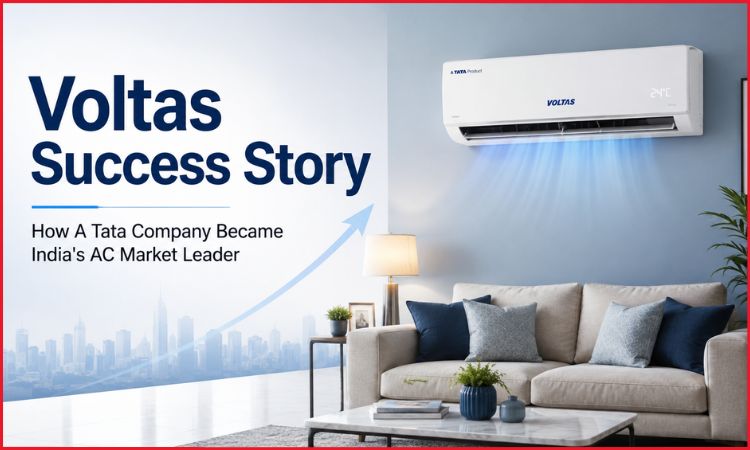
In 1954, owning an air conditioner in India meant importing one at a price only maharajas, five-star hotels, and government offices could afford. Room cooling was a luxury item, not a household plan. Few could have guessed that a small joint venture forming that year in Mumbai would eventually turn air conditioning into a middle-class purchase.
That venture was Voltas, created when Tata Sons partnered with the Switzerland-based trading house Volkart Brothers to take over Volkart’s engineering and import division. The Voltas Success Story is unusual because the company did not start out chasing cooling at all; it began as a diversified engineering and trading outfit long before air conditioners became its calling card. Its journey sits alongside other names covered in the Tata Group Success Story, where scale often followed decades of quiet restructuring rather than one dramatic launch.
Today, Voltas is India’s largest room air conditioner brand by market share, and its rise says as much about distribution and brand trust as it does about compressors. This piece traces the Voltas business journey from a 1954 trading joint venture to AC market leadership – the strategy behind it, the milestones that mattered, and the mistakes along the way.
Quick Glance
| Founded By | Tata Sons and Volkart Brothers |
| Company | Voltas Limited |
| Founded Year | 1954 (incorporated September 6, 1954) |
| Sector | Air conditioning, refrigeration, and engineering services |
| Key Stat | Sold over 2 million ACs in FY24 – the highest ever by any brand in a single financial year in India (Business Standard, 2024) |
| Current Status | India’s largest room AC company by market share; Chairman Noel Tata, MD & CEO Mukundan C. P. Menon |
Voltas History: How It All Started
Voltas’ history begins with paperwork, not product launches. On September 6, 1954, the company was incorporated in Mumbai to take over the Engineering & Import Division that Volkart Brothers already ran in India. Tata Sons brought capital and a name; Volkart brought an existing trading network.
The early catalogue looked nothing like today’s split ACs. Voltas built its name on industrial engineering refrigeration plants, mining equipment, and textile machinery – playing a supporting role in India’s early industrial build-out at a time when few Indian firms had comparable technical partnerships.
Voltas And The Tata Group Advantage
Being a Voltas Tata company meant more than a name on the letterhead. The Tata association gave Voltas early access to capital, group governance practices, and – most importantly for a consumer-facing business – inherited trust that shortened the distance between an unfamiliar product and a first purchase.
That advantage compounds. Group scale helped Voltas negotiate technology partnerships, including its later joint venture with Arçelik, and it plugs Voltas into a wider Tata network alongside businesses profiled in the list of companies under Tata Group, from steel and IT to retail.
From Engineering Company To Consumer Brand
For its first few decades, Voltas was a B2B engineering house, not a household brand. The shift toward consumer air conditioning tracked India’s own economic shift, as rising incomes and urban housing growth from the 1990s onward opened a personal-cooling market that had barely existed before.
Voltas read that shift earlier than most industrial peers and repositioned around it. Through the 1990s and 2000s it also shed pharmaceuticals, beverages, and its loss-making chemicals arm, narrowing the Voltas business journey to cooling products and engineering services, the focus that eventually built its market-leading scale.
Building The Business: The Voltas Air Conditioner Business Model
Three Business Segments
Today, the Voltas air conditioner business sits inside a company organised around three segments. Unitary Cooling Products room ACs, air coolers, commercial refrigeration, and water coolers contribute close to two-thirds of total revenue. Electro-Mechanical Projects & Services handles HVAC and MEP contracts for buildings in India and overseas markets such as the UAE and Saudi Arabia. Engineering Products & Services covers textile machinery and mining and construction equipment, a direct descendant of the original 1954 catalogue.
Revenue Model And Joint Ventures
Voltas doesn’t manufacture everything itself. In 2017, it formed a 50:50 joint venture with Turkish appliance maker Arcelik, launching Voltas Beko in 2018 to sell washing machines, refrigerators, and other home appliances under a shared brand. The arrangement let Voltas add a full appliance line without building manufacturing and R&D capability from scratch – Arcelik supplied the technology, Voltas supplied the distribution.
Distribution-Led Growth Strategy
The single biggest asset behind Voltas AC market leader status is reach, not just product. The company services its room AC business through more than 30,000 customer touchpoints across India (Tata Group, 2026), a network built over decades rather than assembled quickly. That matters because roughly 70 percent of AC buyers in India are purchasing their first unit and tend to buy on brand trust rather than technical comparison, an advantage that favours a familiar, Tata-backed name over newer entrants.
How Voltas Became An AC Market Leader
- Distribution network: over 30,000 customer touchpoints across India for the cooling business, built over decades rather than assembled quickly (Tata Group, 2026).
- Affordable pricing: Voltas positions most models in the mass and mass-premium price bands rather than competing purely on premium specifications.
- Products built for Indian climate conditions: several current models are rated for high-ambient cooling up to 52°C, aimed at regions with intense summer heat.
- Focus on cooling performance: consistent investment in compressor and heat-exchange design to hold performance during long, hot Indian summers.
- Strong after-sales service: multi-year warranties on compressors, alongside a wide network of service touchpoints that matter most to first-time buyers.
Voltas Air Conditioner Business Strategy
Voltas splits its air conditioner business across residential and commercial segments. The residential range spans window and split ACs across tonnages, while the commercial side covers ducted systems, VRF units, and chillers for offices and institutions, a different sales cycle and buyer altogether.
On the residential side, inverter and energy-efficient technology now dominates new launches, with variable-speed compressors and adjustable cooling modes marketed through ISEER efficiency ratings. Price points range from entry-level fixed-speed units to WiFi-enabled, convertible-mode models at the premium end, letting Voltas serve a budget-first buyer and a specification-conscious upgrader from the same catalogue.
Growth & Turning Points
| 1954 | Company incorporated as a Tata Sons – Volkart Brothers joint venture |
| 1998 | Loss-making chemicals division sold off |
| 2000 | White goods business transferred to a joint venture with Electrolux |
| 2017 | 50:50 joint venture signed with Arçelik to enter home appliances |
| 2018 | Voltas Beko brand launched in India |
| 2024 | Crossed 2 million AC units sold in a single fiscal year, a first for any Indian brand (Business Standard, 2024) |
Challenges And Setbacks
Diversification without focus, 1954 to the 1990s: running pharmaceuticals, beverages, and mining equipment alongside cooling products spread capital and management attention thin. When the chemicals division turned loss-making, Voltas sold it in 1998 rather than fix it.
Market share slippage, FY26: Voltas’ share of the room AC market fell to 17.8 percent in the April-June quarter of FY26, down from 19.5 percent a year earlier, as unseasonal rains cut into the summer cooling season. Revenue for the quarter dropped 20 percent year-on-year, a reminder that a single-category leader also carries a single category’s weather risk.
Key Takeaways
- Narrowing focus, not adding categories, turned an unfocused trading conglomerate into a market leader.
- Distribution reach and after-sales service matter more than specifications when most buyers are first-timers.
- Joint ventures let Voltas add capability, like Beko’s appliance technology, without owning the entire value chain.
- Category leadership concentrates risk as well as reward, as the FY26 monsoon slippage showed.
Conclusion
Voltas did not become India’s largest air conditioning company by predicting where cooling would go in the 1950s it became one company among several before deciding, decades later, to trim down to what worked. That decision is the real substance behind this Voltas Success Story. The Voltas Tata company connection, now overseen by chairman Noel Tata, provided capital and credibility, but the discipline to exit pharmaceuticals, beverages, and chemicals is what gave the cooling business room to scale.
Frequently Asked Questions
1. When was Voltas founded?
Voltas was incorporated on September 6, 1954, as a joint venture between Tata Sons and Volkart Brothers, the starting point for most accounts of Voltas history.
2. Is Voltas a Tata Company?
Yes. In discussions of Tata Voltas success story, one cannot miss a reference to the Voltas Limited, which is a part of the Tata Group, currently headed by Noel Tata.
3. What makes Voltas the market leader in the AC market in India?
Reach, low cost and Tata brand recognition amongst first time buyers. Voltas was the first brand from India to sell over two million ACs in 1 year in FY24.
4. How much is the value of Voltas Beko?
A joint venture started in 2017 and launched in 2018 between Voltas and Turkish appliance manufacturer Arçelik to sell washing machines and refrigerators in India is a 50:50 partnership.
5. Do they manufacture ACs for both residential and commercial use as a company, Voltas?
Yes. The Voltas air conditioner business includes window air conditioners, split, VRF and ducted systems, and chillers for offices and institutions.
6. What are the risks to Voltas being a market leader?
The impact of weather is also noticeable, a lean monsoon or slow down in summer can take a hit on AC sales, which happened in FY26. Now, as more and more players like Blue Star, LG, Daikin and Samsung are entering the market, the value of brand trust is limited in itself.
Read also: Top Indian Companies With Global Presence In 2026