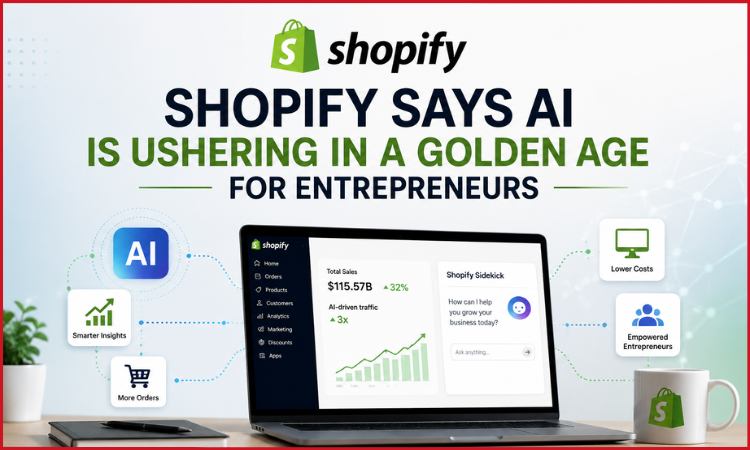
Artificial intelligence is lowering the cost of starting and running a company, according to Shopify President Harley Finkelstein.
Speaking after Shopify’s latest earnings report, Finkelstein described the commerce platform as being at the “epicenter of the AI era.” He argues that market research, design, service and data analysis are becoming accessible to a founder with a laptop.
The enthusiasm is backed by a strong quarter. Shopify reported sales growth and more AI-generated shopping activity. Investors responded by pushing the company’s shares up more than 18% during Wednesday trading.
For Shopify, AI for entrepreneurs is not only a productivity story.
Shopify’s AI Momentum at a Glance
| Measure | Second-Quarter Result |
| Revenue | $3.58 billion, up 34% |
| Gross merchandise volume | $115.57 billion, up 32% |
| Adjusted earnings | $0.42 per share |
| AI-driven traffic to stores | Roughly tripled |
| Orders from AI traffic | Roughly tripled |
| Daily merchants using Sidekick | Up 3.6 times year over year |
Revenue exceeded analysts’ expectations of about $3.45 billion, while adjusted earnings topped the $0.40-per-share consensus.
Why Shopify Sees an Opening for Small Businesses
Finkelstein’s “golden age of entrepreneurship” thesis rests on the idea that AI compresses the distance between an idea and a functioning store. A small operator can draft product descriptions, examine sales patterns or prepare campaign concepts without hiring a specialist.
That does not mean software can replace taste, judgment or knowledge of a customer. Instead, Shopify AI tools can help founders complete routine work more quickly and test ideas before committing scarce money.
Common applications now include:
- Creating an initial storefront layout and product copy.
- Summarizing customer questions and identifying recurring problems.
- Reviewing performance data to spot products gaining momentum.
This practical layer is why AI for entrepreneurs may matter most to one-person companies and lean teams.
AI Is Sending Shoppers to Merchant Websites
Shopify’s results also challenge the fear that conversational search will keep shoppers inside AI platforms and away from online stores. The company said both AI-driven traffic and orders originating from that traffic tripled in the quarter. That reach could widen opportunity beyond established brands.
Shopify has partnerships with OpenAI, Google and Microsoft intended to help merchants appear when consumers use AI assistants for product discovery. Finkelstein said this shift can be especially useful for smaller brands, which make up most of Shopify’s merchant base and may struggle to compete for conventional search visibility.
If those integrations continue producing qualified visitors, AI for entrepreneurs could become a customer-acquisition channel as well as an operating aid. The important test will be whether AI referrals convert consistently, not merely whether they generate clicks.
Strong Earnings Lift Expectations
Shopify forecast third-quarter revenue growth in the low-30% range, comfortably above the 26.3% pace analysts had expected. It also projected gross profit growth in the mid-to-high 20% range.
The outlook helped reassure investors that spending on Shopify AI tools is supporting growth rather than weakening near-term performance. Still, running advanced models and cloud infrastructure is expensive. Rising computing costs could test margins if new services fail to generate enough merchant activity or additional sales.
The company must also demonstrate that AI features improve outcomes across its broad customer base, from first-time sellers to global brands. A surge in experimentation is encouraging, but lasting value depends on retention, conversion and measurable productivity.
What to Expect From Shopify Next
The next phase will show whether the excitement around AI for entrepreneurs develops into a durable change in commerce. Investors and merchants should watch three signals:
- Growth in orders that originate through AI assistants.
- Continued adoption of Sidekick and other Shopify AI tools.
- Evidence that revenue gains outpace infrastructure costs.
Shopify’s latest quarter gives Finkelstein’s optimism credible financial support, but the “golden age” is still an ambition, not a settled outcome. If discovery partnerships expand and merchants keep adopting the technology, AI for entrepreneurs could lower barriers for a much wider group of founders. The winners, however, will still need distinctive products, disciplined execution and the trust of real customers.