A tea bag, a truck, a hotel room, and a line of code running someone’s payroll in Ohio. All four can trace back to one holding company in Mumbai. Few business houses touch that many unrelated lives in a single day.
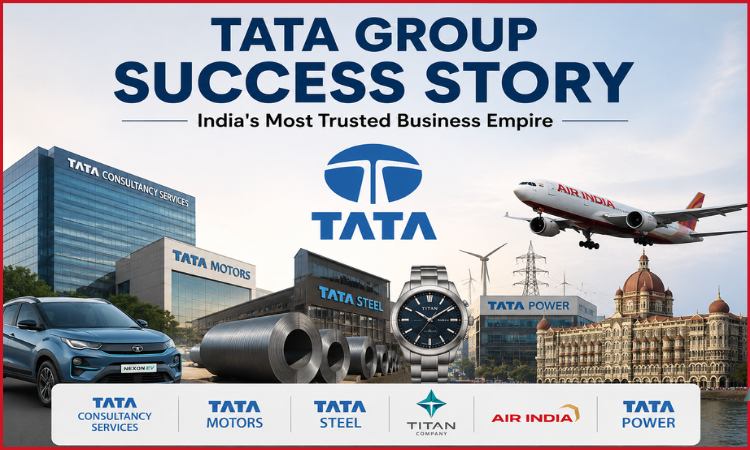
That reach is the real story here. The Tata Group success story isn’t one company’s rise it is 26 listed businesses under Tata Sons, with group turnover crossing $180 billion and a combined market cap of $328 billion as of March 2025 (Tata Sons, 2025). Jamsetji Tata started it in 1868 as a trading firm. Five generations and one bruising boardroom war later, it is still India’s most recognisable conglomerate.
This piece walks through how the group is structured, what drives its numbers today, and where Chairman N Chandrasekaran is placing his newest bets.
Quick Glance: Tata Group
| Full Name | Tata Group |
| Founded | 1868, Bombay (now Mumbai), India |
| Founder | Jamsetji Nusserwanji Tata |
| Headquarters | Mumbai, Maharashtra, India |
| Chairman | N Chandrasekaran (Tata Sons, since February 2017) |
| Turnover (FY25) | Over $180 billion (Tata Sons, 2025) |
| Market Cap (March 2025) | $328 billion (Tata Sons, 2025) |
| Workforce | 1,151,353 employees (March 2025) |
| Ownership | About 66 percent held by Sir Dorabji Tata Trust and Sir Ratan Tata Trust |
| Listed Companies | 26, including TCS, Tata Motors, Tata Steel, Titan, and Tata Power |
| Known For | A trust-owned conglomerate spanning IT, steel, autos, aviation, and consumer goods |
From a Bombay Trading Firm to a Global Empire
Jamsetji Tata built his first fortune in cotton and trade. He wanted three things beyond that: a steel company, a world-class hotel, and an institute of science. He got all three before he died in 1904; the Taj Mahal Palace opened in 1903, and Tata Steel and the Indian Institute of Science followed soon after.
The group turned global under Ratan Tata, who ran it from 1991 to 2012 and pushed three landmark deals: Tetley in 2000, Corus Steel in 2007, and Jaguar Land Rover in 2008. Those bets turned a domestic conglomerate into a genuine multinational, and JLR remains one of Tata Motors’ biggest profit engines today.
The Tata Group Business Model: Trusts, Tata Sons, and Autonomy
Tata Sons is the parent that owns stakes across the group and holds the Tata trademarks. About 66 percent of Tata Sons itself sits with philanthropic trusts, mainly the Sir Dorabji Tata Trust and Sir Ratan Tata Trust, money that funds education, health, and research across India.
Each operating company TCS, Tata Steel, Tata Motors runs with its own board and listed shares. Tata Sons sets direction; it doesn’t run daily operations. That structure is why one weak year at Tata Motors rarely drags down TCS.
Key Group Companies
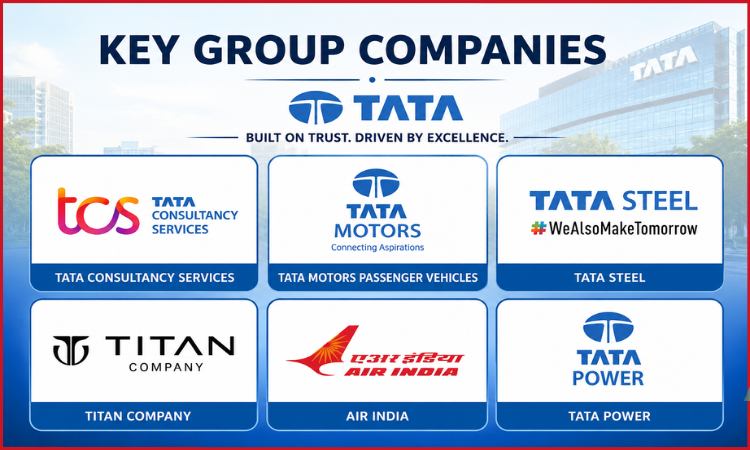
| Company | Sector | Recent Metric |
| Tata Consultancy Services | IT services | Group’s single largest profit engine; roughly $30 billion in annual revenue |
| Tata Motors Passenger Vehicles | Cars, EVs, Jaguar Land Rover | Revenue of Rs 4,21,695 crore in FY26, after the 2025 demerger from commercial vehicles |
| Tata Steel | Steel manufacturing | Operations across India and Europe, built on the 2007 Corus acquisition |
| Titan Company | Jewellery, watches, eyewear | Owns Tanishq, one of India’s biggest jewellery brands |
| Air India | Aviation | Revenue of Rs 78,636 crore in FY25, still posting a net loss of about Rs 10,859 crore |
| Tata Power | Power generation and renewables | Expanding solar and EV-charging infrastructure nationally |
Air India is the newest and messiest addition. The group won it back from the government in 2022 after decades of state ownership, and it now owns 74.9 percent of the airline alongside Singapore Airlines (Wikipedia, 2025). Turning around a loss-making national carrier is a different game from running TCS, and the losses show it.
New Bets: Semiconductors, EVs, and AI
Chandrasekaran’s clearest signature is the push into frontier manufacturing. Tata Electronics is building a semiconductor fab in Dholera, Gujarat, and separately runs the iPhone-component plant it picked up from Wistron in Karnataka.
The group has also moved into enterprise AI, partnering with OpenAI in a deal that pairs TCS’s scale with a plan to skill roughly a million Indian workers in AI tools (Business Outreach, 2026). None of these bets pay back quickly. Fabs take years to reach yield, and AI partnerships take longer still to show up in revenue.
Leadership: Chandrasekaran’s Tenure and the Open Questions
N Chandrasekaran took charge of Tata Sons in February 2017, right after the group’s ugliest public fight: the 2016 ouster of chairman Cyrus Mistry, which ended in a 2021 Supreme Court ruling in Tata Sons’ favour. He came up through TCS, not the Tata family, which made him an unusual pick for the top seat.
His scorecard is genuinely mixed. Group turnover and market cap have both grown sharply since 2017, per the company’s own annual report. But Tata Sons’ own profit fell 24.3 percent to Rs 26,232 crore in FY25, down from Rs 34,654 crore a year earlier (Business Standard, 2025), and reports through 2025 pointed to a sharp market-cap pullback across group stocks as investors questioned growth visibility at TCS and the payback timeline on newer bets.
Chandrasekaran’s term runs to February 2027. Noel Tata, who joined the Tata Sons board after Ratan Tata died in 2024, is reported to favour splitting the top job into separate chairperson, managing director, and deputy CEO roles a governance debate the group has not settled in public.
Business Lessons From the Tata Playbook
- Route control through ownership, not micromanagement. Tata Sons holds stakes and sets direction; operating companies run themselves.
- Fund philanthropy through equity, not cash donations, so the trusts’ payout scales with group performance.
- Use a strong core business, historically TCS, to underwrite riskier, slower-payback bets like fabs and airlines.
- Resolve leadership disputes decisively and publicly rather than letting them fester; the Mistry episode cost the group years of distraction.
- Expect new frontier bets to weigh on near-term profit before they show up as growth.
Conclusion
Tata’s scale is not really the interesting part anymore; a $180-billion turnover and 26 listed companies speak for themselves. The interesting part is whether trust-led ownership, built for a 19th-century steel and hotel business, can still absorb the volatility of fabs, EVs, and a loss-making airline.
For anyone tracking Tata Group companies and how this Indian conglomerate allocates capital, the next two years matter more than the last two. Chandrasekaran’s term ends in 2027, and how the succession question gets resolved will say more about the group’s governance than any single quarter’s Tata Group net worth headline.
Frequently Asked Questions
1. What is the Tata Group’s current turnover?
Tata Group’s turnover crossed $180 billion for the year ended March 2025, with a combined market cap of $328 billion.
2. Who owns the Tata Group?
Tata Sons is the holding company, and about 66 percent of it is owned by philanthropic trusts, chiefly the Sir Dorabji Tata Trust and Sir Ratan Tata Trust. The remaining shares sit with the Tata family and group companies.
3. What are the main companies under the Tata Group?
Key listed companies – Tata Consultancy Services, Tata Motors, Tata Steel, Titan Company, Tata Power, and Air India, spanning IT, automobiles, steel, consumer goods, and aviation.
4. Who is the current chairman of the Tata Group?
N Chandrasekaran has chaired Tata Sons since February 2017. His current term runs through February 2027, and he came up through Tata Consultancy Services rather than the Tata family.