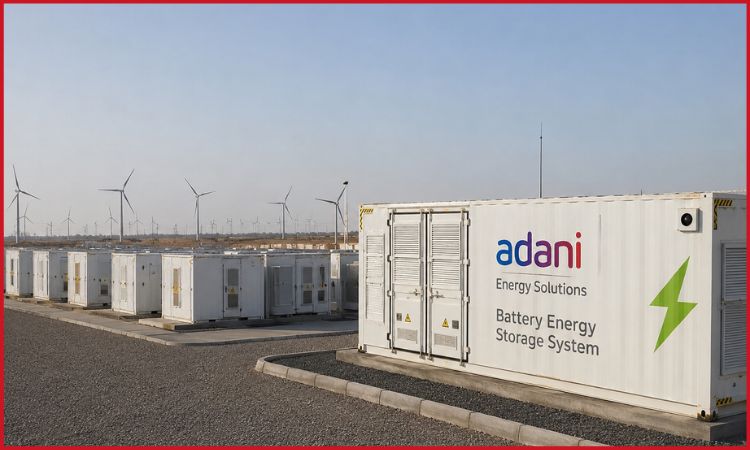
Adani Green Energy Limited (AGEL) has commissioned 3.37 gigawatt-hours of battery energy storage capacity at Khavda, Gujarat. The facility is the world’s largest single-location deployment outside China and was completed in just 10 months from on-site construction start—a record-breaking execution pace in the utility-scale storage sector.
The scale translates to real power. The BESS can store enough clean energy to supply nearly one million homes for an entire day, meeting peak electricity demand for cities like Indore, Chandigarh or the entire state of Goa.
The real story: 50 GWh in five years
What moved markets was AGEL’s commitment to add over 10 GWh of battery storage in FY27 and scale to 50 GWh over the next five years. That signals management sees storage—not solar generation alone—as the margin engine of India’s energy transition.
Battery systems solve a critical problem for renewables: intermittency. Solar plants generate peak power during midday hours when grid demand is lighter. Storage allows that energy to be dispatched during evening peak demand, fundamentally shifting how utilities price and value renewable power.
Stock rallies on storage pivot
Adani Green shares jumped 2.33% to ₹1,445.70 on the battery storage announcement, gaining ₹32.90 intraday. The move reflects investor confidence that the company can execute the 50 GWh deployment pipeline while maintaining acceptable returns on capital.
The rally also signals market recognition that AGEL is shifting from being a renewable generator—a commodity business under tariff pressure—to a dispatchable clean power provider, a more defensible model.
Execution risk remains
India has limited domestic battery manufacturing capacity. Most cells are imported, making supply chain execution a binding constraint.
AGEL’s ability to add 50 GWh in five years without diluting return on capital depends on scaling imports smoothly while managing integration complexity.
Storage projects carry different risk and return profiles than solar plants. Grid support contracts, renewable energy certificates, and energy arbitrage create multiple revenue streams, but execution risk is higher. Analysts will be watching capital intensity metrics closely.