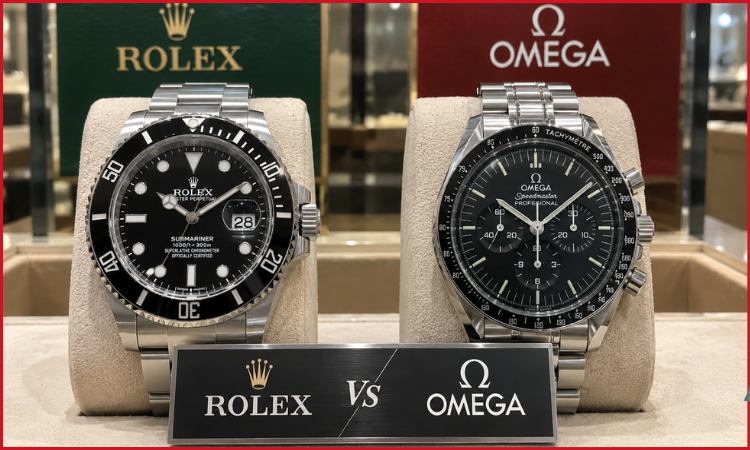
When people talk about serious Swiss watchmaking, Rolex and Omega are almost always the first names that come up. Both built global recognition through craftsmanship, but they win buyers over differently. Rolex trades on exclusivity and status; Omega built its name on engineering breakthroughs and space missions.
It’s hard to shop for a premium Swiss watch without facing the Rolex-or-Omega question. Neither disappoints on quality, so the better choice comes down to design, heritage, movement, resale value, or plain prestige.
Rolex made its name in places built for endurance: the Submariner on divers’ wrists, the Daytona timing laps at Le Mans. Omega’s defining moment came 384,000 kilometers away, on Buzz Aldrin’s wrist during the Moon landing.
This Rolex vs Omega comparison covers who owns each brand, how they performed in 2025, the watches that made Rolex and Omega household names, and a few marketing lessons along the way.
Quick Glance
| Category | Rolex | Omega |
| Founded | 1905, London | 1848, La Chaux-de-Fonds, Switzerland |
| Founder | Hans Wilsdorf | Louis Brandt |
| Headquarters | Geneva, Switzerland | Biel/Bienne, Switzerland |
| Ownership | Wilsdorf Foundation (private) | Swatch Group (public, SIX Exchange) |
| Industry Position, 2025 | Clear market leader (Morgan Stanley & LuxeConsult, 2026) | Slipped in the rankings, per the same report |
| Known For | Submariner, Daytona, GMT-Master II | Speedmaster “Moonwatch,” Seamaster |
Brand History: Rolex and Omega
Rolex
Rolex was founded in 1905 by Hans Wilsdorf and Alfred Davis in London before relocating its headquarters to Geneva, Switzerland, in 1919. Wilsdorf believed wristwatches could achieve the same precision as pocket watches, a vision that transformed the industry. Rolex later introduced several milestones, including the waterproof Oyster case in 1926 and the Datejust in 1945.
Following Hans Wilsdorf’s wishes, ownership of Rolex was transferred to the Hans Wilsdorf Foundation, allowing the company to focus on long-term growth rather than quarterly shareholder expectations. This unique ownership structure remains one of Rolex’s biggest competitive strengths.
Omega
Omega’s story began much earlier, in 1848, when Louis Brandt started assembling precision pocket watches in Switzerland. His sons later expanded the business, introduced the famous Omega calibre in 1894, and helped establish the brand as one of Switzerland’s finest watchmakers.
Today, Omega operates under the Swatch Group, one of the world’s largest watch manufacturers. Throughout its history, Omega has built its reputation through innovation, becoming the official timekeeper of the Olympic Games and the first watch worn on the Moon during NASA’s Apollo 11 mission.
These distinct histories continue to shape how each brand is perceived today. Rolex focuses on timeless exclusivity, while Omega emphasizes technical innovation and historic achievements.
Rolex Vs Omega: Head-To-Head Comparison
The table below lays out the core Rolex and Omega differences side by side, from design philosophy to resale demand.
Head-To-Head Comparison for Rolex and Omega
| Factor | Rolex | Omega |
| Design philosophy | Evolution, not revolution; near-identical silhouettes for decades | Broader range: sporty Speedmaster, diving Seamaster, dressy Constellation |
| Movement technology | In-house calibres, Superlative Chronometer standard | Co-Axial escapement, Master Chronometer, strong anti-magnetic resistance |
| Price positioning | Narrow, consistently high price band | Wide band, from mass-market collaborations to premium mechanical pieces |
| Resale demand | Generally strong; some references sell above retail | Solid on Speedmaster and Seamaster, less broad overall |
| Cultural association | Status, achievement, exclusivity | Space missions, sport, James Bond |
Design And Style
Rolex changes slowly on purpose. The Submariner and Datejust have kept their core look for decades, which is exactly why they’re so easy to recognize.
Omega spreads its design language wider. The Speedmaster reads technical and sporty, the Seamaster reads like a diving tool, and the Constellation reads dressier and more refined.
Movement And Technical Innovation
Rolex builds every movement in-house and certifies it to its own Superlative Chronometer standard, a tougher bar than the industry-wide COSC test.
Omega answered with the co-axial escapement in 1999 and, from 2015, Master Chronometer certification, checked by the Swiss Federal Institute of Metrology (METAS) and known for strong resistance to magnetic fields, according to Omega’s parent company (swatchgroup.com).
Rolex leans on consistency and long-term reliability. Omega leans on visible, headline technical features. In the Rolex vs Omega watches debate, both approaches work; they’re just aimed at different buyers.
Rolex vs Omega Price Comparison
Rolex continued its strong momentum through 2026, maintaining its leadership in the global luxury watch industry. The brand benefited from sustained demand, limited production, and strong pricing power, reinforcing its position as the market leader despite ongoing supply constraints.
Omega faced a more challenging market environment. While it remained one of the world’s leading Swiss luxury watch brands, industry estimates suggested softer sales growth compared with some of its competitors. Brands such as Audemars Piguet and Patek Philippe continued to strengthen their positions in the premium watch segment.
It’s worth noting that industry rankings and sales estimates published by firms such as Morgan Stanley and LuxeConsult are based on third-party research rather than audited company disclosures. Swatch Group, Omega’s parent company, has previously questioned parts of these estimates, stating that some figures do not accurately reflect its business performance.
Entry-level Rolex sits firmly in luxury territory from the start. Omega offers a wider ladder, including its mass-market Moonswatch collaboration, giving it a lower and more accessible starting point, one of the clearest Rolex and Omega differences for a first-time buye
Resale Value And Investment Potential
Rolex sports models, especially the Submariner and Daytona, often trade above retail in the pre-owned market. Rolex’s Certified Pre-Owned program now accounts for a meaningful share of some retailers’ turnover.
Omega references such as the Speedmaster and Seamaster hold value reasonably well too, though depreciation tends to be more noticeable across the wider catalogue. No luxury watch should be treated as a guaranteed investment.
Brand Prestige And Status
Rolex’s crown logo carries outsized status value worldwide; the name alone signals success to most people, watch enthusiast or not. For buyers chasing pure prestige, Rolex is often the answer to “what’s the best luxury watch brand?”
Omega’s prestige runs differently. Its ties to NASA, the Olympic Games, and James Bond give it a distinct cultural identity among people who care about the story behind the watch.
Iconic Models
Rolex luxury watches:
- Submariner
- Daytona
- Datejust
- GMT-Master II
- Oyster Perpetual
Omega luxury watches:
- Speedmaster Professional Moonwatch
- Seamaster Diver 300M
- Seamaster Planet Ocean
- Constellation
- De Ville
These collections have played a major role in shaping the global reputation of both brands. Rolex models are known for their timeless appeal, strong resale value, and enduring demand, while Omega’s flagship collections are celebrated for their technical innovation, precision, and rich heritage in space exploration and professional diving.
Marketing Lessons From Philip Kotler’s Playbook
Philip Kotler’s core marketing tools- segmentation, targeting, positioning, and the four Ps- explain a lot about why both brands still sell so well.
Segmentation and positioning:
Rolex targets one narrow slice: buyers who want maximum status per watch. Omega targets a wider slice, from a first-time Moonswatch buyer to a serious collector. Rolex positions around scarcity; Omega positions around achievement, built on a real event, the Moon landing, rather than an invented story.
The four Ps:
Product leans on engineering consistency versus heritage storytelling. Price sits in a narrow, high band versus a much wider one. Place means tightly limited boutiques versus a broad retail network. Promotion means silent waitlists versus visible campaigns tied to space and film.
Strong brands don’t try to be everything to everyone. They pick a segment and align all four Ps around it.
Rolex Vs Omega: Which One Should You Buy?
Choosing between Rolex and Omega ultimately depends on what you expect from a luxury watch.
If your priority is exclusivity, prestige, and long-term resale value, Rolex remains the stronger choice. Models like the Submariner, Daytona, and GMT-Master II continue to enjoy exceptional demand and are often difficult to purchase at retail prices.
Omega is better suited for buyers who value technical innovation, precision engineering, and a wider range of styles at more accessible price points. Collections such as the Speedmaster and Seamaster deliver outstanding performance while offering a lower entry point into Swiss luxury watch ownership.
For first-time luxury watch buyers, Omega generally offers better value for money. For collectors and buyers focused on brand recognition and investment potential, Rolex continues to hold the advantage.
Key Business Takeaways
These are the Rolex and Omega differences that matter most from a business, not just a buyer’s, point of view.
Vertical Ownership Structure:
A private foundation can plan in decades; a listed parent must justify results every reporting cycle.
Scarcity Marketing And Pricing Power:
Deliberately shipping fewer watches, as Rolex has done recently, can raise average price faster than chasing extra volume.
Brand Equity Built On Cultural Capital:
A single defining moment, a moon landing or a film franchise, works as free brand equity for decades.
Secondary Market As A Demand Signal:
Resale pricing trends are a more honest read on brand strength than the official boutique price list.
Conclusion
Rolex protects margin per unit through deliberate scarcity, and its steady lead in the rankings shows that strategy still works. Omega protects reach across a wider income bracket, including buyers who start with an affordable Moonswatch and might trade up later.
Neither approach is wrong. This Rolex vs Omega comparison shows the two brands simply optimize for different things, and the best watch brand for you depends on whether you value exclusivity or technical range more.
Frequently Asked Questions (FAQs)
1. Which is more expensive, Rolex or Omega?
Rolex sits in a narrow, consistently high price band. Omega’s catalogue covers a much wider range, from more accessible luxury models to premium mechanical watches, making it the more approachable brand for many first-time buyers.
2. Who owns Rolex and Omega?
Rolex is owned by the Hans Wilsdorf Foundation, a private trust based in Switzerland. Omega is owned by the Swatch Group, which is listed on the SIX Swiss Exchange.
3. Which brand holds its value better on resale?
Rolex sports models generally command stronger and more consistent resale premiums because of limited supply and high demand. Select Omega models, particularly the Speedmaster and Seamaster, also hold their value well, although depreciation is typically greater across the broader collection.
4. Which is better for a first luxury watch?
Omega’s lower entry price, wider availability, and advanced movement technology make it an excellent choice for first-time luxury watch buyers. Rolex remains the preferred option for buyers focused on prestige, collectability, and long-term brand value.