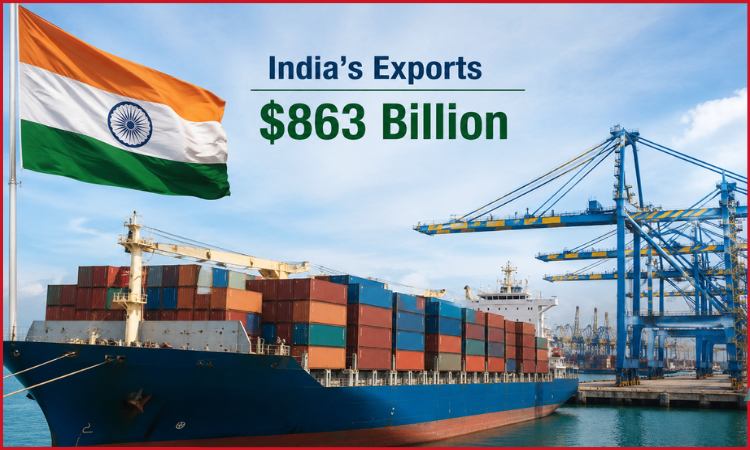
India’s exports touched a record $863.1 billion in FY 2025-26, the Commerce Ministry told the Lok Sabha today. Minister of State Jitin Prasada, in a written reply, credited the surge to stronger trade flows under free trade agreements with the UAE, the UK and Australia.
Merchandise, services shipments both hit new highs in FY26
Merchandise exports came in at $441.8 billion. Services added $421.3 billion. Together, they pushed India’s total exports to their highest-ever level.
ASEAN and UAE anchor the FTA numbers
Among India’s trade pacts, the ASEAN-India agreement generated the most merchandise exports in FY26, at $38.42 billion.
The UAE’s Comprehensive Economic Partnership Agreement (CEPA) was close behind at $37.36 billion, followed by the South Asian Free Trade Area at $25.77 billion.
Newer agreements are also gaining ground. The India-UK trade pact, effective just two weeks ago, already shows $13.44 billion in exports. Singapore stands at $11.86 billion, Nepal at $7.45 billion, Australia at $7.28 billion, and Oman — barely two months into its own CEPA — at $4.02 billion.
Certificates of Origin point to rising FTA use
The ministry tracks how much exporters actually use these tariff deals through Certificates of Origin (CoO). The numbers show steady gains.
Since the UAE CEPA took effect in May 2022, exporters have claimed 4.45 lakh Certificates of Origin. The range of products shipped has widened too — tariff lines to the UAE rose from 7,546 to 8,053, a 6.7 per cent jump, now worth $37.3 billion.
Australia’s ECTA tells a similar story. Certificate issuance jumped from just 1,482 a year before the pact to an average of 45,527 a year since, totalling 2.73 lakh so far. Exported tariff lines rose from 5,396 to 5,668, adding $7.2 billion in trade.
Smaller markets are moving fast too. Under the Mauritius pact, tariff lines exported jumped 20.9 per cent, to 4,345, worth about $473 million. Oman’s exports rose 54.7 per cent month-on-month and nearly tripled year-on-year, hitting $622.8 million in June alone. The India-EFTA deal, in force since October 2025, has already generated 7,885 Certificates of Origin.
Labour-intensive sectors in focus
The ministry said its FTA strategy is designed to help labour-intensive industries — textiles, leather, gems and jewellery, marine products, carpets and handicrafts — gain wider market access, while shielding sensitive domestic sectors through calibrated tariff cuts.
It pointed to preferential access covering 99 per cent of Indian exports to the UK, full duty-free access to New Zealand, and 99.6 per cent of tariff lines under the EFTA agreement.
To help exporters use these openings, the Department of Commerce has expanded its Trade e-Connect platform and Trade Intelligence and Analytics Portal, offering market intelligence and Rules of Origin guidance.