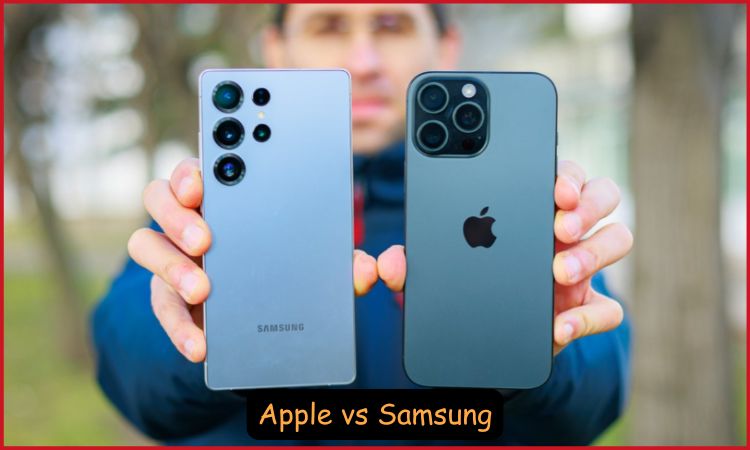
The Apple vs Samsung debate used to have a clear winner every year. One led on cameras. The other on speed or battery. Simple choices.
In 2026, that clarity is gone. Both phones are so close on nearly every front that picking one is no longer a technical decision. It is a personal one.
Here is what the data and the benchmarks actually say.
1. Apple vs Samsung Market Share, Revenue & Profit Comparison (2026)
Apple and Samsung shipped almost the same number of phones in 2025. But the revenue picture looks nothing like the unit picture.
| Metric | Apple | Samsung |
| Global Market Share (2025) | 20% | 19% |
| Global Revenue Share (Q2 2025) | 43% | 15% |
| Average Selling Price (Q2 2025) | $879 | $270 (blended) |
| Global Smartphone Profit Share | 60%+ | 15–25% |
| Customer Retention Rate | 92% | 77% |
| US 5G Market Share | 60% | 21% |
Apple took home 43% of all global smartphone revenue with 20% of units. Samsung took 15% of revenue with 19% of units. Same battlefield. Very different war.
One more number worth knowing: in Q4 2025, roughly 82% of Samsung’s operating profit came from semiconductors — not phones.
Apple wins the money game. Samsung wins the volume game. Both claim the throne — just for different reasons.
2. iPhone vs Samsung Comparison 2026: Camera, Battery, Display & Performance
Camera
Tech reviewer Arun Maini (Mrwhosetheboss) ran an 11-category camera test. The result was nearly a dead heat.
- iPhone 16 Pro Max: 6 wins
- Galaxy S25 Ultra: 5 wins
- iPhone leads on: video, low-light portraits, skin tone accuracy, colour consistency
- Samsung leads on: zoom range, fine detail at high magnification, camera app smoothness
Independent lab DXOMark flagged real Samsung weaknesses — noise in high-contrast scenes, skin tone shifts under mixed lighting, and 8K video that uses AI upscaling rather than true optical resolution.
Display
- Samsung: higher resolution (1440 x 3120), better colour volume, superior anti-reflective glass outdoors
- iPhone: brighter in real-world tests — 1,796 nits vs Samsung’s 1,417 nits in auto mode
- Important: Samsung claims 2,600 nits peak brightness. Independent testing clocked 1,417 nits. The iPhone measured higher in actual use.
- Colour accuracy (Delta-E): Samsung 0.24 vs iPhone 0.26 — both near-perfect
Battery
The iPhone has a smaller battery. It still lasts longer. That is software optimisation doing the work.
- Battery capacity: Samsung 5,000 mAh vs iPhone 4,685 mAh
- Real-world screen-on time: iPhone 11h 30min vs Samsung ~11h
- Charging — 0 to 70%: Samsung wins — ~30 minutes
- Full charge time: Samsung 1 hour vs iPhone 2 hours
Performance
- Geekbench 6 single-core: iPhone wins by ~15%
- Geekbench 6 multi-core: Samsung wins (9,413 vs 8,387)
- 3DMark Solar Bay GPU: Samsung wins — 42.4 fps vs 28.1 fps (+51%)
- Real-world daily use: No noticeable difference on either phone
- Thermal performance: iPhone runs cooler — 36–37°C vs 41°C under heavy load
Source: PhoneArena Geekbench 6; Tom’s Guide 3DMark Solar Bay
Samsung wins on paper. Apple wins in use. This pattern repeats across nearly every category.
3. Samsung Strategy in 2026: Innovation vs Real-World Trade-Offs
Samsung keeps pushing hardware into new territory. But not always all the way.
- Galaxy AI is polished and functional — more consumer-ready than Apple Intelligence right now
- The S Pen is the only built-in stylus on any flagship — no Apple equivalent exists
- Samsung DeX turns the phone into a desktop — a genuine power-user feature
- Foldable pipeline (Z Fold, Z Flip) is the most mature in the industry
Where Samsung held back: the Z Fold 7 kept a 4,400 mAh battery while rivals adopted larger silicon-carbon cells. The Exynos chip switch in certain markets raised questions about sustained efficiency.
4. Apple vs Samsung AI Features 2026: Galaxy AI vs Apple Intelligence
Both brands made AI central to their 2025 story. Samsung got there first.
- Galaxy AI: fully launched — photo editing, Audio Eraser, AI Select all work well
- Apple Intelligence: still rolling out — notification summaries work, broader features are pending
- Sentiment: widespread fatigue with AI marketing across both brands and their communities
Apple’s AI is expected to close the gap through 2026. But right now, Samsung has the more complete product.
5. Apple vs Samsung Comparison Table 2026: Full Feature Breakdown
| Category | iPhone 16 Pro Max | Galaxy S25 Ultra |
| Camera — overall | Wins (6-5) | Zoom and detail |
| Camera — video | Wins | 8K (AI-upscaled) |
| Performance — real world | Tie | Tie |
| Performance — GPU benchmark | Wins (+51%) | |
| Battery life (screen-on) | Wins (efficiency) | |
| Charging speed | Wins (1hr full) | |
| Display brightness (real-world) | Wins (1,796 nits) | |
| Display resolution and colour | Wins | |
| AI features | Catching up | Wins |
| Ecosystem | Wins clearly | Improving |
| Revenue and profit | Wins (43% / 60%+) | |
| Customer retention | Wins (92%) | 77% |
| Starting price | $1,199 | $1,299 |
6. Which Is Better iPhone or Samsung in 2026? (Buying Guide)
| Go iPhone if you want… | Go Samsung if you want… |
| Consistent performance for years | More features packed in |
| Best video recording quality | Better zoom and 8K video |
| Tight Apple ecosystem (Mac, iPad, Watch) | Android customisation and DeX mode |
| Higher resale value over time | Faster charging and S Pen included |
7. iPhone vs Samsung: Why the Choice Is Now About Identity, Not Specs
When cameras score the same, batteries last the same, and performance feels identical in daily use — specs stop being the reason people pick a phone.
Brand identity takes over.
- iPhone stands for: simplicity, reliability, and status — 63% of US adults aged 25–34 use one
- Samsung stands for: flexibility, control, and a willingness to experiment
Customer retention data confirms this. Apple holds 92% of its users at upgrade time. Samsung holds 77%. Once people are in, they rarely leave. That loyalty is not about specs. It is about how a brand makes people feel.
The spec war ended in a draw. The identity war is just getting started.
Final Verdict: Apple vs Samsung — Which Phone Wins in 2026?
The rivalry used to be simple. One brand won a category. You picked your winner.
In 2026, the Apple vs Samsung debate has shifted beyond specs.
Performance, camera, and battery are no longer decisive factors in everyday use. The real difference lies in approach — Apple’s controlled ecosystem versus Samsung’s flexibility and experimentation.
Apple wins on money, loyalty, and ecosystem. Samsung wins on hardware ambition, AI, and volume
Frequently asked questions
Which is better: iPhone or Samsung in 2026?
Neither wins outright. The iPhone is better for the ecosystem, video, and long-term reliability. Samsung is better for features, AI, and flexibility. The right answer depends entirely on how you use your phone.
Which phone has the best camera in 2026?
iPhone 16 Pro Max won a direct 11-test comparison 6-5. It leads in video and portraits. Samsung leads in zoom. For video creators, iPhone is the safer bet. For photographers who zoom often, Samsung is stronger.
Is Samsung more innovative than Apple in 2026?
Yes — Samsung experiments more openly. Foldables, the S Pen, Galaxy AI, and DeX are all ahead of Apple equivalents. Apple waits, refines, and then sets the standard. Different strategies. Both work.
Which phone should I buy in 2026?
Own a Mac, iPad, or Apple Watch? Go iPhone — the ecosystem pays dividends daily. Want more hardware, a stylus, better zoom, and Android flexibility? The S25 Ultra is one of the best phones ever made.