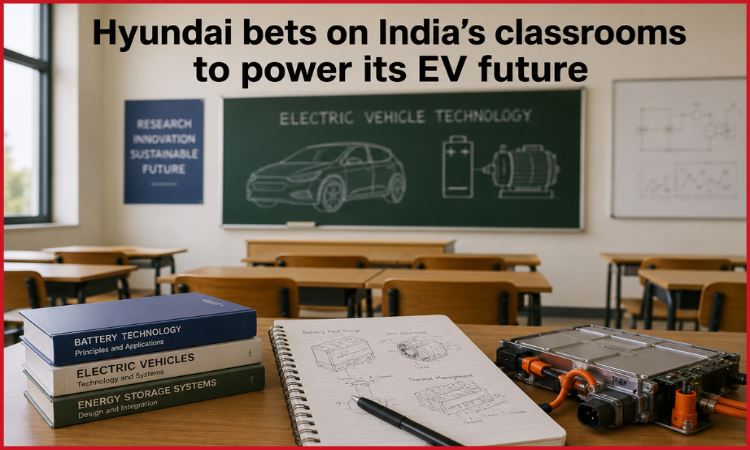
Hyundai Motor Group this week signed agreements with four Indian universities — IIT Kanpur, IIT Hyderabad, Visvesvaraya National Institute of Technology (VNIT) Nagpur, and Tezpur University — expanding its Center of Excellence (Hyundai CoE) in India into a seven-institution consortium, the country’s largest academic-industrial network focused exclusively on battery and electrification research.
The signing ceremony was held in New Delhi. The four join founding partners IIT Madras, IIT Delhi, and IIT Bombay, who came on board at the CoE’s 2025 launch.
“By bringing together the distinguished professors and emerging researchers from these seven institutes, we can create powerful synergies that will yield immense value for both Hyundai and India’s sustainable growth,” said Chang Hwan Kim, Head of the Electrification Energy Solutions Tech Unit at Hyundai Motor Group.
“I strongly believe that the Hyundai CoE will grow to become the premier expert network of the Indian academic community,” Kim added.
The network, which launched in 2025, has already seeded 39 joint research projects across the seven universities. Those projects span battery cell design, battery management systems, energy density, safety, durability, and diagnostics — each a foundational pillar of EV readiness. Two headline initiatives stand out: battery design and materials research optimised specifically for India’s market conditions, and the development of an AI-powered Vehicle-to-Grid (V2G) platform.
The inclusion of Tezpur University, a central university in Assam, is quietly significant. Every other partner institution is an IIT or NIT — India’s most competitive technical schools. Bringing Tezpur into a consortium that includes the IITs signals that the Group is thinking beyond the traditional metro and premier-institute belt, building research capacity in geographies that are often overlooked by global automotive majors.
To ensure research flows in both directions, Hyundai is also launching a Korea Visiting Program — a structured exchange that will allow Indian researchers to work alongside Korean scientists on EV technology development. The Group will additionally host a global e-conference for leading academics and a series of tech forums bringing together government, industry, and academia.
Tarun Garg, Managing Director of Hyundai Motor India Limited, was among the Group officials present at the signing, alongside Eul Kyo Lim, Head of R&D Planning and Coordination Center, and Chang Yeon Cho, Head of Hyundai Motor India Engineering Center. From the academic side, Prof. Bijaya Ketan Panigrahi, Dean of IIT Delhi and Hyundai CoE Co-Chair, represented the founding institutions, with deans from each of the new partners also in attendance.
The long-term ambition, the Group says, is to evolve the Hyundai CoE from a research node into a comprehensive hub that actively contributes to India’s EV transition — generating research findings, strategic insights, and a pipeline of talent equipped to build the next generation of India-specific mobility solutions.