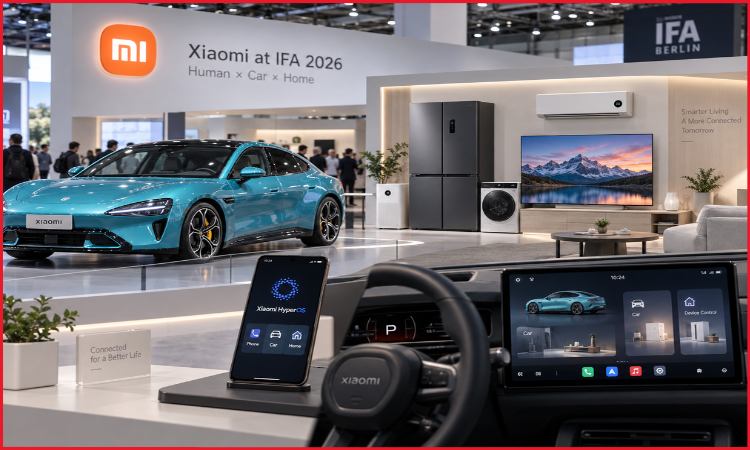
Xiaomi has made its first appearance at IFA in Berlin with its largest standalone overseas exhibition, presenting more than 380 products, technologies and demonstrations across smartphones, appliances, electric vehicles, artificial intelligence and robotics.
The company occupied more than 3,300 square metres at IFA 2026. Rather than treating the event as a series of separate launches, Xiaomi organised the display around its “Human × Car × Home” strategy, connecting personal devices, vehicles and household equipment through Xiaomi HyperOS.
The exhibition was divided into three areas: AI Tomorrow, AI Today and the Human × Car × Home product portfolio. Together, they showed both commercially available products and forward-looking concepts. Not everything displayed at IFA is ready for consumers or confirmed for every market.
Xiaomi’s objective is to move beyond individual connected devices. It wants compatible products to share context and coordinate actions, subject to the user’s permission, instead of requiring a separate command for every appliance.
HyperOS Connects More Than 380 Products
The Human × Car × Home ecosystem covers seven areas at the exhibition: cooking and food storage, home cleaning, air management, audiovisual entertainment, security, personal devices and smart mobility.
In one demonstration, the system used time, location and weather information to adjust lighting and air conditioning before a user arrived home. Another showed several devices working together to print a recently captured photograph. A reading scenario coordinated lights, curtains and temperature.
These demonstrations show how Xiaomi intends its platform to function; they do not mean every feature is immediately available across all products and regions. Compatibility will depend on the device, software version and market.
Xiaomi says its consumer AIoT platform includes more than 1.1 billion connected devices, excluding smartphones, laptops and tablets. It serves over 175 million users and households worldwide.
The company also highlighted internally developed AI technologies, including MiMo-V2.5-Pro, Xiaomi Miloco and Xiaomi Miclaw. These projects are intended to improve understanding, reasoning and task execution across devices.
Xiaomi displayed the Xiaomi 18 Fold with its next-generation XRING O3 processor. The appearance confirmed the device and chip as part of the showcase, although complete international pricing and availability were not provided with the ecosystem announcement.
Cars and Robotics Extend Xiaomi Beyond Electronics
Mobility formed a major part of the company’s IFA 2026 debut. Xiaomi displayed its new-generation SU7 electric sedan and high-performance SU7 Ultra, both designed to integrate with HyperOS and other connected products.
Xiaomi says its automotive division has delivered more than 700,000 vehicles in mainland China since its first customer delivery in March 2024. The company expects Xiaomi Auto to enter European markets, including Germany, in 2027.
This remains a planned expansion rather than an immediate launch. Prices, available models, sales channels and final dates have not been announced for individual European countries.
The futuristic part of the display was Xiaomi Vision Gran Turismo, a virtual electric hypercar created for the Gran Turismo franchise. Xiaomi became the first technology company to participate in the Vision Gran Turismo programme.
Because it is a virtual concept, the car should not be confused with a confirmed production model. It explores ideas involving automotive design, aerodynamics and digital interaction.
Xiaomi’s CyberOne humanoid robot also appeared, responding to visitors through gestures. The company is testing humanoid robots at its vehicle factory for work such as tightening nuts.
Xiaomi said the success rate for that task increased from about 90% to 98% over four months. The robots remain under evaluation, so the demonstration does not establish that they are ready for widespread factory deployment.
Mijia Begins Wider European Expansion
The home component is being strengthened through the expansion of Mijia across Europe. Xiaomi’s smart-home brand covers more than 2,000 products in over 130 categories, including kitchen equipment, cleaning devices, air-purification products, entertainment systems and security.
Compatible products can be managed through the Xiaomi Home application. The broader plan is for appliances to coordinate across household situations while keeping authorisation with the user.
Europe is central to the strategy because Mijia’s expansion and Xiaomi Auto’s planned 2027 entry would bring personal devices, cars and smart homes into the same regional market.
Supporting this expansion will require substantial investment. Xiaomi expects worldwide research and development spending to exceed €24 billion between 2026 and 2030. The programme covers AI, operating systems, internally developed semiconductors, smart vehicles, robotics and intelligent manufacturing.
Xiaomi says its smartphone shipments have remained among the global top three for 24 consecutive quarters. Its tablets ranked fourth worldwide in the second quarter of 2026, while its smart bands and smartwatches placed second, based on Omdia data cited by the company.
IFA therefore served as more than a hardware display. It presented Xiaomi’s effort to become a unified technology platform spanning the devices people carry, the appliances inside their homes and the vehicles they use.
The immediate developments are the wider European Mijia push and Xiaomi Auto’s planned 2027 arrival. The concepts, AI demonstrations and robotics trials show where the company wants the ecosystem to move next, but their eventual availability will depend on continued development and region-specific launches.
Reference:
https://www.gadgetmatch.com/xiaomi-makes-ifa-debut-showcasing-human-x-car-x-home-ecosystem/