Meta’s 8,000 job cuts, announced this week, signal a brutal new normal amid the AI boom and global geopolitical tensions.
“You are part of a restructuring.” That was the substance of what thousands of Meta employees heard this week, as the social media giant terminated 8,000 people in a single wave — its largest single-day cut of 2026. Mark Zuckerberg has been unambiguous about the logic: AI agents will do the work that humans once did, and the company intends to be leaner for it. A second round of cuts is already planned for the second half of the year.
49,452 tech employees impacted in May 2026 alone
Meta was not alone in May. Intuit cut 3,000 employees. PayPal announced 4,760 job losses as part of a $1.5 billion AI overhaul. Fidelity let go of 800 workers. General Motors terminated 500 to 600 IT staff via abrupt 15-minute virtual calls in Austin and Warren, Michigan — no warning, no ceremony. Walmart eliminated or relocated 1,000 corporate roles as it merged its global tech and product teams. Israeli GPU database startup SQream shut down entirely, with 100% of staff let go. TrueUp’s live Tech Layoffs Tracker, updated as of May 21, recorded 49,452 tech employees impacted in May alone — and the month is not yet over.
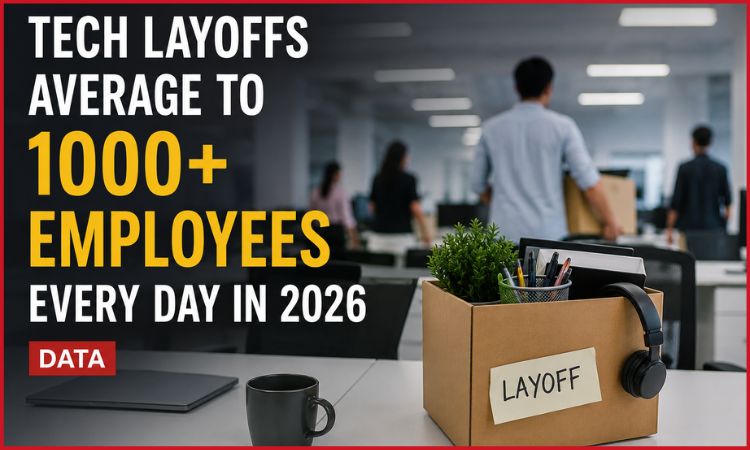
TrueUp’s data shows 2026 has already logged 330 layoff events at tech companies, with 142,223 people impacted — that calculates to more than 1,000 tech workers losing their jobs every single day.
The pace has accelerated sharply from 2025, which saw 783 layoffs affecting 245,953 people at 674 a day. The largest single action of the year remains Oracle’s March 31 cut of 30,000 employees in one morning, followed by Amazon at 19,100 and Nokia at 14,000. Meta, across multiple rounds this year, has now shed 8,900 in total, as per TrueUp’s tracker.
Who’s to blame
Two forces are converging to make 2026 uniquely brutal. The first is AI. Company after company — Meta, PayPal, Snap, Salesforce, Atlassian — has cited AI-driven efficiency as the primary justification for cuts. Workers are not being replaced by cheaper labour in another geography. They are being replaced by software, and the companies doing the replacing are simultaneously posting record capital expenditure on AI infrastructure.
The second force is geopolitical. Trade tensions, tariff uncertainty, and the economic overhang of ongoing conflict have made boards deeply reluctant to carry headcount through a period of prolonged uncertainty. Technology eliminates roles from the inside while macro pressure compresses hiring from the outside, leaving workers with nowhere to turn.