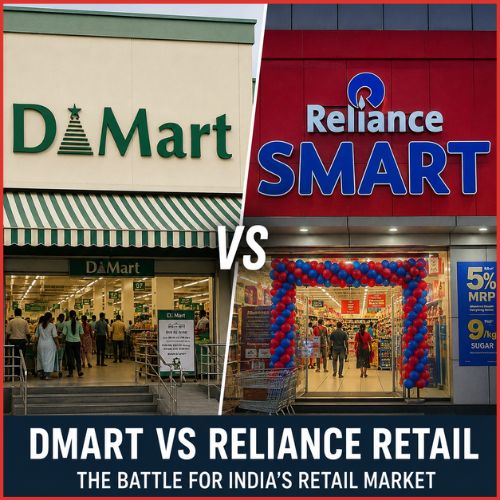
A battle for dominance in Indian commerce is taking place right now, with two retail titans going toe-toe as they fight for market share in one of India’s most attractive sectors — and also one of its most competitive.
Reliance Retail vs. DMart sees Radhakishan Damani go head-to-head against his long-time rival and former colleague, Mukesh Ambani. But what makes this clash so interesting isn’t just that these two retailing behemoths have different approaches to building out store footprints. Rather, their diverging paths offer insights into some of the key questions facing the industry today about growth, scalability, and how best to serve an increasingly price-sensitive customer base.
For those unfamiliar with the players involved, here’s a short summary of the competition landscape:
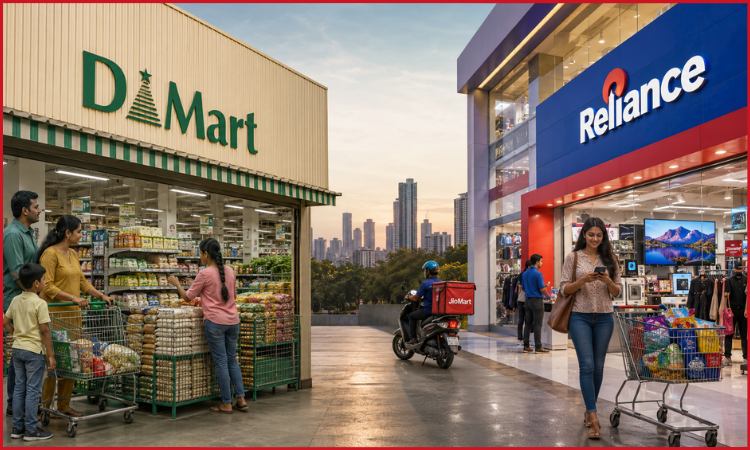
While DMart has been sticking to a small number (around 500) of stores — all owned instead of leased — Reliance Retail has opted for a massive network of over 20,000 leased, multi-format stores supported by JioMart’s logistics arm. Both companies aim to capture a sliver of the country’s growing ₹90-lakh-crore market through their respective business models, supply chains, and digital strategies, but the differences between them couldn’t be more stark.
Business Models Decoded: Asset-Owned Precision vs. Aggressive Conglomerate Expansion
DMart’s operating logic can be summarised in three words Radhakishan Damani himself has used for years: Everyday Low Cost, or EDLC. Rather than running periodic discounts and festive-season markdowns, the Everyday Low Price (EDLP) approach favoured by many Western retailers.
DMart keeps its cost structure permanently lean, then passes that saving to customers as a standing low price. The mechanism behind this is unglamorous but effective: DMart owns most of the real estate its stores sit on. Owning property means no rent inflation eating into margins year after year, no landlord renegotiations, and a fixed-cost base that only gets more efficient as stores mature.
Reliance Retail takes the opposite bet. It leases aggressively, expands into new formats almost as fast as it can staff them, and treats real estate as a tool for velocity rather than a long-term asset to be owned outright. This is how the company crossed 20,000 stores in FY26 alone, spanning grocery, fashion, electronics, and pharmacy under banners like Smart Bazaar, Trends, and Reliance Digital — a sprawl DMart, with roughly 500 stores nationwide, has never attempted to match.
| Parameter | DMart (Avenue Supermarts) | Reliance Retail |
| Model Type | EDLC, single-format value retail | Multi-format, diversified conglomerate retail |
| Real Estate Strategy | Predominantly owned property | Predominantly leased property |
| Expansion Strategy | Slow, cluster-based, contiguous growth | Rapid, nationwide, acquisition-driven growth |
| Primary Target Segment | Value-conscious mass and middle-income household shoppers | Broad spectrum — mass grocery to premium fashion and electronics |
| E-commerce Integration | Limited, DMart Ready (18 cities) | Deep omni-channel via JioMart and hyper-local delivery |
This is precisely why store ownership vs store leasing model debates dominate any analyst note on the sector. DMart’s owned-asset approach caps its expansion speed but insulates its margins from India’s volatile commercial rental market. Reliance Retail’s leased, acquisition-heavy model sacrifices some of that insulation but buys something DMart cannot easily replicate: presence in nearly every pin code that matters.
Supply Chain Strategy and SKU Management: The secret game
Spend twenty minutes in a DMart and the SKU discipline becomes obvious. There are rarely more than two or three brands per category, shelf space is allocated with almost mathematical precision, and impulse-buy clutter near the billing counter is minimal by design.
A former DMart regional manager, quoted in an industry roundtable a few years ago, put it simply: every additional SKU is a liability until it proves its inventory turnover. DMart’s famously high stock-turn ratio, inventory frequently cycles through in under three weeks — comes directly from refusing to stock anything that doesn’t move fast enough to justify shelf space.
Reliance Retail runs the opposite playbook. Visit a Smart Bazaar aisle and the sheer product variety is the point: hundreds of SKUs per category. An aggressive private-label push through Reliance Consumer Products (which posted roughly ₹22,000 crore in gross revenue in FY26, doubling year-on-year), and vendor relationships that span everything from hyperlocal kirana partnerships to global FMCG tie-ups.
Where DMart negotiates hard with a small, trusted vendor base to protect its cost structure, Reliance leverages its conglomerate weight: manufacturing, logistics, telecom infrastructure through Jio to build a private-label engine only few competitors can match on scale.
The trade-off is legible in day-to-day shopper behaviour. Someone doing a fixed monthly grocery run, price-sensitive and list-driven, tends to gravitate toward DMart’s no-nonsense aisles. Someone browsing for a specific imported skincare brand or the latest small appliance, less anchored to a shopping list, is more likely to end up at a Smart Bazaar or scrolling JioMart instead. Both strategies are rational responses to a fragmented, price-sensitive Indian organised retail market — they are simply optimising for different customers.
Financial Performance and Operational Metrics
Numbers tell a more nuanced story than headline revenue alone. Reliance Retail’s scale is undeniable, gross revenue of roughly ₹3.70 lakh crore in FY26, up 11.8% year-on-year, with profit after tax rising nearly 12% to ₹13,842 crore.
Avenue Supermarts’ FY26 revenue came in far smaller at roughly ₹66,968 crore, up 15.9% year-on-year, with net profit after tax of ₹3,224 crore.
Yet scale alone misses the more interesting comparison — efficiency per outlet:
- Store count gap: Reliance Retail crossed 20,000 stores in FY26; DMart operates roughly 500. Reliance’s average store, therefore, generates a fraction of the revenue a DMart outlet does.
- Profit-per-store dynamics: with only 500 large-format stores generating over ₹3,200 crore in annual profit, DMart’s profit-per-store figure comfortably outpaces Reliance Retail’s per-outlet economics, even though Reliance wins decisively on absolute scale.
- Margin pressure: DMart’s EBITDA margins have compressed slightly through FY26 amid rising employee costs and competitive FMCG pricing, while Reliance Retail’s EBITDA margin sits near 8.3%, reflecting the cost of running a much wider, tech-heavy format mix.
- Return on Capital Employed (ROCE): DMart has historically posted a healthier ROCE, a direct consequence of its owned-asset, low-debt model — capital efficiency that leased-model retailers, including Reliance, find structurally harder to match.
The takeaway for anyone tracking Avenue Supermarts financial performance closely is that DMart is not competing with Reliance on size. It is competing on a narrower, more defensible claim: that a smaller store fleet can be more profitable per square foot than a much larger one. Whether that claim holds as quick commerce reshapes shopping habits is the sector’s next big question.
The Digital Front: Quick Commerce and Omni-channel Warfare
If the store-ownership battle defines the last two decades of Indian retail, the quick commerce threat to retail giants is very plausibly defining the next one. Apps like Blinkit, Zepto, and Swiggy Instamart have trained a generation of urban Indian consumers to expect groceries at their door in ten to twenty minutes. A habit that neither DMart’s owned hypermarkets nor Reliance’s leased big-box stores were originally built to serve.
Reliance has responded with characteristic scale. JioMart now operates through more than 3,100 stores across over 1,200 cities and 5,100-plus pin codes, and its hyper-local commerce arm has become the company’s fastest-growing segment, average daily orders climbed more than 300% year-on-year in the final quarter of FY26 alone.
Backed by Jio’s telecom and data infrastructure, Reliance is essentially trying to out-build the quick commerce specialists rather than compete with them on their own narrow turf.
DMart’s response has been comparatively modest. DMart Ready, its e-commerce and delivery arm, operates in only 18 cities as of March 2026, and the company has actually pulled back in at least one city during the year, choosing to concentrate resources on home delivery in established metro markets rather than chase nationwide quick commerce coverage.
This is arguably consistent with Damani’s founding logic i.e. expand only where the unit economics are already proven, but it does leave a real question mark over how DMart Ready vs JioMart plays out as ten-minute delivery becomes less a novelty and more a baseline consumer expectation, particularly among younger, urban shoppers who increasingly view a same-day grocery run as slow.
The Verdict: Which Empire Claims the Evergreen Advantage?
Neither retailer is likely to “win” in the sense of eliminating the other — India’s retail market is large and fragmented enough to sustain fundamentally different models operating side by side for years to come.
Reliance Retail’s advantage lies in reach, capital depth, and an omni-channel ecosystem few global retailers can rival, giving it the muscle to absorb the quick commerce threat by building competing infrastructure at speed.
DMart’s advantage lies in discipline: owned real estate, tight SKU curation, and a cost structure that converts into consistently strong profit-per-store economics, even if it means growing at a fraction of Reliance’s pace.
For investors, the practical read is less about picking a winner and more about picking an exposure, steady, asset-backed compounding on one side, or high-growth, ecosystem-driven scale on the other. The Reliance Retail vs DMart comparison, in the end, is less a duel than a long-running experiment in two coexisting theories of Indian retail.
FAQs: Reliance Retail vs DMart
1. Which is bigger, Reliance Retail or DMart?
Reliance Retail is far bigger — about ₹3.70 lakh crore in FY26 revenue versus DMart’s ₹66,968 crore, roughly 5.5x larger. But DMart runs only 500 stores to Reliance’s 20,000-plus, so per-store economics tell a different story.
2. Why is DMart more profitable per store than Reliance Retail?
DMart owns most of its real estate, so there’s no rent inflation chipping away at margins. Combined with tight SKU discipline and fast inventory turnover, each store runs leaner than Reliance’s leased, wider-format outlets.
3. Is DMart Ready better than JioMart for online grocery delivery?
JioMart wins on reach, with 3,100+ stores across 1,200+ cities versus DMart Ready’s 18. DMart has stayed deliberately narrow, prioritizing proven unit economics over rapid expansion.
4. Can DMart survive the quick commerce threat from Blinkit and Zepto?
DMart hasn’t chased 10-minute delivery aggressively, betting instead on planned, monthly-haul shoppers who still prefer walking into a store. Whether that patience holds depends on how permanent the quick commerce habit turns out to be.