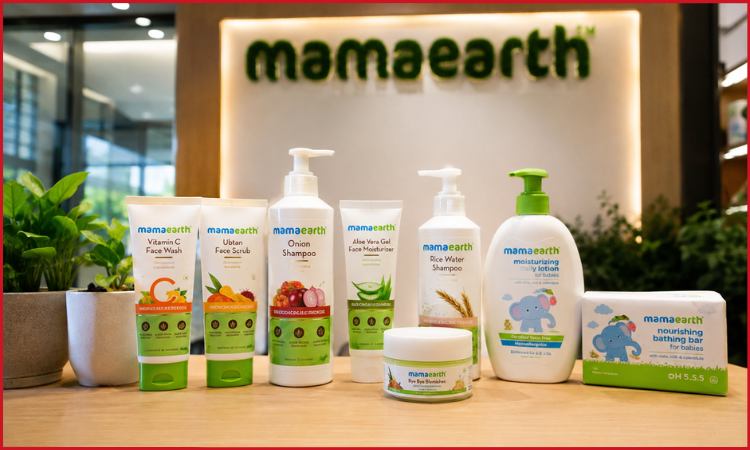
India’s beauty and personal care industry is highly competitive and driven by constant innovation, but few startups have successfully challenged established players such as Hindustan Unilever, Dabur, Himalaya, and L’Oréal. Mamaearth is one such success story. Starting as a D2C skincare brand in 2016, it has grown into one of India’s largest digital-first beauty companies within a decade.
Today, Mamaearth is part of Honasa Consumer Limited, a BSE/NSE-listed house of brands that has several fast-growing beauty and personal care brands in its fold. FY26, Honasa Consumer Limited clocked revenue of 2,392 crore and net profit of 200 crore, and achieved its highest-ever quarterly revenue and profit in Q4 FY26. The management expects revenue growth of 30%+ year-on-year in Q1 FY27, implying robust momentum across its signature brands.
What sets Mamaearth apart from the thousands of beauty startups launched every year? The answer lies in its business model, digital-first strategy, data-driven product development, and ability to scale multiple brands instead of relying on a single success.
About Honasa Consumer
Honasa Consumer Limited is an Indian beauty and personal care company founded by Varun Alagh and Ghazal Alagh in 2016 and headquartered in Gurugram. The company positions itself as a house of brands serving diverse customer segments across skincare, haircare, baby care, men’s grooming, and dermatologist-inspired products.
Its portfolio now includes:
- Mamaearth
- The Derma Co.
- Aqualogica
- Dr. Sheth’s
- BBlunt
- Staze
- Lumineve
- Reginald Men
This multi-brand strategy reduces dependence on any single brand while enabling the company to expand across premium and niche beauty categories.
The Story Behind Mamaearth
Unlike many consumer brands that begin with a market opportunity, Mamaearth was born from a personal experience.
After becoming parents, Varun and Ghazal Alagh found it difficult to source toxin-free baby products that met high safety standards. Rather than relying on expensive imported products, they identified a growing demand for safe and toxin-free alternatives in India.
This understanding forms the basis for Mamaearth.
From day one, the brand has been built on transparency around ingredients, toxin-free products, and consumer trust. It doesn’t compete solely on price but uses purpose-driven brand positioning and storytelling to build a unique identity.
As consumer awareness of clean beauty increased, the brand gradually expanded into skincare, haircare, body care, and wellness products.
How Mamaearth’s Business Model Works
Mamaearth operates an asset-light omnichannel business model.
The company distinguishes itself by focusing on product innovation, research and development, branding, customer acquisition, and distribution while outsourcing manufacturing to contract manufacturing partners. This results in shorter product development cycles, less capital-intensive operations, and greater operational flexibility.
The business model is built on five key pillars:
1. Digital-First Customer Acquisition
The company’s early growth was driven primarily through digital channels rather than expensive offline marketing.
Performance marketing, influencer collaborations, educational content, and social media campaigns helped the company reach millions of consumers while maintaining a relatively low customer acquisition cost.
2. Direct-to-Consumer (D2C) Commerce
Selling directly through its website gives the company access to first-party customer data. It enables the company to understand the buying process better, improve customer retention, and develop products based on consumer needs rather than retailer preferences.
This direct relationship further enhances margins over conventional FMCG distribution.
3. Omnichannel Expansion
Although digital commerce was the company’s initial growth driver, Honasa gradually expanded into general trade, modern trade, pharmacies, beauty retailers, and exclusive brand outlets (EBOs).
4. House of Brands Strategy
Instead of extending the Mamaearth brand into every beauty category, Honasa has built and acquired specialised brands to address different customer segments.
For example:
- The Derma Co. focuses on science-backed skincare.
- Dr. Sheth’s offers dermatologist-inspired skincare formulations.
- BBlunt strengthens the company’s presence in the professional haircare segment.
- Reginald Men expands its presence in the men’s grooming category.
By taking this approach, Honasa effectively caters to different customer segments without diluting the unique identity of each brand.
Revenue Model
Honasa Consumer’s primary source of revenue is the sale of its products through both online and offline channels, supported by multiple distribution streams.
Its revenue comes from:
- Direct website sales
- Marketplaces: Amazon, Nykaa, Flipkart, etc.
- Modern retail chains
- General trade distributors
- Exclusive Brand Outlets (EBOs)
- International sales in selected markets
Rather than relying on a single flagship product, the company generates recurring revenue through a diversified portfolio spanning skincare, haircare, baby care, face washes, shampoos, serums, sunscreens, moisturizers, and dermatologist-developed products.
This diversified product portfolio reduces category-specific risk while increasing customer lifetime value through cross-selling opportunities.
Funding, Financial Performance, Growth Strategy, and Future Outlook
Funding History: Building a Scalable Consumer Brand
Unlike many startups that raise significant capital in their early stages, Honasa Consumer adopted a gradual fundraising strategy. Each funding round enabled the company to invest in product development, distribution, technology, and brand building.
Before its IPO, Mamaearth raised an estimated US$126–130 million from leading investors such as Fireside Ventures, Peak XV Partners (formerly Sequoia India), Stellaris Venture Partners, Sofina, and Evolvence India. The funding enabled the company to evolve from a baby-care startup into a diversified beauty and personal care business.
One of the company’s biggest milestones came in 2023 when Honasa Consumer Limited launched its Initial Public Offering (IPO). Being listed on the NSE and BSE enhanced access to capital while strengthening transparency and investor confidence. As of mid-2026, Honasa Consumer had a market capitalization of nearly ₹10,000 crore and ranked among India’s most valuable listed digital-first beauty companies.
Financial Performance Reflects a Strong Turnaround
Honasa Consumer’s FY26 performance reflects its strategic shift from prioritizing rapid expansion to focusing on sustainable, profitable growth.
The company reports:
- FY26 Revenue: 2,391.9 crore
- FY26 Net Profit: 200.2 crore
- Revenue Growth: 16% year-on-year
- Net Profit Growth: 175% year-on-year
The March quarter is also the company’s best quarter since listing.
Q4 FY26 records:
- Revenue: 675.96 crore
- Net Profit: 69.2 crore
- EBIT margin: Greater than 12%, the highest in the company’s history.
These figures show that Honasa has improved operational efficiency while continuing to expand its brand portfolio.
Marketing Strategy: Building Communities Instead of Just Campaigns
Mamaearth has diversified its marketing strategy rather than relying solely on television advertising.
The company has built a digital-driven marketing engine powered by influencer marketing, educational content, performance marketing, and customer testimonials.
Its strategy revolves around four pillars:
- Influencer-led product education
- Social media storytelling
- Performance-driven digital advertising
- User-generated content and customer testimonials
The company uses first-party customer data collected through its D2C channels to understand buying patterns and introduce products based on evolving consumer preferences, helping reduce product failures and improve repeat purchases.
Omnichannel Distribution Strengthens Market Presence
Although Mamaearth began as a D2C brand, Honasa has gradually evolved into an omnichannel business.
Today, its products are available through:
- Its own website
- Amazon
- Nykaa
- Flipkart
- General trade stores
- Modern retail chains
- Exclusive Brand Outlets (EBOs)
By FY26, Honasa had expanded its offline presence to more than 270,000 retail outlets across India, significantly strengthening its retail distribution network. Its omnichannel approach enables customers to shop through their preferred channels while reducing dependence on any single sales channel.
Expanding Beyond Beauty
From 2026 onwards, Honasa has also expanded into the nutraceuticals segment.
The company acquired a 58% stake in Fluence Pharma at an enterprise value of ₹135 crore and launched Honasa Health, its new subsidiary focused on science-based nutraceuticals under the Natural Care brand. This move aligns with the growing consumer preference for holistic beauty-from-within solutions and complements brands such as The Derma Co. and Dr. Sheth’s.
Competitive Advantages
Honasa Consumer distinguishes itself from traditional FMCG companies and newer D2C startups for the following reasons.
- Strong house-of-brands strategy
- Digital-first customer acquisition
- Data-driven product development
- Omnichannel distribution network
- Diversified product portfolio
- Asset-light operating model
- Rapid innovation cycles
By building a portfolio of category-focused brands that serve diverse consumer needs, Honasa has reduced its dependence on the Mamaearth brand and strengthened the resilience of its overall business.
Challenges
Despite its strong growth, Honasa continues to face several business challenges.
Competition in India’s beauty and personal care market remains intense, with established FMCG companies, global brands, and digital-first startups continuing to invest heavily in product innovation and marketing.
The company must also manage:
- Rising customer acquisition costs
- Margin pressure from discounting
- Supply chain volatility
- Intensifying competition from brands such as Nykaa, Minimalist, Plum, WOW Skin Science, and international beauty brands.
Another key challenge is sustaining profitable growth while expanding its offline distribution network.
Future Outlook
Management expects strong business momentum to continue into FY27, with revenue growth of more than 30% YoY projected for Q1 FY27 despite changes in marketplace revenue accounting. During its 2026 investor presentations, Honasa outlined a long-term target of achieving ₹5,500 crore in annual revenue by FY31, driven by improving profitability, premium brand expansion, a stronger omnichannel presence, and strategic acquisitions.
As India’s beauty and personal care industry continues to grow, Honasa appears well positioned to capture additional market share through innovation, technology, and its diversified house-of-brands strategy.
Conclusion
Mamaearth is far more than just a clean beauty brand. Honasa Consumer has created a scalable business by integrating digital-first consumer acquisition, an asset-light operating model, omnichannel distribution, data-led innovation, and a diversified brand portfolio.
Honasa’s FY26 financial performance demonstrates that the company is now balancing growth with improved profitability. Going forward, it plans to continue investing in premium brands, science-based products, offline expansion, and new ventures such as nutraceuticals to strengthen its position as one of India’s leading consumer goods companies.
Its journey shows how a startup born from a personal parenting challenge evolved into a ₹10,000+ crore listed company, highlighting how customer confidence, product innovation, and disciplined execution can create long-term business success.
FAQs
1. What is Mamaearth’s business model?
Mamaearth follows an omnichannel business model that combines digital-first customer acquisition with a strong offline retail presence. As Honasa Consumer Limited, the company earns sales from the D2C website, marketplaces, modern trade, general trade, and exclusive brand outlets. It has adopted the house-of-brands approach with brands like The Derma Co., Dr. Sheth’s, and BBlunt.
2. Who owns Mamaearth?
Mamaearth is owned by Honasa Consumer Limited, an Indian publicly traded beauty and personal care enterprise established by Varun Alagh and Ghazal Alagh in 2016. Honasa Consumer Limited covers several individual brands instead of a single flagship brand.
3. How does Mamaearth make money?
Mamaearth generates revenue by selling skincare, haircare, baby care, body care, and wellness products through its own portal, through popular e-commerce portals, offline retail outlets, and exclusive brand outlets. Its wide product portfolio and presence on multiple delivery channels contribute to recurring revenue.
4. How much revenue does Honasa Consumer generate?
Honasa Consumer reported FY26 revenue of ₹2,391.9 crore and a net profit of ₹200.2 crore, reflecting growth supported by its diversified product portfolio and omnichannel business model.
5. How has Mamaearth grown so quickly?
Mamaearth has expanded through influencer marketing, digital advertising, data-driven product launches, ingredient-specific branding, strategic acquisitions, and rapid omnichannel expansion. Its house-of-brands strategy allows it to enter into different customer segments and reduce reliance on one specific product.
6. What companies compete with Mamaearth?
Mamaearth competes with well-entrenched FMCG companies and digital-first beauty brands such as Nykaa, Minimalist, Plum, WOW Skin Science, Himalaya, Biotique, Lakmé, and L’Oréal India. Competition continues to intensify as consumers increasingly demand scientifically backed and clean beauty products.
7. What is the future of Honasa Consumer?
Honasa Consumer intends to bring focus on expanding premium beauty brands, increasing retail penetration through offline channels, and new category expansion, such as the nutraceuticals segment, through mergers and acquisitions, and targets a ₹5,500 crore revenue goal by FY31. The company has also projected 30%+ YoY revenue growth for Q1 FY27.