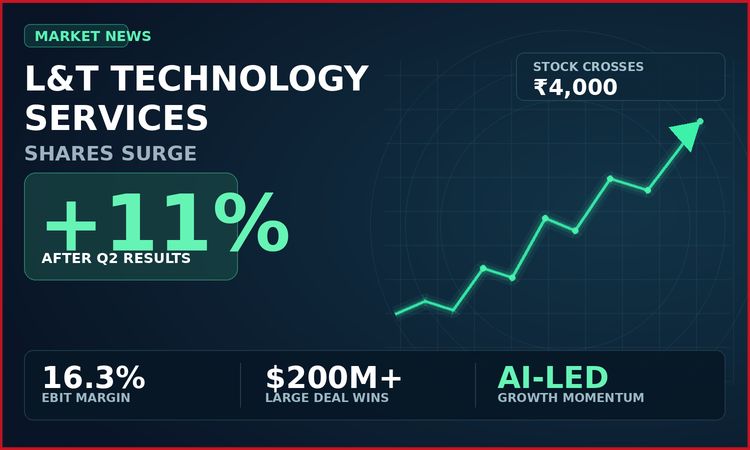
L&T Technology Services shares surged nearly 11% on Wednesday morning, pushing past the ₹4,000 mark after its September-quarter numbers gave investors three things they had been waiting for: better margins, stronger deal wins and clearer evidence that artificial intelligence is turning into actual revenue.
The LTTS share price climbed sharply after Q2 revenue rose 3.4% sequentially to ₹3,040 crore. In constant-currency terms, dollar revenue increased 2.7% quarter on quarter to $317 million.
The surprise, though, was profitability. EBIT margin reached 16.3%, well ahead of several brokerage estimates and 60 basis points higher than the June quarter.
That was enough to change the mood around the stock.
Revenue Growth Was Steady Rather Than Spectacular
LTTS reported revenue of ₹3,040.4 crore for the quarter ended September 30.
That was 12.1% higher than a year earlier and 3.4% above Q1.
The constant-currency growth number was slightly softer at 2.7% sequentially, but still represented an acceleration from the previous quarter.
For an engineering research and development company, that improvement matters because demand has been uneven across sectors such as automotive, telecom and medical technology.
The L&T Technology Services Q2 results suggest some of those pressures are beginning to ease, although the recovery is not uniform.
Sustainability was the strongest part of the portfolio, while the technology vertical remained softer.
The 16.3% Margin Was the Bigger Surprise
Analysts had been expecting EBIT margin closer to 15.6%.
LTTS delivered 16.3%.
That difference may look small on paper, but margins are closely watched in IT and engineering services because companies are simultaneously dealing with wage increases, investment in AI and pressure from customers to deliver more work for the same cost.
The 60-basis-point sequential improvement also put LTTS into its mid-16% margin target earlier than some analysts had expected.
Adjusted profit after tax rose 7.9% from Q1 and 19.7% from a year earlier to roughly ₹380 crore.
Reported net profit was higher at ₹548.2 crore because it included a one-time gain of ₹165 crore from the sale of the Smart World and Communication business.
AI Is Starting to Show Up in the Deal Book
The quarter also gave investors something more concrete around artificial intelligence.
LTTS won more than $200 million of large deals during Q2, and over half of that value came from AI-related work.
The wins included one contract worth $75 million, another above $30 million, a $25 million deal and six contracts worth more than $10 million each.
That is important because many technology companies have spent the past couple of years discussing AI without disclosing much commercial impact.
For LTTS AI revenue, the picture is becoming clearer.
Annualised AI revenue has reached roughly $120 million, equivalent to around 9.5% of quarterly revenue.
More Than 16,000 Engineers Have Been Trained in AI
LTTS has also been preparing its workforce for that shift.
More than 16,000 engineers, or roughly two-thirds of the company’s employee base, have now been trained in artificial intelligence.
The company ended Q2 with 24,035 employees.
This is particularly relevant for engineering services because AI is moving beyond writing software code.
LTTS is using it in manufacturing, product development, robotics, plant operations and other physical-engineering environments.
Its Engineering Intelligence platform now contains more than 100 solutions.
The company has also launched an Engineering Intelligence laboratory with Nvidia focused on AI-native applications across manufacturing, robotics and supply chains.
Sustainability Was the Strongest Vertical
The sustainability business delivered the fastest growth during Q2.
The segment represents about 38% of LTTS revenue and grew roughly 4.9% sequentially.
Demand came from data centres, energy transition projects, robotics, automation and plant engineering.
It is also the company’s most profitable vertical, carrying an EBIT margin of about 29.5%.
That combination—high growth and strong profitability—helps explain why the segment has become increasingly important to the overall LTTS growth outlook.
Data-centre investment is especially relevant because the global AI build-out is creating demand far beyond chips and software.
Those facilities require power systems, cooling, automation, engineering and physical infrastructure.
Mobility Continued Growing
The mobility vertical also moved higher.
Revenue increased around 2.3% sequentially, supported by North American automotive work, aerospace, rail and trucks and off-highway businesses.
Europe remains more difficult.
Automotive manufacturers there continue to restructure, and LTTS does not expect a full recovery immediately.
Management believes conditions could improve over the next nine to 12 months.
That makes the geographic mix important.
Growth in North America is helping offset some of the weakness from European automotive customers while the company waits for spending there to recover.
Technology Was the Weak Spot
The technology vertical declined around 0.9% sequentially.
There were still pockets of strength.
Semiconductors and technology infrastructure performed well, helped by an AI-led engagement with a global telecom-equipment customer.
The problem came from a MedTech programme ramp-down and delays in follow-on work.
Management expects the technology vertical to remain relatively muted in Q3 before improving from the fourth quarter.
That means LTTS revenue growth in the near term may continue to depend more heavily on sustainability and mobility.
Management Expects a Stronger Second Half
One of the reasons investors reacted so strongly is management’s confidence about the rest of FY27.
LTTS says its order backlog and pipeline are both improving from last year.
The large-deal pipeline itself has risen more than 25% year on year.
Management is aiming for roughly $200 million in large-deal wins per quarter, which would give the company a healthier stream of business that can gradually convert into revenue.
Previously won contracts are also beginning to ramp.
That supports LTTS’s view that the second half of FY27 should be stronger than the first.
Wage Hikes Will Test the Margin
The next quarter will not be straightforward.
LTTS is scheduled to implement wage increases in Q3.
Management expects those raises to affect margins by roughly 50-80 basis points.
The company still believes it can keep EBIT margin around the mid-16% level through a better business mix, AI-driven productivity and tighter control over selling and administrative expenses.
That will be an important test.
Delivering a 16.3% margin before wage hikes is encouraging. Holding close to that level afterwards would provide stronger evidence that the improvement is sustainable.
Brokerages Raised Targets but Remained Cautious
The 11% stock rally was stronger than the reaction from several analysts.
Motilal Oswal retained a Neutral rating while lifting its target price to ₹3,850 from ₹3,400.
Nuvama maintained Hold and raised its target to ₹3,450, while Nomura kept a Neutral rating and increased its target to ₹3,500.
Those targets sit below the roughly ₹4,000 level touched by the stock on Wednesday.
That creates an interesting gap between market enthusiasm and brokerage caution.
The L&T Technology Services share rally is effectively pricing in faster deal conversion, sustained AI growth and continued margin strength.
Q2 provided evidence for all three.
The next few quarters now have to prove the market has not moved ahead of the numbers.