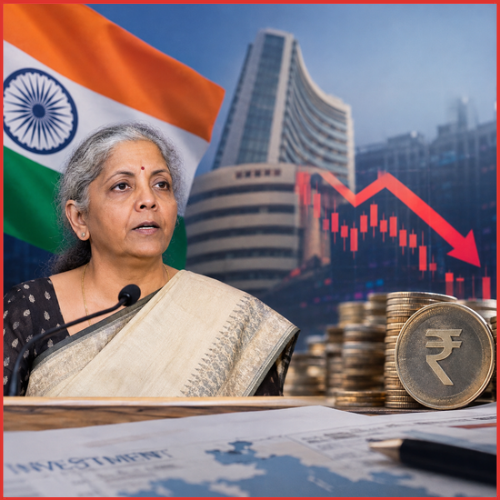
Finance Minister Nirmala Sitharaman has flagged persistent foreign capital outflows as one of the main risks for next year, even as she maintained that India’s underlying economic fundamentals remain sound.
The warning comes after a difficult year for Indian stock markets. The Nifty 50 is down more than 12% in 2026, while the Sensex has fallen by a similar amount. Foreign portfolio investors have sold more than $33 billion worth of Indian equities during the year.
That selling has also added pressure on the rupee and forced the Reserve Bank of India to become increasingly active in the currency market.
Foreign Investors Have Been Pulling Money Out
The scale of foreign selling is one of the clearest reasons the market has struggled.
Foreign portfolio investors have withdrawn more than $33 billion from Indian equities during 2026.
September alone saw about $4.1 billion of foreign institutional selling, reversing around $2.4 billion of inflows recorded in August.
Those numbers matter because foreign investors still play a large role in determining how Indian equities are valued.
When international funds reduce exposure, large-cap stocks often feel the pressure first. The effect can then spread into the wider market as sentiment weakens and investors become more cautious.
That is why foreign portfolio outflows from India are becoming more than a stock-market issue.
They are beginning to affect the currency and the broader financial system as well.
Domestic Investors Are Buying, but Foreign Money Still Matters
There is another side to the story.
Indian institutions have continued buying.
Domestic investors purchased around $8.1 billion worth of equities during September, moving in the opposite direction to foreign funds.
Equity mutual funds have also recorded net inflows every month since March 2021.
That steady flow of domestic money has provided an important cushion.
Without it, India’s market decline could have been considerably sharper.
But domestic buying cannot completely replace global capital.
When they sell Indian shares, they often convert the proceeds back into dollars, increasing demand for the US currency and putting pressure on the rupee.
That is where the equity story starts connecting with the foreign-exchange market.
India Has Lost Weight in Regional Benchmarks
India’s relative position inside Asian equity benchmarks has also changed.
According to figures cited in the report, India’s weight in the MSCI Asia Pacific ex-Japan index has fallen to roughly 10%, from around 19% a few years ago.
Taiwan now carries close to a 29% weight, while South Korea is around 22%.
Much of that shift has been driven by the global rush into artificial intelligence, semiconductors and related technology companies.
Taiwan and South Korea are home to several major AI hardware and chip businesses, giving global investors direct exposure to the sector.
India has benefited less from that specific trade.
The result is that global capital flows have increasingly moved towards markets offering stronger AI exposure.
Sitharaman Sees a Different Side to the AI Trade
There is a potential advantage to that lack of exposure.
Sitharaman argued that India may also be less vulnerable if the global AI investment boom eventually corrects sharply.
If an AI bubble were to burst, markets heavily concentrated in semiconductor and AI-related stocks could face a larger adjustment.
India, by comparison, did not attract the same scale of AI-driven foreign investment.
That does not remove the current disadvantage of capital moving elsewhere.
It simply means India may also avoid some of the downside if enthusiasm around global AI stocks reverses.
For now, though, the immediate issue remains the money leaving Indian markets.
The Rupee Has Been Caught in the Same Pressure
Foreign selling has been one of several forces weighing on the Indian rupee.
High crude oil prices and elevated US Treasury yields have added to the pressure.
India imports most of the oil it consumes, so higher crude prices create additional demand for dollars. At the same time, attractive US bond yields give international investors another reason to move capital towards dollar assets.
The combination pushed the rupee close to 97 per dollar earlier this month.
The RBI responded with a series of measures aimed at reducing speculative dollar demand and stabilising the currency.
Those steps helped the rupee recover towards the 95 level.
RBI Has Used Billions Defending the Currency
The central bank has not relied only on regulatory changes.
Economists estimate that the RBI has used around $75 billion to $80 billion through spot dollar sales and foreign-exchange swaps since June.
That represents roughly half of the more than $140 billion the central bank had previously accumulated through various measures.
India’s foreign-exchange reserves stood at about $734.6 billion in early October, roughly $51 billion below their September peak.
Those reserves remain substantial.
Still, analysts are watching how quickly they are being used.
A central bank can defend a currency for long periods when it has a large reserve buffer, but repeated intervention is not free. If reserves fall too quickly, traders can begin questioning how long the same strategy can continue.
2027 May Be More About Capital Than Growth
India’s domestic economy has not suddenly stopped expanding.
That is why India’s 2027 economic risk is increasingly being framed around capital flows rather than a simple growth slowdown.
Continued foreign selling can pressure stocks, weaken the rupee and force the RBI to use more of its reserve buffer.
Domestic investors have helped absorb much of the selling so far.
The question for 2027 is whether that support remains strong enough if foreign money continues heading elsewhere.
Source:
India’s Finance Minister Flags a Major 2027 Risk as Indian Stocks Slide Over 12%