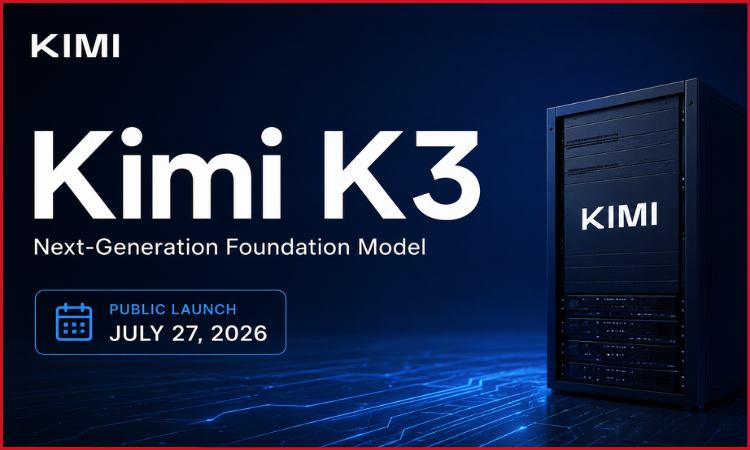
Beijing-based Moonshot AI on July 17, 2026 launched Kimi K3, a 2.8-trillion-parameter open-weight model it calls the world’s largest. The release drew immediate comparisons with the leading closed systems from Anthropic and OpenAI.
The model is live today on Kimi.com, the Kimi Work and Kimi Code apps, and the Kimi API. Full model weights are scheduled for public release by July 27.
Moonshot describes Kimi K3 as the first open model to reach the 3-trillion-parameter class.
It’s built on two in-house architectural updates the company calls Kimi Delta Attention and Attention Residuals, paired with a Mixture-of-Experts design that activates just 16 of 896 experts at a time. Moonshot says this delivers roughly 2.5 times the scaling efficiency of its earlier Kimi K2 model.
K3 also ships with native vision capability and a 1-million-token context window.
How it stacks up
Moonshot frames the release with a caveat: it says K3’s overall performance still trails Anthropic’s Claude Fable 5 and OpenAI‘s GPT 5.6 Sol. But it claims K3 consistently beats every other model it tested, including Claude Opus 4.8 and GPT 5.5.
To back this, the company points to internal case studies rather than leaderboard scores alone.
In a 24-hour GPU-kernel optimisation test on Nvidia H200 and rival hardware, Moonshot says K3 matched Fable 5 and beat Opus 4.8, GPT 5.6 Sol and GPT 5.5. In a separate test, K3 reportedly built a Triton-like GPU compiler, MiniTriton, from scratch — with performance the company says rivals Nvidia’s own Triton stack on some workloads.
Moonshot also cites a nano-scale chip designed and verified autonomously in a single 48-hour run, and a research task where K3 reproduced a set of astrophysics relations by cross-checking 20-plus papers and generating over 3,000 lines of code — work the company says would typically take a researcher one to two weeks.
What it costs
Through the Kimi API, K3 is priced at $0.30 per million tokens for cache-hit input, $3.00 per million tokens for cache-miss input, and $15.00 per million tokens for output.
Moonshot credits this pricing to a disaggregated inference system, built on its Mooncake architecture, that it says keeps cache-hit rates above 90% on coding workloads. The company recommends deploying K3 on hardware clusters of 64 or more accelerators.
Moonshot’s blog post also lists limitations.
K3 was trained to rely on a preserved “thinking history,” and switching an in-progress session to K3 from another model — or using a harness that doesn’t pass back full thinking content — can make its output unstable, the company warns.
Moonshot also cautions that K3 tends toward “excessive proactiveness” on long, ambiguous tasks, making decisions on a user’s behalf unless developers set tighter constraints. It further acknowledges a “noticeable gap” in overall user experience compared with Fable 5 and GPT 5.6 Sol.
The release landed days after a Financial Times report suggested K3 was built to close the gap with Anthropic’s Opus 4.8. It follows a string of earlier Kimi releases — K2, K2 Thinking and K2.5 — that had already narrowed the distance between China’s open-weight models and the leading US labs.