In March 2026, a consortium of the Aditya Birla Group, the Times of India Group, Bolt Ventures and Blackstone paid close to INR 16,660 crore (USD 1.78 billion) for Royal Challengers Bengaluru. This franchise cost its original bidder a fraction of that in 2008.
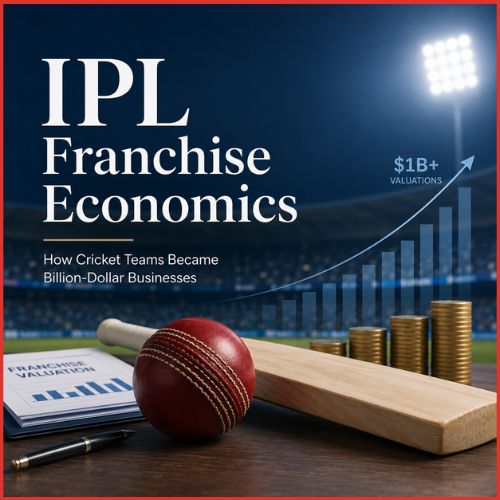
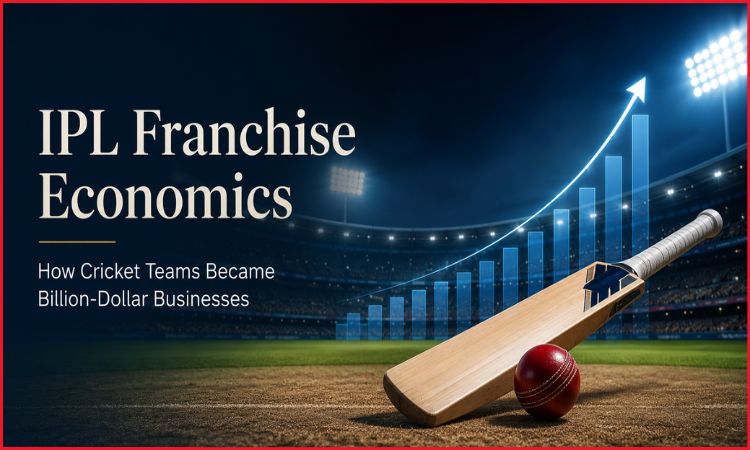
Lalit Modi built the league that year around one idea: sell cricket like a media property. That idea still drives IPL franchise economics today; the league’s business enterprise value hit USD 18.5 billion in 2025, up 12.9 percent year-on-year, per Houlihan Lokey. This piece covers the IPL team business model, the main IPL franchise revenue sources, how IPL team valuation is calculated, and where this cricket franchise business is headed next.
Quick Glance
| Founded | 2008 by the BCCI; founding chairman Lalit Modi |
| Franchises | 10 |
| League Enterprise Value (2025) | USD 18.5 billion, up 12.9% YoY (Houlihan Lokey) |
| Most Valuable Franchise (2025) | RCB, USD 269 million brand value |
| Highest Franchise Sale | RCB, USD 1.78 billion (March 2026) |
| Current Media Rights Deal | INR 48,390 crore / USD 6.2 billion, 2023-27 |
| Title Sponsor | Tata Group, USD 300 million through 2028 |
How The IPL Franchise Business Model Works
Every franchise balances two revenue tracks: one it controls, one it doesn’t.
Central Vs. Franchise-Controlled Revenue
The BCCI collects the league’s biggest cheques, mainly media rights, and redistributes a fixed share regardless of commercial performance. Everything else, from sponsorship to food stalls, is sold and kept by the franchise – the IPL team business model in short: guaranteed income up top, hustle underneath.
How Franchise Ownership Works
Teams are owned by private companies or consortia under long-term BCCI agreements, rarely by public shareholders. Chennai Super Kings is the exception: its parent became India’s first listed sports franchise, crossing a market cap of roughly ₹7,600 crore in 2022.
Why The Model Attracts Investors
Investors like predictable income layered with brand upside. A fixed media rights share behaves like an annuity, while sponsorship and merchandise offer margin that grows with fan engagement – why Reliance, Adani, and GMR keep expanding cricket holdings.
Major IPL Franchise Revenue Sources
Five income streams make up nearly every franchise’s books.
Media Rights
Broadcast and digital deals form the single largest income source for every team, distributed centrally rather than earned individually; the one line item every franchise can budget around, win or lose.
Sponsorship And Advertising
Jersey branding, stadium hoardings, and digital placements are negotiated directly by each franchise, the most competitive layer of IPL sponsorship and advertising revenue, where bigger fan bases out-earn weaker performers.
Ticket Sales
Matchday revenue depends on stadium capacity, pricing, and home fixtures a smaller slice than media rights but one franchise fully controls.
Merchandise And Licensing
Jerseys, caps, and licensed fan gear generate steady income tied to brand loyalty, letting older franchises like Mumbai Indians and Chennai Super Kings out-sell newer teams.
Digital Revenue
Streaming, apps, and fantasy-sports tie-ups add a growing digital layer, scaling with viewership rather than stadium size.
How IPL Team Valuation Reached Billion-Dollar Levels
IPL team valuation is where franchise economics gets contested — two respected valuers, two different numbers, every year.
Franchise valuation factors
Two rival estimates circulate each year: Houlihan Lokey put the league at USD 18.5 billion in 2025 using a brand-value model (media reach, sponsor diversity, viewership); D&P Advisory, using a profit-based approach, put it lower at ~USD 8.8 billion, its second straight annual decline. Check the methodology before comparing figures year to year.
Brand value and fan base
RCB topped the 2025 brand rankings at USD 269 million, ahead of Mumbai Indians (USD 242 million) and Chennai Super Kings (USD 235 million); Punjab Kings grew fastest, up 39.6%, on a 2025 final run.
Investor interest
Diageo had flagged its RCB stake for “strategic review” as a non-core asset months before selling, a sign of a maturing secondary market for franchise stakes, not just one-way capital inflow.
Recent billion-dollar franchise deals
| 2008 Value | ~USD 111 million |
| Revenue Before Sale | INR 504 crore (latest season) |
| 2025 Brand Value | USD 269 million |
| March 2026 Sale Price | USD 1.78 billion |
| Seller | United Spirits (Diageo India) |
The buyer’s math priced RCB at over 20 times core revenue — a multiple that holds only if media rights and brand value keep compounding.
The Economics Behind IPL Media Rights & Sponsorships
A closer look at how IPL media rights revenue and sponsorship money are actually structured and split.
₹48,390 crore media-rights deal
Disney Star paid INR 23,575 crore for TV rights (2023-27); Viacom18 paid INR 23,758 crore for digital, the first time in Indian sport digital outsold TV, and nearly triple the previous cycle’s value.
Central revenue distribution
The BCCI splits this money evenly across all ten franchises regardless of market size or performance, anchoring the 50-60% central-pool share of team income.
Team sponsorships
Tata holds the league title sponsorship (~USD 300 million through 2028); franchises separately run their own jersey, stadium and city-level sponsorship deals.
Advertising and commercial partnerships
The 2025 season drew 425+ advertisers, over 270 of them first-timers, across 40 categories; IPL 2026 added Google, Amazon, Uber, Skoda, OpenAI and P&G, reflecting advertisers treating the IPL as a category-agnostic reach platform.
The Future of IPL Franchise Economics
Global expansion
The BCCI is weighing an earlier 2027 season window (to dodge summer heat) and a 94-match, home-and-away format from 2028, without new franchises for now. Adelaide Oval has proposed hosting an IPL match in March 2027 – only the fifth time the league would be played outside India.
Digital monetisation
JioStar’s FY27 Q1 results show growth shifting from ads toward commerce and AI engagement: 530 million average monthly JioHotstar users (+15% YoY), regional-language digital watch time up 33%, and in-match features like Swiggy ordering and OpenAI voice search.
Women’s cricket
The WPL, built on the same central-pool model, was valued at ~USD 1.5 billion in 2025 despite a 5.6% dip on softer sponsorship spend – average team values of USD 100-150 million and sponsors like Tata and Dream11 suggest it’s maturing into its own commercial property.
Rising franchise valuations
Teams worth USD 67-112 million in 2008 carried brand values above USD 200 million by 2025, and RCB sold for USD 1.78 billion in 2026 a trajectory that depends on media rights and brand value continuing to outgrow league costs.
IPL as a global sports-business model
The IPL’s central revenue-sharing design is now studied by other leagues weighing similar structures; see how it compares in our roundup of the richest sports leagues in the world.
Risks in the IPL Business Model
- Media rights dependency: roughly half of league income sits in one five-year contract.
- Regulatory exposure: gaming, betting-adjacent and fintech sponsors face tightening ad rules.
- Ownership churn: RCB, Rajasthan Royals and others have changed hands for parent-company reasons, not team performance.
Conclusion
IPL franchise economics work because the league solved a distribution problem before a cricket one: pool the biggest revenue line centrally, let franchises compete on everything else. That’s why a USD 67-112 million team in 2008 can sell for near USD 2 billion today – and why this IPL team business model, and the cricket franchise business it inspired, is now extending into digital commerce, a bigger match calendar and a fast-growing women’s league.
Frequently Asked Questions
1. What is the current IPL team valuation?
Ans. USD 18.5 billion in 2025 per Houlihan Lokey, though D&P Advisory’s profit-based method puts it lower.
2. What is the biggest of all IPL franchise revenue sources?
Ans. Central media rights distribution – roughly 50-60% of a franchise’s annual income.
3. Most valuable franchise in 2025?
Ans. RCB, at USD 269 million brand value, ahead of Mumbai Indians and Chennai Super Kings.
4. What did the 2023-27 media rights deal sell for?
Ans. INR 48,390 crore (~USD 6.2 billion), split between Disney Star and Viacom18.
5. Why did Diageo sell RCB?
Ans. United Spirits called cricket a non-core asset and sold it in March 2026 for ~USD 1.78 billion.
Read also: How IPL Teams Earn Money