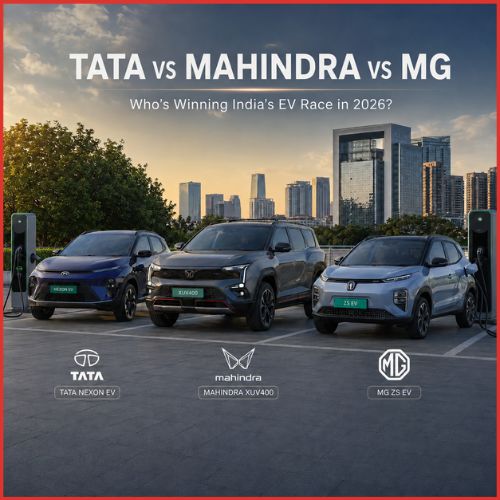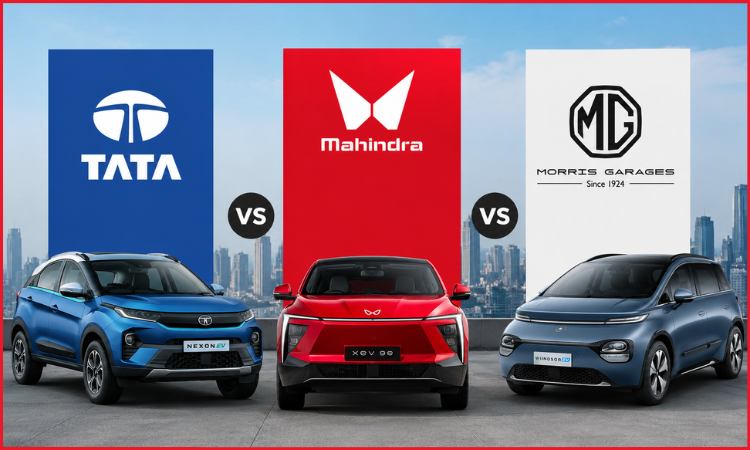
Tata, Mahindra, and MG are the three names actually deciding how India’s EV market shapes up in 2026, and the gap between them has narrowed a lot faster than most people expected. A silent commute past a fuel station without a second thought. An electric SUV pulling away from a highway queue on pure torque, no drama, no downshift. What used to be a curiosity for early adopters in Bengaluru or the NCR has become the default choice in plenty of tier-2 and tier-3 towns too. This isn’t a promise anymore — it’s just how a growing share of the country drives.
Three things converged to make that happen: battery manufacturing moved local and got cheaper, charging infrastructure spread well past the big expressways, and prices finally started closing in on comparable petrol and diesel cars. Tata Motors, Mahindra & Mahindra, and JSW MG Motor India are the three manufacturers fighting hardest over the result, and each is running a genuinely different playbook to get there.
Here’s where all three actually stand in 2026 — their strategies, their flagship products, and what the sales numbers say about who’s actually ahead.
How We Evaluated the Contenders
Hype is easy to come by in this segment; useful signals are not. So the comparison sticks to four things that actually move the needle:
- Market share and sales volumes — registration data and growth trends, tracked consistently rather than cherry-picked.
- Platform architecture — whether a car rides on a converted ICE platform or a purpose-built “Born Electric” one.
- Pricing and ownership innovation — Battery-as-a-Service programs, local supply chains, and how low the entry point really goes.
- Charging and ecosystem support — dedicated networks, dealership readiness, and whether service actually holds up outside the metros.
1. Tata Motors
Market Share (H1 2026): 39%
Best Known For: First-mover advantage, mass-market volume, and deep infrastructure integration.
Tata built the foundations of Indian EV adoption almost single-handedly, starting with the Nexon EV and Tiago EV — both converted ICE platforms, chosen deliberately to keep costs down while the market was still finding its feet. By 2026, the company had moved on to dedicated architectures, bringing the Punch EV and the long-awaited Sierra EV to market. In the first half of the year alone, Tata sold north of 57,000 EVs.
What really sets Tata apart is how much of the surrounding ecosystem Tata Group controls. Tata Power handles a huge share of public charging installation, and Tata AutoComp keeps component sourcing local. That end-to-end grip translates directly into buyer confidence — service reach in smaller cities is something competitors are still catching up on.
The one thing that’s changed: Tata no longer commands the 80%+ near-monopoly it once had. Competition has eaten into that dominance steadily, even as raw volume keeps setting monthly records.
Key Takeaway: Tata is still the volume king. Its range runs from hatchbacks to SUVs, which makes it the easiest on-ramp for a first-time EV buyer.
2. Mahindra & Mahindra
Market Share (H1 2026): 23%
Best Known For: High-performance electric SUVs, dedicated “Born Electric” (INGLO) platforms, and aggressive growth.
Mahindra took the opposite route — deliberately late, deliberately patient. Instead of rushing out a modified ICE platform to compete early, it poured its R&D into the ground-up INGLO architecture and waited.
That patience is paying off now. Mahindra’s “Born EV” lineup — aggressive styling, genuinely capable software — grew a startling 147% year-on-year in H1 2026, crossing 34,000 units sold. The XEV 9e, the BE 6, and the three-row XEV 9S between them pushed the brand solidly into second place.
There’s no ultra-budget option under ₹10 lakh here, and that’s a real gap. But the focused push into mid-to-premium SUVs has been enough to knock MG out of the number two spot.
Key Takeaway: Mahindra is the fastest-growing name in the performance and mid-size SUV segments, betting on high-margin vehicles built on genuinely purpose-designed electric platforms.
3. JSW MG Motor India
Market Share (H1 2026): 21%
Best Known For: Disruption via Battery-as-a-Service (BaaS), tech-loaded interiors, and diverse form factors.
MG has been the most willing to break convention. Rather than compete on the usual terms, it introduced a Battery-as-a-Service model that separates the battery cost from the price of the car itself — effectively bringing the upfront cost of an EV down to something that competes directly with an equivalent petrol car.
The lineup spans a genuinely wide range: the compact Comet EV for city driving, the Windsor EV crossover doing most of the heavy lifting on volume, and premium halo models like the Cyberster and the M9 MPV at the top end. The Windsor alone moved around 19,000 units in H1 2026.
The catch is perception — buyers are still working out how they feel about long-term battery rental logistics, and resale value on BaaS models remains a bit of a grey area. That hasn’t stopped shoppers chasing feature-heavy cabins at a lower entry price from flocking to the brand anyway.
Key Takeaway: MG is the disruptor of the group. Its pricing model and interior-first approach make it a real alternative to the legacy domestic players.
Quick Comparison of India’s EV Leaders
| Brand | Primary Focus Category | Standout Strengths | Weaknesses / Challenges |
|---|---|---|---|
| Tata Motors | Mass market (Hatchbacks, Compact & Mid SUVs) | Nationwide service reach; integrated charging network; broader price coverage | Market share dilution from new entrants; tech glitches on earlier software suites |
| Mahindra | Performance SUVs & “Born EV” platforms | Purpose-built INGLO architecture; high real-world range; strong brand loyalty in SUV segments | Lack of budget options (under ₹12 lakh); longer waiting periods for top variants |
| JSW MG Motor | Urban mobility & tech-forward crossovers | Innovative BaaS financing models; feature-rich, lounge-style interiors; rapid execution | Complex battery-rental subscriptions; smaller tier-3 service footprint |
Strategic Playbooks: How Their Approaches Differ
Tata’s advantage was never really about the car sitting on the showroom floor — it’s about everything wrapped around it. Syncing production with Tata Power’s charging network, and leaning on Tata AutoComp for local sourcing, has built something close to a walled garden. For a practical buyer worried about long-term reliability, that’s exactly the kind of peace of mind that closes a sale.
Mahindra went the other direction entirely, skipping the quick-fix conversions altogether to build dedicated EV platforms from scratch. Optimized battery placement, rear-wheel-drive dynamics, genuinely fast charging — the whole approach is aimed at buyers who won’t compromise on how the car actually drives or how much room it gives them.
MG’s read on the market was simpler but no less sharp: the upfront price tag is still the single biggest thing keeping Indian buyers out of EVs. BaaS turns the most expensive part of the car — the battery — from a lump-sum cost into a running, per-kilometer expense. That one shift has opened the door to buyers who’d otherwise have written off electric mobility as unaffordable.
The Verdict: Who Is Winning in 2026?
It genuinely depends on what “winning” means to you.
By raw volume, it’s still Tata — 39% market share in H1 2026, and the widest nationwide reach of the three. By momentum, it’s Mahindra, whose Born-EV platform has let it storm into high-value SUV territory fast enough to overtake MG outright, on the back of 147% year-on-year growth. And by sheer willingness to rethink the rules, it’s MG — BaaS alone has forced the rest of the industry to reconsider how EVs get priced in the first place.
As local battery manufacturing scales further and newcomers like Maruti Suzuki and VinFast push into the market, India’s EV story is shifting from an early-stage scramble into something closer to a mature, clearly segmented market. Buyers aren’t stuck with basic conversions anymore — there’s a genuine option at nearly every price point, body style, and driving preference.
Frequently Asked Questions
Which company sells the most EVs in India?
Tata Motors, by a comfortable margin — roughly 39% of the market as of mid-2026, with the Punch EV and Nexon EV doing most of the heavy lifting.
What is the Battery-as-a-Service (BaaS) model offered by MG?
It lets you buy the car without paying for the battery upfront. Instead, you pay a rental or subscription fee tied to usage, often per kilometer, which brings the initial purchase price down significantly.
Is Mahindra catching up to Tata in EVs?
Yes, and quickly. Mahindra grew 147% year-on-year in H1 2026, enough to overtake MG and claim the second spot at 23% market share, largely on the strength of its new “Born Electric” SUV lineup.
Are there new EV brands entering India in 2026?
Yes — the field is getting more crowded. Maruti Suzuki has entered with the eVitara, and global entrants like VinFast are starting to pick up share as well.
Should I buy a Tata or Mahindra EV?
It comes down to budget and priorities. Tata covers a wider range, from affordable hatchbacks up through mid-size SUVs, backed by an extensive service network. Mahindra is leaning hard into premium, high-performance SUVs on dedicated EV platforms — the better pick if performance and cabin space matter more to you than price.