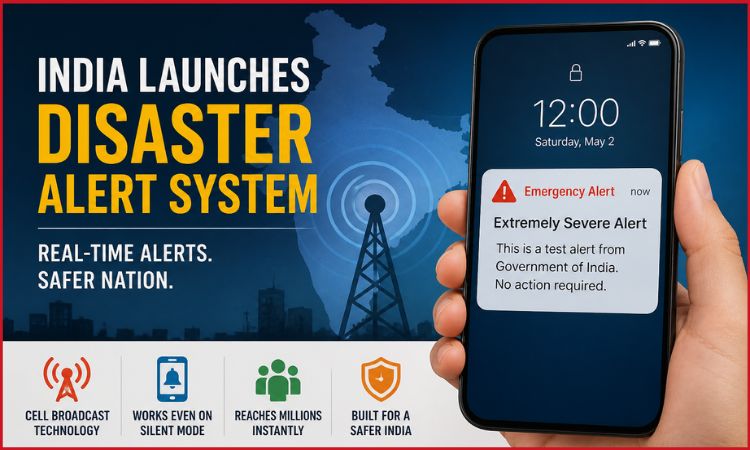
A new alert system that works even in network congestion, and even on silent mode
It was a regular Saturday for most Indians, until the government sent their phones blaring in an “extremely severe alert”. On May 2, millions of Indians picked up their phones to find an unusual notification staring back at them, blaring a loud alarm tone even on silent mode. It was a test alert — like a mock drill, only digital.
With this, India joins the US, Japan, and South Korea in having a national cell broadcast system. For context, the US has had Wireless Emergency Alerts since 2012. Japan’s system saved thousands during the 2011 tsunami.
A different level of crisis communication
Union Minister for Communications Jyotiraditya Scindia, under the guidance of Union Home Minister Amit Shah, launched this Cell Broadcast Alert System today. It is a homegrown, real-time disaster warning platform that marks a significant leap in how India communicates with its people during crises.
The message that flashed across phones read: “India launches Cell Broadcast using indigenous technology, for instant disaster alerting service for its citizens. Alert citizens, safe nation.”
A huge push to disaster management in India, the system did not emerge from nowhere. In fact, it’s indigenously built. At its core is SACHET — the Integrated Alert System developed by C-DOT, the R&D arm of the Department of Telecommunications — which has been operational across all 36 states and Union Territories and has disseminated over 134 billion SMS alerts in more than 19 Indian languages during cyclones, floods, and severe weather events. That is an enormous operational track record.
Now, SMS has limits. Networks congest precisely when disasters hit.
Cell Broadcast solves this differently.
Unlike regular SMS that clogs networks in a crisis, it blasts geo-targeted messages to every mobile device in a specific area simultaneously — via base stations, not the internet — reaching phones even when networks are overloaded. The new technology pushes messages directly to mobile devices even if they are on silent or do-not-disturb mode — a critical distinction when a tsunami warning needs to wake someone at 3 AM.
What makes today’s launch particularly significant is who built it. C-DOT has been entrusted with the indigenous development and implementation of this Cell Broadcast-based public emergency alert system — without dependence on foreign vendors or platforms. In a domain as sensitive as national emergency communication, that matters. The system follows the Common Alerting Protocol recommended by the International Telecommunication Union, ensuring global interoperability while remaining entirely domestically built and operated.
The system is designed to handle time-critical emergencies including tsunamis, earthquakes, lightning strikes, and man-made hazards such as gas leaks and chemical incidents — alerting only those in the affected geographic zone, not the entire country.
Tests began on April 29, covering major cities, with the full pan-India rollout launched today covering Delhi-NCR and all state and Union Territory capitals.
The system is designed to deliver disaster and emergency-related alerts directly to citizens’ mobile phones in real time. For a country of 1.4 billion people — many in disaster-prone coastal, riverine, and seismic zones — that is not a technical upgrade. It is infrastructure that saves lives.