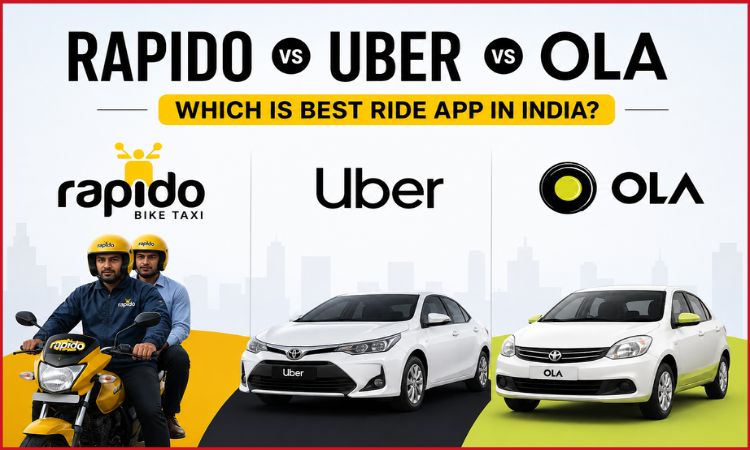
It is 8:45 a.m. in any Indian metro, and the daily commute has become a small negotiation with technology. One app promises speed, another promises familiarity, and a third promises a cheaper ride if you are willing to sit on two wheels. That is the real story of Rapido vs Uber vs Ola: not just a battle for bookings, but a fight to define what “affordable mobility” means in the India ride-hailing market. Uber, Rapido and Ola are all active across multiple ride formats. However they follow very different business models.
Rapido vs Uber vs Ola: How India’s Ride-Hailing Market Is Changing Beyond Cabs
The most important shift in India’s mobility market is that the category has stopped behaving like a simple cab business.
- Rapido built its identity around bike taxis and now offers bikes, autos and cabs.
- Uber in India offers autos, Moto rides and cabs, while Ola continues to position itself as a multi-modal platform spanning cabs, autos, rentals and outstation travel.
This matters because the winning platform is no longer defined by the biggest airport presence. It is the one that can serve the office commute, the college travel, the metro connection and the late-night trip home.
The regulatory backdrop also changed in 2025. The central Motor Vehicle Aggregator Guidelines updated the playbook around fare structures, cancellations and bike-taxi legality, while state-level enforcement remained uneven.
“At the same time, the market kept getting louder about fairness, the Indian government sent notices to Ola and Uber in January 2025 over allegations of different prices for iPhone and Android users, and Karnataka’s bike-taxi fight continued into 2026 with a fresh Supreme Court challenge from the state government.”
In other words, this is not a stable market. It is a moving target.
Here is a clear comparison of current market cap and annual revenue of the three companies:-
| Company | Valuation | Annual revenue | Profit/Loss | Status |
| Uber Technologies Inc. | ~$152-154 billion | $14.4 billion (Q4 2025 Annualized) | Profitable | Public(NYSE:UBER) |
| Rapido | ~$2.3 billion | $112 million (FY25) | Reduced losses | Private |
| Ola cabs | ~$1.88 billion | $211 million (FY24) | Profitable | Private |
Sources: Uber filings (FY2025), Reuters reporting, and industry estimates for Rapido and Ola (FY24–FY25).
Note: Rapido and Ola figures are based on publicly reported estimates as audited financials are not fully disclosed.
Rapido Business Model in India: Why It Wins in Low-Cost Bike Taxi Segment
Rapido’s smartest move was never trying to look like Uber first. It came from the bottom of the market and stayed there long enough to build a habit.
Its official positioning is blunt: low-price, comfortable and quick rides, with bikes at the center of the proposition. That is why Rapido has become so relevant in the bike taxi India conversation. For a commuter who is late for office, a bike is not a “cheap alternative”; it is often the only option that makes the trip economically and time-wise sensible.
- When a ride is short, urgent and price-sensitive, users do not want luxury; they want certainty.
- From a driver’s point of view, the attraction is equally clear: a model that reduces the feeling of being trapped by commissions and gives more control over earnings.
Reuters reported in 2025 that Rapido was entering food delivery with a fixed-fee model, signaling that the company is testing the same playbook outside mobility.
Uber in India: Pricing Strategy, Market Position & Localization Challenges
Uber still carries the advantage of brand recall and product breadth. In India, it offers autos, Moto rides, taxis and premium options across many cities, which gives it a broader service ladder than most competitors.
But the bigger story is that Uber has been forced to localize its economics.
- India is not a market that rewards generic global thinking. It rewards pricing clarity, quick ETAs, and enough driver supply to avoid cancellation fatigue.
- In February 2025, Reuters reported that Uber moved its Indian autorickshaw business to a zero-commission, subscription-based model, explicitly following the local rivals’ playbook.
That is a significant admission; Uber did not copy a local tactic; it acknowledged that India required a different monetization logic.
Ola Business Model in India: Zero Commission Strategy & Driver Trust Issues
Ola still matters because it was one of the first names to make app-based mobility mainstream in India. Its official site continues to emphasize a broad, multi-modal mobility platform, and its driver-facing ecosystem now leans heavily on a zero-commission story.
- In 2025, Ola said it had rolled out a zero-commission model across India, with drivers moving to subscription-style access instead of per-ride commission cuts.
The strategic logic is simple: if drivers feel they are earning more predictably, they are less likely to churn.
- Ola’s challenge is not visibility; it is consistency.
Ask a driver in Bengaluru what changed after Ola’s zero-commission rollout and the answer is rarely enthusiastic. The subscription fee arrived, but the ride volume didn’t always follow. In cities like Pune and Hyderabad, drivers began double-apping — keeping Ola running in the background while actively prioritising Rapido or Uber requests. Not because they hate the platform, but because trust, once worn down by years of fluctuating incentives and disputed surge payouts, doesn’t snap back on the strength of a press release.
- In the ride-hailing competition India scene, legacy brands often struggle when users perceive uneven service quality, unpredictable pricing or weaker trust in dispatch reliability.
The question is whether the market sees Ola as an integrated mobility platform or just another app that sometimes works better than the others.
Rapido vs Uber vs Ola: Pricing, Driver Earnings & Trust Comparison
“Rapido vs Uber vs Ola: which is better in India”
At the surface, all three compete on price. At a deeper level, they compete to sustain thin margins.
- Rapido is strongest where the trip is short and price sensitive.
- Uber is strongest where the user wants breadth, familiarity and a globally polished product.
- Ola is strongest where legacy usage and driver incentives still matter.
But none of them can ignore the same three truths: India is price conscious, drivers are increasingly aware of economics, and regulation can redraw the market overnight.
“Rapido vs Uber vs Ola: which is best for drivers in India”
To get a broader idea, let’s understand this scenario, where the rider works daily for approximately 8 hrs a day.
| PLATFORM | MODEL TYPE | COMMISSION/ FEE | ESTIMATED NET MONTHLY INCOME |
| Rapido | Zero commission/ subscription | ₹9-20 per day | ~ ₹7000+ |
| Uber (auto)/(cabs) | Zero commision/Pivoted to subscription (2025) | ₹120-140 per day | ~ ₹6200 – ₹6300 |
| Ola | Subscription/ zero commision | ₹67 per day | ~ ₹6000+ |
These figures account for fuel, maintenance, insurance, and applicable platform fees. (Rough estimates), Via Claude Ai.
As of April 2026, Ola and Uber are trying to make some changes in their models, to attract more drivers and head towards profits.
Conclusion
The next phase of the India ride-hailing market will likely be decided by three forces: regulation, driver economics and category expansion.
- If bike taxis get clearer legal standing in more states, Rapido’s model becomes more powerful.
- If subscription-led driver economics become the industry norm, Uber and Ola lose one of their old advantages.
- And if platforms keep branching into food delivery, rentals, outstation rides and electric mobility, the market stops being a cab war and starts becoming an urban logistics war.
In my opinion, India does not end up with one dominant ride-hailing champion. It ends up with different winners for different jobs. Rapido may own the short, cheap, fast commute. Uber may own the trust premium. Ola may still matter where legacy reach and driver economics meet.
In the end, there may not be one clear winner. Instead, the answer to which is better—Rapido, Uber or Ola in India depends on your priority: price, convenience, or trust.
Frequently asked questions:
1.Which is cheaper: Rapido, Uber or Ola for daily commute in India?
If your commute is short (3–8 km), Rapido usually wins on price, especially with bike taxis. It cuts through traffic and keeps fares low.
2. Is Rapido safe compared to Uber and Ola?
Safety is less about the brand and more about execution on the ground.
Uber has a strong global safety framework and in-app tracking features, Ola offers similar safety tools but consistency varies by city and Rapido has improved safety features, but bike taxis feel more exposed to some users.
3. Why is Rapido growing so fast in the bike taxi India segment?
Rapido understood one simple truth: India doesn’t just need cabs—it needs faster, cheaper mobility.
Bike taxis solve three real problems:
- Traffic (they move faster)
- Cost (almost half of cab fares)
- Availability (easier to find in crowded areas)
4. Which platform is better for drivers: Rapido, Uber, or Ola?
From a driver’s perspective, this is where the real battle is happening.
- Rapido: Often preferred for lower commission pressure and simpler earnings
- Uber: More ride volume, but earnings depend heavily on demand and incentives
- Ola: Moving towards zero-commission models, but driver trust is still rebuilding