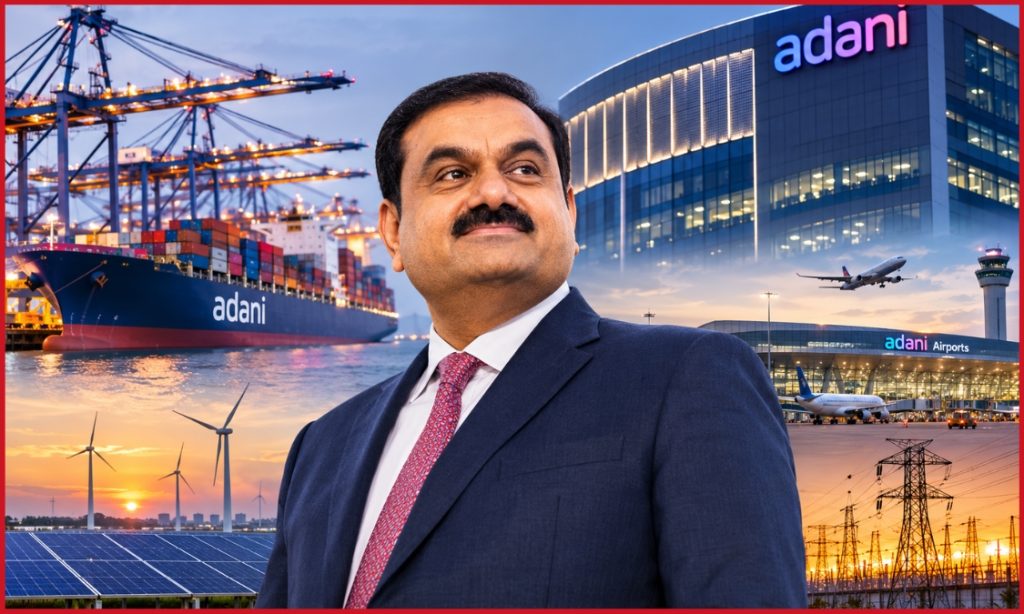
Not many entrepreneurs change the face of a nation’s infrastructure. Gautam Adani has done exactly that. Starting with a small trading firm in 1988, the Adani Group has grown into one of India’s largest business conglomerates, with interests spanning ports, airports, power generation and transmission, renewable energy, logistics, cement, and several other business sectors across multiple countries.
The organization’s expansion did not happen overnight. Rather, it resulted from a clearly defined business strategy. Instead of initially expanding into consumer-focused industries, Gautam Adani concentrated on building businesses in trade, logistics, transportation, energy, and infrastructure that form the backbone of economic growth.
In FY2026, the Group continues expanding across both traditional businesses and emerging sectors such as renewable energy, green hydrogen, AI-ready data centres, and proposed nuclear power projects.
Now, here’s how Gautam Adani transformed the Adani Group into one of India’s largest business empires.
Quick Glance
| Category | Details |
| Founder | Gautam Adani |
| Founded | 1988 (as Adani Exports Limited) |
| Headquarters | Ahmedabad, Gujarat, India |
| Industry | Infrastructure Conglomerate |
| Core Businesses | Ports, Airports, Logistics, Power, Renewable Energy, Cement, Mining, City Gas, Transmission, Data Centres, Defence, Media, Roads, Food |
| Flagship Company | Adani Enterprises Limited |
| Business Presence | Operations and investments across India and multiple international markets |
| FY26 Group EBITDA | ₹94,834 crore (Record High) |
| FY26 Capital Expenditure | ₹1.53 lakh crore |
| Growth Strategy | Vertical Integration, Infrastructure-First Approach, Strategic Acquisitions, Long-Term Investments |
| Major 2026 Focus | Renewable Energy, Green Hydrogen, AI-Ready Data Centres, and the proposed 10 GW Nuclear Power Plan by 2035 |
Who Is Gautam Adani?
Gautam Adani didn’t inherit a business empire—he built one by identifying opportunities where others saw challenges. Born on 24 June 1962 in Ahmedabad, Gujarat, he grew up in a middle-class Jain family. Instead of following a conventional career path, he chose business over completing his college education, believing that real-world experience could teach him more than a classroom.
His first major learning came in Mumbai, where he worked as a diamond sorter. The job introduced him to the world of trading, negotiation, and international markets. Later, after returning to Ahmedabad, he joined his brother’s plastics business, where he gained hands-on experience in imports, exports, and supply chain operations. These early experiences helped shape his entrepreneurial mindset.
In 1988, Adani started a small commodity trading company that would eventually become the Adani Group. Rather than chasing quick profits, he focused on building businesses that supported India’s long-term infrastructure needs. This vision transformed him into one of the richest people in India and made the Adani Group a global name in ports, airports, energy, logistics, and several other critical industries by 2026.
The Birth of the Adani Group
Gautam Adani founded Adani Exports Limited in 1988. The company initially focused on importing and exporting agricultural products, polymers, and other commodities.
The timing was significant. As India gradually liberalised its economy, private companies found new opportunities to participate in global trade.
Rather than remaining only a trading company, Adani reinvested profits into infrastructure. He recognised that controlling logistics and transportation infrastructure would create long-term competitive advantages beyond commodity trading alone.
The Business Strategy Behind Adani’s Growth
The infrastructure-first approach is perhaps the single biggest reason behind the Adani Group’s growth.
Instead of operating as a collection of unrelated businesses, the Group has built an integrated ecosystem where different businesses support one another.
Vertical integration means controlling multiple stages of the value chain instead of depending heavily on third-party companies. This allows the Group to improve operational efficiency, reduce costs, and strengthen long-term competitiveness.
For example, ports connect with logistics businesses. Logistics operations support warehouses and industrial parks, which in turn serve manufacturing facilities, power plants, and export businesses. The Group’s energy companies then supply electricity to industries and urban developments, creating an interconnected business ecosystem.
Another major strength is the Group’s focus on vertical integration. Rather than depending on multiple external partners, Adani builds capabilities across the value chain—from power generation and transmission to logistics, ports, and distribution—through closely connected businesses.
Major Businesses That Power the Adani Group
The Adani Group operates across several high-impact industries, with each business contributing to an integrated infrastructure ecosystem that supports India’s long-term economic growth.
Ports and Logistics
Ports form the foundation of the Adani Group’s infrastructure business.
Through Adani Ports and Special Economic Zone (APSEZ), the Group operates India’s largest commercial ports network. Handling millions of tonnes of cargo every year, these ports connect India with global trade routes.
Its logistics business also includes rail terminals, inland transportation, warehousing, and multi-modal logistics parks.
Together, these businesses create an integrated supply chain that supports manufacturers, exporters, and importers across the country.
Airports
The Adani Group is India’s largest private airport operator.
It manages major airports including Mumbai, Ahmedabad, Lucknow, Jaipur, Guwahati, Mangaluru, and Thiruvananthapuram.
Rather than viewing airports solely as transportation hubs, the Group develops integrated commercial ecosystems that include retail, food and beverage, hospitality, cargo handling, and digital services, creating multiple revenue streams beyond passenger traffic.
Energy and Utilities
Energy is one of the Adani Group’s core business pillars.
Its diversified portfolio spans thermal power, renewable energy, electricity transmission, city gas distribution, and power distribution.
The Group also continues investing heavily in solar manufacturing, renewable energy infrastructure, and green hydrogen projects, making it one of the world’s leading renewable energy developers.
In FY2026, the Group is also pursuing its long-term plan to develop up to 10 GW of nuclear power capacity by 2035, complementing its existing investments across thermal, renewable, hydro, gas, and transmission infrastructure.
Cement and Building Materials
Following the acquisition of Ambuja Cements and ACC, the Adani Group has significantly strengthened its presence in India’s construction sector.
These acquisitions have positioned the Group among India’s largest cement producers while strengthening its presence in the Indian Cement Industry.
The expansion also complements the Group’s infrastructure businesses by creating operational synergies across construction, transportation, logistics, ports, and industrial development.
Strategic Acquisitions Accelerate Growth
Although organic expansion remains central to the Adani Group’s strategy, every major Gautam Adani acquisition has played a significant role in accelerating the Group’s growth and strengthening its integrated infrastructure ecosystem.
Rather than acquiring businesses indiscriminately, the Group focuses on companies that strengthen its integrated infrastructure ecosystem.
One of its biggest milestones came in 2022, when it acquired the Indian operations of Holcim, including Ambuja Cements and ACC. The acquisition immediately positioned the Adani Group among India’s largest cement producers.
The acquisition also strengthened the Group’s vertical integration strategy. Cement is a critical input for highways, ports, airports, industrial parks, and large infrastructure projects. By expanding into building materials, the Group increased control across another important part of the infrastructure value chain.
The Group also acquired a controlling stake in NDTV, marking its entry into the media sector. Although the media differs from traditional infrastructure businesses, the acquisition expanded the Group’s presence across multiple industries.
Rather than diversifying for the sake of expansion, the Adani Group acquires and invests in businesses that support India’s long-term economic development.
Expanding Beyond India
The Adani Group’s growth extends well beyond India.
Its businesses operate across Asia, the Middle East, Africa, Australia, Europe, and North America through investments, strategic partnerships, trading activities, and infrastructure projects.
The Group manages international supply chains, supports global trade, invests in overseas mining operations, and develops renewable energy projects to meet growing global energy demand.
This international diversification reduces dependence on any single market while strengthening the Group’s position across global supply chains.
Financial Growth Reflects Long-Term Execution
For FY2026, the Group reported a record EBITDA of ₹94,834 crore, driven by strong performance across its infrastructure, utilities, logistics, and energy businesses.
The Group also invested ₹1.53 lakh crore in capital expenditure during FY2026, representing one of the largest annual infrastructure investment programmes undertaken by an Indian corporate group.
Adani Enterprises, the Group’s flagship incubator company, reported an FY2026 EBITDA of ₹16,464 crore, with nearly 80% contributed by its core infrastructure and utility businesses.
Investing in the Next Generation of Infrastructure
The Adani Group is expanding beyond its established businesses by investing in industries expected to shape the future of the global economy.
Renewable energy continues to be one of the Group’s biggest priorities. It continues expanding its solar, wind, green hydrogen, and integrated clean energy projects.
In addition, it is also expanding its AI-ready data centre business to meet the growing demand for digital services, cloud computing, and artificial intelligence in India.
Another major announcement in 2026 is the Group’s plan to develop 10 GW of nuclear power capacity by 2035, complementing its existing portfolio across thermal, hydro, gas, renewable energy, and electricity transmission.
Challenges Along the Way
Like most global business groups, the Adani Group has faced significant challenges.
In 2023, short-selling firm Hindenburg Research published a report alleging governance and accounting irregularities. The report resulted in a sharp decline in the market capitalisation of several Adani Group companies and triggered widespread market concerns.
The Adani Group rejected the allegations, describing the report as misleading. In the years that followed, the Group continued to strengthen transparency, reduce leverage across selected businesses, attract new investors, and maintain execution of major infrastructure projects.
In the following years, the Group reports stronger earnings while continuing to execute large-scale infrastructure projects.
Business Lessons from Gautam Adani’s Journey
For entrepreneurs and business leaders, Gautam Adani’s journey offers several valuable lessons.
- Build businesses that address long-term needs rather than short-term trends.
- Create an ecosystem where different businesses strengthen one another.
- Reinvest profits into assets that generate sustainable competitive advantages.
- Think decades ahead when making strategic investment decisions.
- Use acquisitions to strengthen existing businesses rather than diversify into unrelated sectors.
- Remain resilient during periods of uncertainty while continuing to execute long-term projects.
These principles have helped transform a small trading company into one of the world’s largest infrastructure groups.
Conclusion
Their journey demonstrates how a forward-looking vision, disciplined execution, and long-term thinking can build a global infrastructure empire.
Since starting as a commodity trading business in 1988, the Adani Group has built an integrated portfolio spanning ports, airports, logistics, thermal and renewable energy, cement, digital infrastructure, and several other core industries.
Despite the challenges it has faced, the Group continues to strengthen its competitive position through large-scale infrastructure execution, vertical integration, and diversification across complementary industries.
Frequently Asked Questions (FAQs)
1. What strategies is Gautam Adani deploying to transform the Adani Group into a global giant?
Gautam Adani has built the Adani Group with a long-term infrastructure-first strategy rather than focusing only on commodity trading. Through vertical integration, strategic acquisitions, and continual reinvestment of profits, the Group has expanded into ports, logistics, airports, energy, renewable energy, cement, and digital infrastructure, becoming one of the world’s leading infrastructure companies.
2. What is the core business strategy of the Adani Group?
The Adani Group follows an infrastructure-centric, vertically integrated business model. Instead of operating isolated companies, it builds interconnected businesses across ports, logistics, airports, energy, transmission, and industrial infrastructure. This improves efficiency, reduces costs, and creates long-term competitive advantages.
3. Which industries does the Adani Group operate in?
The Adani Group operates across ports, logistics, airports, power generation, renewable energy, electricity transmission, city gas distribution, cement, mining, roads, defence, data centres, digital infrastructure, media, and food products, making it one of India’s most diversified infrastructure conglomerates.
4. What are the Adani Group’s biggest achievements in 2026?
In FY2026, the Adani Group reported a record EBITDA of ₹94,834 crore and invested ₹1.53 lakh crore in capital expenditure. The Group also continued expanding renewable energy, green hydrogen, and AI-ready data centres, and announced plans to develop 10 GW of nuclear power capacity by 2035.
5. What lessons can entrepreneurs learn from Gautam Adani’s success story?
Entrepreneurs can learn the importance of thinking long term, investing in durable businesses, building integrated ecosystems, making strategic acquisitions, reinvesting profits into scalable assets, and remaining resilient during periods of uncertainty. These principles have helped the Adani Group grow into one of the world’s leading infrastructure businesses.