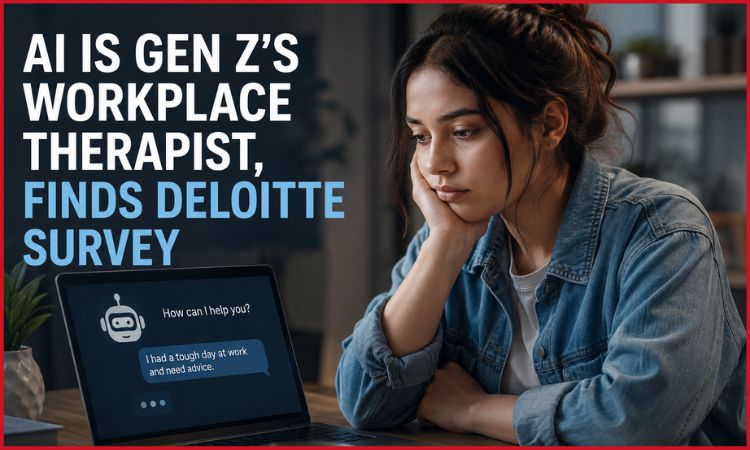
Have you ever turned to Artificial Intelligence (AI) to vent about a rough workday or seek advice about manager issues?
More than two-thirds of Gen Z and millennial workers across 44 countries are using artificial intelligence to cope with work-related stress, according to Deloitte’s 2026 Global Gen Z and Millennial Survey, released recently, marking a shift in how the world’s two largest working generations are seeking emotional and professional support outside traditional structures.
Beyond the to-do list
The survey, which polled more than 22,500 respondents, found that AI adoption at work has surged sharply in a single year: from 57% of Gen Zs and 56% of millennials reporting some use last year, to 74% across both generations in 2026.
But what is less reported is what they are using it for. Respondents said they are using AI to identify learning and development opportunities (79% of both generations), seek career advice (72% of Gen Zs and 69% of millennials), and cope with work-related stress (67% of Gen Zs and 65% of millennials). The data points to AI functioning as an always-on career counsellor and emotional outlet — not merely a productivity tool.
What organisations are not providing
The pattern becomes more pointed when set against what employers are failing to deliver. Around one-third of respondents said their employer is not sufficiently training employees on AI’s capabilities and value, and roughly 30% said their organisation is not prepared for the changes AI will bring.
Separately, more than half of Gen Zs (58%) and millennials (54%) reported experiencing digital fatigue, feeling overwhelmed by constant alerts and the need to navigate multiple platforms. The same technology ecosystem generating stress is, for many, also the place they are turning to relieve it.
A gap no manager is filling
The survey surfaces a structural explanation for why AI has stepped into this space. Only a minority of respondents — 28% of Gen Zs and 30% of millennials — believe managers should focus on guiding teams on how to integrate AI effectively, and even fewer think it is happening in practice (20% of Gen Zs and 21% of millennials).
Guiding teams on AI integration ranked at the very bottom of the list of responsibilities respondents believe their managers should prioritise. With financial pressure remaining the top concern for the fifth consecutive year, and roughly one-third of respondents reporting they feel anxious or stressed most or all of the time, the emotional labour is falling somewhere. Increasingly, chatbots are filling in for humans in EQ as well.