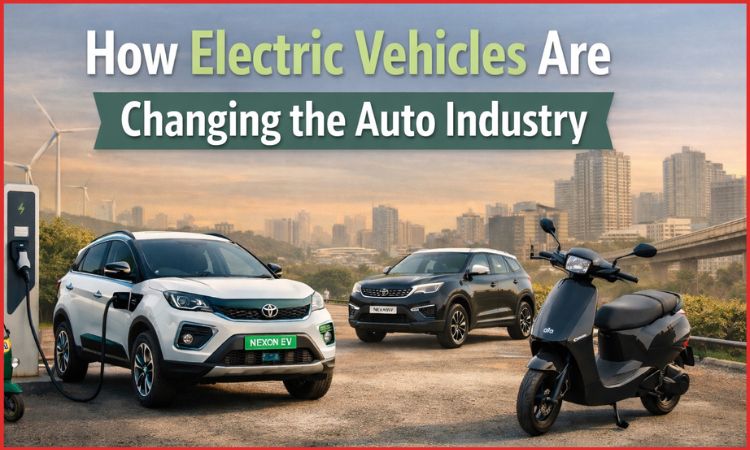
Drive through any major Indian city today and you don’t need a data report to tell you something has changed. A Nexon EV sits in the apartment parking lot where a Swift used to be. An Ola S1 threads through traffic with that distinctive electric whirr. Electric three-wheelers — once a rarity — now queue outside malls like it’s always been this way.
What’s remarkable isn’t just that electric vehicles in India have arrived. It’s how quickly they stopped being remarkable. Adoption has moved faster than the projections, and the industry is still catching up to what that actually means for everyone involved.
Why Electric Vehicles Are the Future of Transportation
The environmental case for EVs gets most of the headlines, but the numbers deserve a proper look. NITI Aayog’s 2023 report on India’s EV ecosystem estimated that meeting adoption targets by 2030 could eliminate up to 474 million tonnes of CO₂ emissions and reduce oil import bills by $14.5 billion every year. This transition isn’t just about emissions — it’s about energy security, manufacturing competitiveness, and what kind of industrial economy India wants to build over the next two decades.
Start with the basics. A petrol engine converts between 30 and 40% of fuel energy into movement — everything else bleeds away as heat and noise. An electric motor runs north of 90% efficiency from battery to wheel. Battery costs have fallen from over $1,000 per kWh in 2010 to under $100 today — a collapse that doesn’t just improve electric vehicles, it rewrites the economics of the entire segment. Governments have followed: several Indian states now have ICE phase-out timelines in motion, and automakers are putting electrification at the centre of capital allocation, whether they want to or not.
“The shift to electric mobility is not incremental. It is a full reset of how we build, sell, and think about cars.”
How Indian EV Companies Are Leading the Charge
Tata Motors: The Early Bet That Paid Off
Nobody in the industry will tell you they were certain the Nexon EV would work the way it did. It answered a question the market had been quietly asking: would Indian buyers back a domestic EV brand without a foreign nameplate? The answer was yes — and that wasn’t obvious before it happened. The broader Tata play goes further: Tata Power builds charging infrastructure, Agratas develops batteries in-house, and Tata Motors sells the vehicles. Full vertical integration across the EV value chain is rare globally and carries its own execution risks, but as a strategic ambition, it’s difficult to criticise.
Ola Electric & Mahindra: Challengers With Different Bets
Ola Electric’s 2021 launch was aggressive — direct-to-consumer, no dealer network, online-first. The traditional auto establishment treated it with open scepticism. Then the volumes came, and the scepticism became grudging acknowledgement. Long-term customer satisfaction remains under close watch, but the market position is real. Mahindra arrived later but brought a genuinely serious platform: INGLO underpins both the BE 6 and XEV 9e, targeting buyers who might otherwise have considered European crossovers. The product credentials are strong. Consistent delivery at scale is the question still being tested.
Ather Energy & Bajaj Chetak: Getting the Details Right
Ather Energy has perhaps made the least noise while doing some of the most methodical work. Backed by Hero MotoCorp, it built the Ather Grid charging network alongside its vehicles — not as an afterthought but as part of the core product. Range anxiety isn’t really about range; it’s about confidence. Bajaj’s decision to revive the Chetak name as an electric scooter was either inspired or risky, depending on who you asked. Early sales have been solid — there’s clearly a segment that wants an EV with heritage rather than novelty.
“An electric drivetrain has roughly 20 moving parts. A petrol engine has over 2,000. That simplicity is quietly changing who gets to build vehicles — and who gets left behind.”
EV Charging Infrastructure in India: Progress and Gaps
Talk to an EV owner in Delhi or Bengaluru and you’ll hear something that might surprise you: range anxiety, for them, is largely a solved problem. Overnight home charging has become routine. Travel to Patna or Jodhpur and the conversation changes completely. In Tier-2 cities, public charging points are thin on the ground, and for apartment residents without dedicated parking, home charging isn’t even an option. That gap — between the metro experience and the Tier-2 reality — is where the next chapter of Indian EV adoption will actually be written.
Tata Power, ChargeZone, and Statiq are expanding networks with FAME scheme support, but fast DC chargers along intercity highways remain sparse. The operators who close that gap at real scale aren’t just building a business — they’re shaping Indian mobility for a generation, much as early fuel networks shaped automobile adoption in the 20th century.
Electric Vehicle Market in India: What the Numbers Show
India’s EV growth is being led by two-wheelers and three-wheelers, not cars — and that makes complete sense. An auto-rickshaw driver covering 150 km daily on electricity saves dramatically more relative to income than a private car owner doing 30. Fleet operators have done that calculation and are acting on it. India’s EV market hit $18.79 billion in 2025, with analysts projecting it crossing $31 billion in 2026. EV passenger vehicle sales jumped 51% year-on-year in January 2026 alone. Tata Motors holds roughly 43% share in the electric passenger car segment — a commanding position that Mahindra, MG, and others are actively working to erode.
The complexity beneath these numbers is real. Battery supply chains are entangled with geopolitics in ways the petrol supply chain never was — lithium, cobalt, and rare earth processing are concentrated in a handful of countries. Software-defined vehicles introduce cybersecurity questions regulators are still working through. And legacy component manufacturers face a painful transition; the capabilities needed for fuel injectors are largely different from those for battery management systems, and not every company navigating that shift will survive it.
Where India’s EV Industry Stands — and What Comes Next
This is a mid-plot story, not a finished one. Tata, Mahindra, Ola Electric, Ather, and Bajaj have staked out real positions — real products, real revenues, real customers. But competitive rankings are still fluid, consumer confidence outside major metros is still being built, and execution hasn’t always matched stated ambition. What isn’t in doubt is the direction. Whether the next three to five years bring acceleration or messier consolidation will depend on how fast charging infrastructure reaches Tier-2 cities, how quickly battery costs continue to fall, and how well the industry earns the trust of buyers who haven’t yet leaped. The urban early adopter is won. Everyone else is still watching.
Frequently Asked Questions About Electric Vehicles in India
Q: Are electric vehicles cheaper than petrol cars in India?
A: Not upfront — but the ownership picture over time is a different calculation. Electricity typically costs 5–7 times less per kilometre than petrol, and maintenance is significantly lower. Over five years, most EV buyers recover the price premium through fuel and service savings.
Q: What is the best electric car to buy in India in 2026?
A: The Tata Nexon EV remains the default answer for most buyers — solid range, a reliable service network, and genuine value. At the premium end, the Mahindra BE 6 has been turning heads with its 500+ km claimed range and a platform that competes with European crossovers.
Q: Is EV charging infrastructure adequate in Indian cities?
A: In the major metros — Delhi, Mumbai, Bengaluru, Hyderabad — the answer is increasingly yes. In Tier-2 cities and along highway corridors, it’s honestly not there yet. Tata Power, ChargeZone, and Statiq are expanding, but if you’re in a smaller city without home charging, the situation requires more planning than it should.
Q: Do electric vehicles require less maintenance than petrol cars?
A: Significantly less. An EV drivetrain has around 20 moving parts versus over 2,000 in a petrol engine — no oil changes, fewer brake replacements due to regenerative braking, and considerably lower total servicing costs. For commercial fleet operators running high daily distances, this difference alone often justifies the switch.
Q: What government subsidies are available for EVs in India?
A: The FAME II scheme provides central government subsidies on eligible purchases, with the strongest benefits on two-wheelers and commercial vehicles. Several states layer additional incentives — reduced road tax, registration waivers, and direct purchase subsidies. Given how frequently state-level policies are revised, verify your state’s current programme before buying.