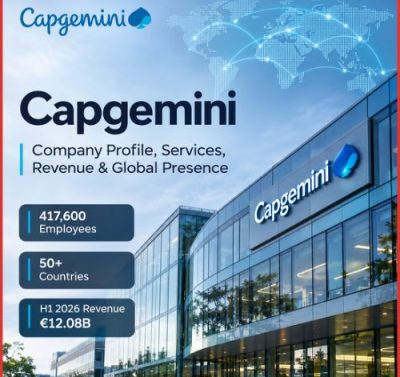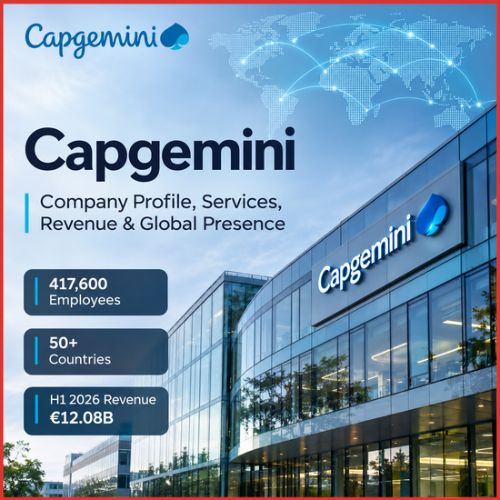
A good Capgemini company profile starts with scale. This Paris-based group now has around 417,600 people on its payroll and booked €12.08 billion in revenue in the first half of 2026 alone. That makes it one of the largest IT services and consulting firms in the world.
Capgemini works with banks, manufacturers, retailers, telecom operators, hospitals and government bodies that want to change how they run on technology. A single client might ask for a strategy workshop, a cloud migration, a security overhaul and a team to run operations afterwards. Over the past few years, Capgemini digital transformation services have moved from a side offer to the centre of the business, and the company says AI is now the biggest source of new demand.
This profile walks through the Capgemini company history, its main Capgemini services, the Capgemini business model, Capgemini revenue 2026 so far, and the reach of its Capgemini global operations. Figures come from the company’s own results unless a line says otherwise.
Capgemini Company Profile: Key Facts
| Particular | Details |
|---|---|
| Company name | Capgemini SE |
| Founded | 1967, in Grenoble, France |
| Founder | Serge Kampf |
| Headquarters | Paris, France |
| CEO | Aiman Ezzat |
| Chairman of the Board | Paul Hermelin |
| Industry | IT services, consulting, engineering and digital operations |
| Stock listing | Euronext Paris (symbol: CAP) |
| Employees | About 417,600 (30 June 2026) |
| Global presence | Operations in more than 50 countries |
| Revenue, H1 2026 | €12,082 million |
| Official website | capgemini.com |
Capgemini SE is publicly listed. It earns its money from consulting engagements, technology projects, engineering work and long-running managed services for businesses and public institutions.
Capgemini Company History: From Grenoble to a 400,000-Person Group
The Capgemini company history begins in 1967, when Serge Kampf started a small data-processing firm in Grenoble. It went by the long name Société pour la Gestion de l’Entreprise et le Traitement de l’Information, which most people shortened to Sogeti. Back then, the pitch was simple: companies were buying their first big computers and needed someone to help them use the machines properly.
Demand grew, and so did the ambition. Through the following decades the firm added consulting, systems integration and outsourcing, and it kept buying its way into new markets. A few deals mark the turning points:
- 2000: The purchase of Ernst & Young Consulting gave it a serious management consulting arm.
- 2015: The acquisition of IGATE added delivery muscle, especially in North America and India.
- 2020: The Altran deal brought in engineering and R&D services.
- 2025: WNS and Cloud4C were both completed in the fourth quarter. Capgemini agreed to buy WNS, a business process specialist founded in Mumbai, for $3.3 billion in cash, and the deal sits behind the group’s new Intelligent Business Operations line.
The pattern across all of these is consistent. Capgemini began as a technology contractor and has slowly become a partner that sits in the room from strategy through to day-to-day operations. Its own description now calls it a business transformation partner for the age of AI. That shift from “we build your system” to “we help you rethink the business” is the main thread running through the Capgemini company history.
Capgemini Services and Digital Transformation Services
Capgemini reports its work in three business lines. Applications & Technology is the biggest by far, at 63% of 2025 group revenue. Operations & Engineering follows with 29%, and Strategy & Transformation, the consulting side, makes up 8%.
Inside those lines, Capgemini services fall into a handful of practical areas:
- Strategy and transformation consulting: Operating models, customer experience, innovation and business redesign, largely through Capgemini Invent and the design studio frog.
- Cloud and infrastructure: Moving applications and data to the cloud, modernising legacy systems and running hybrid or multi-cloud setups. The Cloud4C deal added to this in late 2025.
- Data and artificial intelligence: Data platforms, machine learning, generative AI and, increasingly, agentic AI that carries out business tasks on its own.
- Applications and software: Building, integrating, testing and maintaining the systems that clients run every day.
- Engineering and R&D: Embedded software, connected products, industrial automation and what the company calls Physical AI.
- Cybersecurity and digital sovereignty: Threat monitoring, compliance, and helping governments and regulated firms keep control of their own technology.
- Intelligent operations: Business process work such as finance, procurement and customer support, now strengthened by WNS.
The Capgemini digital transformation services most in demand right now are legacy modernisation and AI. In its first-half 2026 release, the company said clients are updating old systems because a modern digital core is the base for running AI at scale. Strategy and consulting grew 9.2% at constant exchange rates in the first half, and Operations & Engineering grew 24.7%.
The point of bundling all this is stickiness. A client that hires Capgemini for one project often ends up using it across several, which turns a vendor into a long-term technology partner.
Capgemini Revenue 2026: What the Numbers Show So Far
Full-year figures for 2026 are not out yet, so the best view of Capgemini revenue 2026 is the first half plus the company’s own guidance. Revenue for the first six months came in at €12,082 million, up 8.8% on the same period of 2025. Strip out currency swings and growth was 11.3%. Part of that jump came from the WNS and Cloud4C acquisitions, which the company estimates will add around 5 points of growth over the full year.
| Metric (€ million) | H1 2025 | H1 2026 | Change |
|---|---|---|---|
| Revenue | 11,107 | 12,082 | 0.088 |
| Operating margin | 1,377 (12.4%) | 1,506 (12.5%) | 0.093 |
| Operating profit | 976 (8.8%) | 878 (7.3%) | -10.10% |
| Net profit, Group share | 724 | 498 | -31.30% |
| Organic free cash flow | 60 | 37 | down |
The table tells two stories. The underlying business is growing and margins are steady. Reported profit is lower because Capgemini booked €628 million of other operating expenses in the half, mostly restructuring costs tied to its Fit-for-Growth programme. Net debt also stood at €6.5 billion at the end of June, up from €2.8 billion a year earlier, after the WNS and Cloud4C acquisitions.
Bookings, which show what clients have signed for the future, reached €12,602 million in the first half, a book-to-bill ratio of 1.04.
Capgemini 2026 Outlook
2026 outlook (raised in July):
- Revenue growth of about 8.5% to 9.0% at constant exchange rates, up from 6.5% to 8.5%.
- Operating margin of 13.6% to 13.8%, unchanged.
- Organic free cash flow of about €1.8 billion to €1.9 billion, unchanged.
These are targets, not guarantees. Third-quarter revenue is due on 30 October 2026, and full-year results on 16 February 2027.
For context, the last full year on record is 2025. Capgemini reported revenue of €22.465 billion, compared with €22.096 billion in 2024, a rise of 1.7% as reported and 3.4% at constant rates. Operating margin held at 13.3%, while operating profit slipped to €2.199 billion and net profit to €1.601 billion. Generative AI made up more than 8% of bookings that year.
Capgemini Global Presence and Global Operations
Capgemini operates in more than 50 countries, and its Capgemini global operations are built around a simple idea: sell locally, deliver globally. Clients get account teams that know their market, while a lot of the build and run work happens in lower-cost delivery centres elsewhere. At the end of June 2026, 275,800 of the group’s 417,600 employees, or 66%, worked offshore.
Here is how the first half of 2026 split by region:
| Region | H1 2026 revenue (€ million) | Growth at constant exchange rates | Operating margin |
|---|---|---|---|
| North America | 3,501 | 0.198 | 16.50% |
| Rest of Europe | 3,506 | 0.026 | 9.60% |
| France | 2,142 | 0.004 | 7.70% |
| United Kingdom and Ireland | 1,746 | 0.211 | 18.10% |
| Asia-Pacific and Latin America | 1,187 | 0.26 | 14.20% |
| Total | 12,082 | 0.113 | 12.50% |
North America and Europe still carry most of the weight. North America was the fastest large contributor, helped by strong demand in financial services and manufacturing. France, the home market, returned to modest growth in the second quarter. Asia-Pacific and Latin America is the smallest region but grew fastest, and its margin improved by four points.
Capgemini’s Presence in India
India sits at the heart of the delivery network. The country offers a deep pool of engineers, data specialists, consultants and security professionals, and Indian teams serve clients around the world through distributed delivery. The WNS acquisition deepened that link. WNS was founded in Mumbai, and it brought roughly 65,000 people across 64 delivery centres into the group.
For job seekers, Capgemini India hires across software engineering, testing, cloud, data and AI, cybersecurity, consulting and business process services. Roles and eligibility change by business unit and hiring cycle, so the careers page is the place to check.
Capgemini Business Model: How the Company Makes Money
The Capgemini business model is business-to-business and service-led. It does not sell a boxed product. It sells expertise, and clients pay for the hours, teams and outcomes that come with it. Revenue arrives through five main channels:
- Consulting fees for advice on strategy, operating models and technology investment.
- Technology implementation such as building software, modernising applications and rolling out enterprise platforms.
- Managed services, the recurring income from running a client’s infrastructure, cloud environments and applications.
- Engineering services covering product development, connected systems and industrial R&D.
- Business process and intelligent operations, where Capgemini takes over and automates functions like finance or procurement.
Many contracts run for several years, which gives the company steadier income than one-off projects would. Shorter engagements are tied to milestones or a specific piece of consulting.
What makes the model work is the mix. Picture a bank that asks Capgemini to rebuild its mobile banking platform. The same bank may then need its servers moved to the cloud, its security tightened and an AI assistant added to customer support. Each step is billable, and each one is easier to win because Capgemini already knows the client’s systems.
The model has a weak spot too. Because so much revenue depends on people, margins are sensitive to pricing pressure, staff utilisation and skills. Capgemini is running its Fit-for-Growth restructuring at the same time as it pushes into higher-value AI and operations work.
Industries Served, Competitors and Growth Outlook
Industries Capgemini Works In
No single sector dominates the client list, which spreads risk. Manufacturing and financial services together bring in close to half of revenue.
| Sector | Share of 2025 revenue | H1 2026 growth (constant exchange rates) |
|---|---|---|
| Manufacturing | 25% | 0.042 |
| Financial services | 22% | 0.205 |
| Public sector | 15% | 0.095 |
| Consumer goods and retail | 13% | 0.123 |
| Telecoms, media and tech | 12% | 0.084 |
| Energy and utilities | 8% | 0.096 |
| Services | 5% | 0.191 |
Financial services was the standout in the first half, while manufacturing grew the slowest.
Capgemini’s Major Competitors: How It Compares
Capgemini operates in a competitive IT services and consulting market. Its major competitors include Accenture, Tata Consultancy Services (TCS), Infosys, IBM Consulting and Cognizant. These companies offer overlapping services in consulting, software development, cloud computing, artificial intelligence and business process management.
Here is a brief overview of Capgemini’s key competitors:
| Company | Headquarters | Major Areas of Competition |
|---|---|---|
| Accenture | Dublin, Ireland | Management consulting, cloud, AI and digital transformation |
| Tata Consultancy Services (TCS) | Mumbai, India | IT consulting, software development, cloud and enterprise solutions |
| Infosys | Bengaluru, India | Digital services, AI, IT consulting and business technology |
| IBM Consulting | New York, USA | Enterprise technology, hybrid cloud, AI and business consulting |
| Cognizant | Teaneck, USA | IT services, digital engineering, cloud and business operations |
Each competitor has a different market position. Accenture has a strong consulting and technology transformation business, while TCS and Infosys compete through large-scale IT delivery and global engineering teams. IBM Consulting focuses on enterprise technology, hybrid cloud and AI, while Cognizant competes in digital engineering, IT consulting and business operations.
Capgemini differentiates itself through its combination of strategy consulting, technology implementation, engineering, intelligent operations and managed services. However, competition for large enterprise contracts remains strong, particularly as clients compare pricing, technical expertise, AI capabilities and global delivery networks.
The competitive landscape also means Capgemini must continue investing in emerging technologies and specialised talent to maintain its position in the global IT services industry.
Where Growth Could Come From
AI is the obvious answer. CEO Aiman Ezzat said in July that agentic AI is now at the centre of nearly every client conversation. Three other areas stand out:
- Intelligent Business Operations, the new line that combines Capgemini’s process services with WNS.
- Defense, security and technology sovereignty, especially in Europe, where governments want more control over their own systems.
- Physical AI and engineering, covering connected products and industrial technology.
The risks sit on the other side of the ledger. The group expects restructuring costs of about €700 million across 2026 and 2027, net debt is higher after the acquisitions, and growth in continental Europe remains thin. Whether Capgemini turns AI demand into profitable projects will decide how this plays out.
Conclusion
Capgemini has travelled a long way from a small French data-processing shop. Today it is a group of about 417,600 people in more than 50 countries, with services that run from boardroom strategy to the back-office work that keeps a business ticking. The Capgemini company profile for 2026 is one of growth with some strain: revenue is rising and the outlook was raised, but restructuring and acquisition costs are weighing on reported profit.
The next few data points will say a lot. Third-quarter revenue arrives on 30 October 2026, and full-year results follow in February 2027. If AI-led demand keeps coming and the cost programme delivers, Capgemini digital transformation services should stay at the centre of its story.