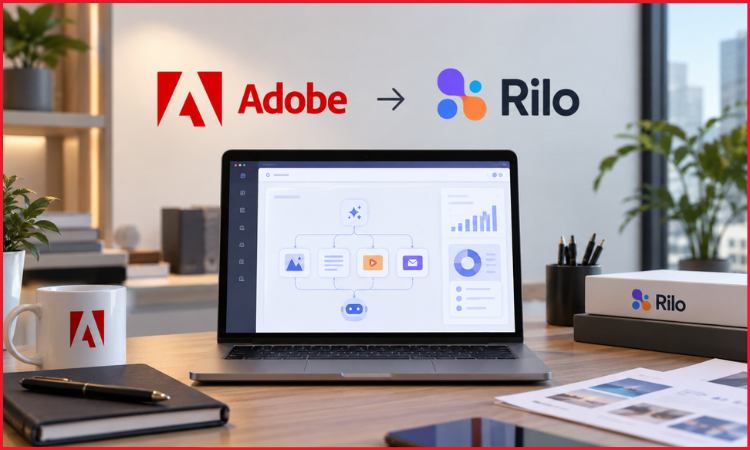
Adobe has acquired Indian artificial-intelligence startup Rilo less than a year after its launch, adding a small team and agent-based workflow technology to its enterprise marketing business.
The companies have not disclosed the purchase price or other financial terms. Reports describe the transaction as involving the licensing of Rilo’s technology and the transfer of its team to Adobe.
Rilo confirmed the acquisition in an announcement dated August 24. The startup said it had closed new registrations and withdrawn access to its hosted application as part of the transition. Existing users will therefore not continue receiving the product as an independent online service.
The deal is Adobe’s second known acquisition of an Indian technology startup. The Photoshop maker acquired Bengaluru-based generative-video company Rephrase.ai in 2023.
Rilo Built AI Agents for Marketing Teams
Founded in September 2025 by IIT Bombay alumni Dhruv Jaglan and Georgi Boby, Rilo was created to make sophisticated workflow automation accessible to people without software-development experience.
Users could describe a task in plain English and allow the platform to build and execute a workflow across multiple online tools. Its AI agents were designed to research information, reason through steps, perform actions and request human involvement when judgement or approval was needed.
Rilo eventually concentrated on marketing and go-to-market teams. Its product supported work such as competitor research, prospect identification, social-media outreach, campaign planning and the preparation of marketing content.
This differs from a conventional chatbot that produces a single answer. An AI workflow agent can remain active across several steps, interact with different software services and work towards a defined business outcome.
That capability is useful to enterprise marketers because launching a campaign often requires information to move between research platforms, content tools, customer databases, approval systems and analytics software.
Rilo said customers also used its agents for operations and research. The larger idea was that AI should take responsibility for completing outcomes instead of handling only isolated tasks.
Startup Reached 10,000 Users Within Months
Rilo grew rapidly during its short period as an independent company. Co-founder Jaglan said the product attracted more than 10,000 users within months of launch.
The startup had raised approximately $1 million from investors including Peak XV Partners, DeVC and Day Zero Ventures. Its last financing reportedly valued the company at about $10 million.
That earlier valuation should not be treated as the acquisition price. Adobe and Rilo have not said whether the purchase was completed for more or less than $10 million, how much was paid in cash or shares, or whether employee-retention payments were included.
Rilo’s value to Adobe may extend beyond its customer base. The transaction brings in a technical team with experience designing agents, connecting software tools and placing human checks inside automated workflows.
Jaglan previously co-founded AI recruitment platform Babblebots.ai, while Boby worked in a technology leadership role at cooking-robotics company CloudChef.
After confirming the deal, Rilo said its team would bring its knowledge of agents, orchestration and human-in-the-loop systems to Adobe. The startup did not announce a timetable for integrating individual features into Adobe products.
Adobe Targets Larger Enterprise Workflows
The Rilo acquisition comes as Adobe increases its use of AI across creative software and customer-experience products.
Adobe already provides large organisations with tools for creating content, managing digital assets, analysing customer behaviour and running marketing campaigns. Agent-based automation could connect these functions and reduce the manual work required to transfer information between systems.
For example, an enterprise agent could research a market, identify relevant audiences, prepare campaign material, route it for approval and monitor performance. Human managers could remain responsible for brand, legal or spending decisions while the software handles repeatable steps.
Adobe has said the deal adds a strong technical team and could help it create broader marketing workflows for customers. However, it has not identified the Adobe product that will receive Rilo’s technology or confirmed when the resulting capabilities will become available.
Rilo’s founders said they were joining Adobe to help bring AI to Fortune 500 marketers. Reaching those customers would give the technology access to organisations with larger campaigns, more data and stricter approval requirements than the startup could serve alone.
The transition creates an immediate change for Rilo customers. The hosted Rilo product is being wound down, new registrations have stopped and visits to the former application now direct users to the acquisition announcement.
This differs from an acquisition in which a startup continues operating under its own name. Rilo’s technology and team are moving inside Adobe rather than remaining a separate customer-facing platform.
The purchase highlights how quickly specialised AI startups can become acquisition targets. Rilo progressed from its September 2025 founding to an Adobe deal in under a year after raising $1 million and building a five-figure user base.
Adobe now has the task of converting that early technology into dependable enterprise features. The next important development will be confirmation of where Rilo’s agents will appear within Adobe’s product portfolio and how the company will manage security, accuracy and human approval when automated systems execute marketing work.