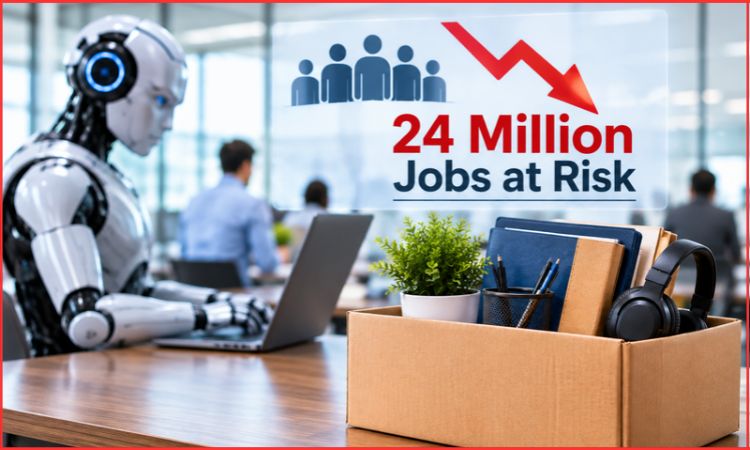
Artificial intelligence could displace around 24 million knowledge-worker jobs globally over five years under an illustrative scenario outlined by J.P. Morgan, adding to the debate over how businesses will use the technology as adoption spreads.
The figure comes with an important qualification. It describes what could happen under particular assumptions about spending and labour substitution, rather than a prediction that employers have already decided to eliminate those positions.
Much of the adjustment could also happen through vacancies left unfilled and slower recruitment. That would make the employment impact less visible than a succession of mass layoff announcements, while still reducing opportunities for people seeking work.
The analysis places a difficult question at the centre of the AI adoption debate: will companies use productivity gains to expand their operations, reduce staffing requirements, or pursue both?
The Assumptions Behind The Estimate
The scenario assumes that half of potential enterprise spending on AI replaces roles that businesses would otherwise fill. It also assumes that the technology costs approximately half as much as the employees whose work it substitutes.
Those assumptions matter as much as the headline number.
If companies mainly use AI to increase output, improve service or develop products, the relationship between technology spending and employment will differ. Equally, implementation costs could affect whether replacing a particular activity produces the savings managers expect.
The calculation therefore offers a way to examine possible disruption. It cannot establish how every employer will behave.
For workers, the distinction is consequential. Exposure to a technology does not mean a redundancy decision has been made, and a theoretical saving does not automatically translate into a workable replacement.
Reduced Hiring Could Carry Much Of The Impact
The quieter employment risk may be a job opening that never appears.
Consider a team expecting a heavier workload next year. Previously, the manager might have requested two additional employees. If AI helps the existing team handle that work, the business might approve neither position.
Nobody in that team loses a job. Nevertheless, two employment opportunities disappear compared with the earlier plan.
The same process could operate when an employee resigns or retires. Instead of recruiting a replacement, management might redistribute responsibilities and automate some tasks.
This is why AI job displacement cannot be measured through layoffs alone. Recruitment plans, entry-level openings and replacement hiring can reveal changes that headline redundancy figures miss.
For applicants, a market with fewer vacancies can feel difficult even when most existing employees remain in their roles.
Tasks And Entire Jobs Are Different
J.P. Morgan’s analysis also emphasises that disruption is more likely to change activities within jobs than eliminate every affected position.
That distinction reflects how work is organised.
A professional might spend part of the day preparing documents, another part checking information and the rest discussing decisions with colleagues or clients. Automating the first activity does not resolve every responsibility attached to the role.
An AI-generated summary, for example, still needs to be relevant to the decision being made. Someone must identify missing information, recognise an unreliable conclusion and decide what action follows.
The employment outcome depends on how much of the overall job changes and what the organisation does with the time released.
Faster completion can support higher output. It can also lead management to reconsider staffing. The technology alone does not determine which outcome occurs.
Adoption Is Still Behind Technical Capability
The report notes a substantial gap between what AI might theoretically assist with and how widely it is embedded in everyday work.
That gap is understandable. Giving employees access to a tool is easier than changing an organisation’s operating processes.
A useful deployment may require access to internal information, clear permissions, reliable quality checks and agreement over who takes responsibility when something goes wrong.
There is also a difference between a convincing demonstration and a dependable workflow. A tool that performs well on selected examples may require more supervision when faced with incomplete records, unusual requests or conflicting instructions.
For businesses, the relevant calculation includes that supervision.
Time saved in producing an answer can be offset by time spent checking or correcting it. Productivity gains become commercially useful when the complete process improves, including the work required after generation.
Concentrated Disruption Could Be Harder To Absorb
A global employment figure can conceal much sharper pressure within a particular occupation or location.
If reduced hiring is spread across many industries, workers may have more opportunities to move elsewhere. If it falls heavily on one kind of work, people with similar experience may compete for a shrinking pool of openings.
The local effects could extend beyond the employees directly affected. Household spending, training choices and the prospects of nearby service businesses can all depend on the health of a major employment base.
This is the significance of concentration in the future of knowledge work debate. A modest aggregate percentage does not describe what happens to a worker whose particular skill becomes less sought after.
Adjustment also takes time. Experience accumulated in one occupation does not always transfer immediately into another.
Entry-Level Work Presents A Training Challenge
One practical concern is how organisations will develop experienced employees if routine tasks become automated.
Preparing a first draft, organising records or carrying out basic research can look repetitive. Those activities can also help junior employees understand a subject, learn standards and recognise common mistakes.
If the task disappears, the learning opportunity may need to be replaced.
That does not mean businesses must preserve every manual process. It means training plans should account for the knowledge those processes previously helped employees acquire.
A junior worker who reviews automated output needs enough understanding to recognise problems. Simply assigning responsibility for checking a result does not create that understanding.
Employers seeking immediate efficiency will therefore face a longer-term question about how expertise is built.
Business Decisions Will Shape The Employment Outcome
For employees, the useful response is to understand which parts of their work are changing and where judgement remains essential. For employers, the challenge is to measure productivity across the whole workflow and prepare people for revised responsibilities.
The J.P. Morgan AI jobs estimate illustrates the scale of a possible adjustment. Its eventual shape will depend on adoption costs, business growth, recruitment decisions and how organisations redesign work.
The number is striking. The more immediate development to watch may be less dramatic: fewer approved vacancies, altered job descriptions and a growing expectation that employees can produce more with the tools available.