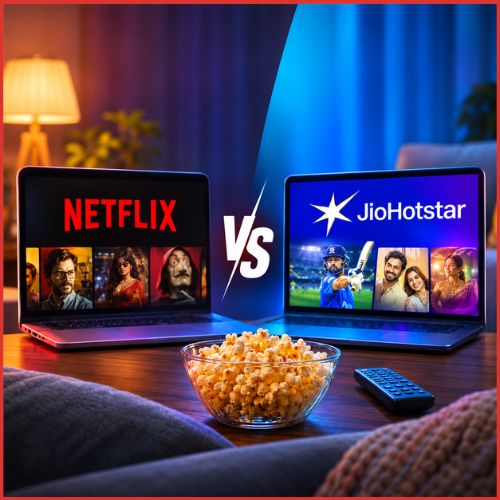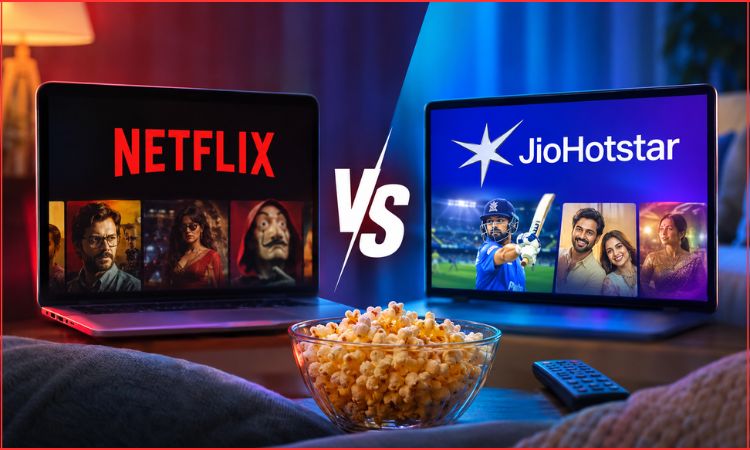
Ask anyone in a Lucknow living room, a Bengaluru co-working space or a Coimbatore family kitchen which app they open first on a weekend, and the answers rarely match. That is how crowded India’s OTT market has become. One rivalry now dominates the conversation: Netflix vs JioHotstar.
Netflix built its brand on polished originals and global hits. JioHotstar built its offer around how Indians actually watch: live cricket, family serials, regional films and very low prices, all backed by the Reliance and Jio ecosystem.
Great shows are only half the job in India. Price, reach, language and live sport decide who gets the monthly payment, and by those measures Netflix is falling behind.
Key takeaways
- JioHotstar starts at ₹79 a month, while Netflix India starts at ₹149 (as reported).
- JioHotstar’s reported subscriber base is many times larger than Netflix’s India estimate.
- Cricket, 19-language content and Jio bundling give JioHotstar its edge.
- Netflix still wins on premium originals and global storytelling.
- “Losing ground” here means share of audience and growth, not a confirmed subscriber drop.
Netflix vs JioHotstar: Quick Comparison
| Factor | Netflix India | JioHotstar |
|---|---|---|
| Core strength | Premium originals, global hits | Live sport, Indian TV, regional content |
| Entry-level price | ₹149/month (Mobile) | ₹79/month (Mobile) |
| Billing options | Monthly | Monthly, quarterly, annual |
| Cricket | No major portfolio | IPL and major ICC events (subject to rights) |
| Languages | Multilingual originals | 19 languages |
| Biggest challenge | Affordability and mass appeal | Retaining fans after tournaments end |
Prices and plans can change, so check each app before subscribing.
How Big Is the Gap? Netflix vs JioHotstar Subscribers in India
JioHotstar Scaled at Record Speed
JioHotstar launched in February 2025 by merging JioCinema and Disney+ Hotstar. Reports say it began with roughly 50 million subscribers and climbed to around 300 million within months, driven largely by IPL 2025.
Netflix’s India Base Is Much Smaller
Analyst estimates from early 2026 put Netflix at around 20 million paying subscribers in India, against roughly 65 million for Prime Video.
A fair caveat: these numbers are not perfectly comparable. JioHotstar’s count includes mobile, bundled and telecom-linked users, while Netflix’s covers paying households. Even so, the difference in scale is huge. Netflix is not collapsing, but it is being outflanked in the mass market.
JioHotstar’s Launch Reshaped the Indian OTT Market
Most platforms spend years building viewing habits. JioHotstar inherited them. Viewers already used its parent apps for cricket, TV serials, reality shows and Hindi and regional films.
One App, Many Reasons to Stay
In one household, one person subscribes for the IPL, another for the evening soap, and the kids for cartoons. That makes JioHotstar feel like a necessity rather than an extra.
Netflix Wins Subscribers One at a Time
Netflix’s pitch is distinctive but narrower: exclusive originals and international series. It attracts people who pay for something special, but it does not automatically bring in the mass audience that cricket and familiar TV do.
Pricing: JioHotstar Subscription Plans vs Netflix Plans
Indian households already pay for mobile data, broadband, DTH and perhaps a couple of apps. A new monthly charge needs a strong reason.
Netflix Plans in India
Netflix’s reported 2026 plans run from ₹149 a month (Mobile, handheld devices only) up to ₹649 for Premium. Good value for daily viewers, harder to justify for occasional ones.
JioHotstar Subscription Plans
Under the revised pricing effective January 28, 2026, new subscribers get three tiers:
- Mobile: ₹79 monthly, ₹149 quarterly or ₹499 annually
- Super: ₹149 monthly, ₹349 quarterly or ₹1,099 annually
- Premium: ₹299 monthly, ₹699 quarterly or ₹2,199 annually
Premium is ad-free apart from live sport and some live shows. Quarterly and annual billing also let a cricket fan pay once and stop thinking about it.
Which Is Cheaper?
JioHotstar. Someone who mainly watches cricket and Hindi or regional shows can be fully satisfied at ₹79, which makes Netflix at nearly double the entry price a hard sell.
Cricket Is JioHotstar’s Biggest Weapon
If one factor explains why JioHotstar vs Netflix India is so uneven for casual viewers, it is cricket.
Live Sport Creates Appointment Viewing
IPL 2025 reportedly reached over a billion viewers across platforms, with tens of millions watching at the same moment. A Netflix series can be a talking point, but people watch it whenever they like. Live cricket sets a deadline, so millions arrive at the same hour and return for the next match.
Cricket Brings in New Paying Users
Live sport attracts people who would never pay for international dramas alone. Once inside, JioHotstar can steer them toward films, serials and originals. Netflix has experimented with live programming elsewhere, but it has nothing comparable to India’s cricket portfolio.
Regional Content Gives JioHotstar Wider Cultural Reach
India is not one entertainment market. Hindi is huge, but Tamil, Telugu, Malayalam, Kannada, Bengali and other languages shape choices too.
19 Languages, One Platform
JioHotstar’s catalogue spans 19 languages across TV, films, originals, reality shows, anime, kids’ content and live events. Picture a household where Dad follows cricket, Mum watches Hindi serials and the teenager loves Telugu films. A single app that serves all three becomes part of the daily routine.
Netflix Is Investing, but Differently
Netflix backs Indian crime dramas, comedies, documentaries and films. But many viewers arrive for one title and leave when it ends, while JioHotstar viewers come back for a mix of sport, familiar TV and regional entertainment.
Distribution and the Jio Ecosystem Tilt the Field
Distribution is the quiet factor in the Netflix vs JioHotstar debate.
Bundling Removes Friction
JioHotstar sits inside the JioStar and Reliance family, with telecom plans, broadband offers and TV networks to promote it. It has also partnered with a large number of phone and smart TV brands. When entertainment arrives inside a connectivity package people already use, there is no fresh buying decision to make.
Netflix Still Sells Stand-Alone
Netflix has telecom and broadband tie-ups, but its core pitch remains a separate subscription. In a price-sensitive market, that extra step costs it users.
Where Netflix Still Wins
Netflix is not finished in India, and a credible comparison should say so.
Premium Originals and Global Reach
Its original content is among the best produced on any platform here. One hit can travel worldwide, and its library of thrillers, sci-fi, documentaries and international series is hard to find on Indian television.
A High-Value Audience
Netflix holds a smaller but affluent audience that pays more per account. It sells a premium identity: shorter seasons, bolder storytelling and mature themes. The problem is not quality. It is that this audience is much smaller than the one JioHotstar serves.
What JioHotstar Still Has to Solve
Leading is not the same as winning for good.
Retention After the Final
Sports-driven audiences are unpredictable. Someone who signs up for the IPL may leave once the trophy is lifted. Steady originals, films and regional releases are the best way to keep them.
Discovery and Costs
A huge catalogue helps only if viewers can find what they like. Sports rights are also expensive, and big viewership does not automatically mean profit, so rights spending and ad revenue have to stay balanced.
Netflix India Strategy: What It Must Do to Compete
Netflix does not need to copy JioHotstar. It needs to become more relevant to Indian households.
- Raise perceived value. Flexible plans, partnerships and must-watch exclusives make the price easier to justify.
- Go deeper on regional stories. Quality Tamil, Telugu, Malayalam and Bengali originals can reach beyond its urban core.
- Keep people engaged all year. A steady release calendar reduces cancellations between big hits.
- Make access easier. Telecom and broadband bundles lower the barrier to subscribing.
- Sharpen the pitch. Competing on price alone would erode its premium identity, while competing on exclusivity will not.
Conclusion: Who Is Winning India’s Streaming War?
On scale, price, cricket, regional depth and distribution, JioHotstar holds the structural edge in India’s mass market. Netflix keeps a loyal premium audience, but its relative position is weakening as the market grows around it.
That is why “losing ground” is accurate in the sense that matters: share of audience, share of attention and share of future growth. JioHotstar must keep fans after tournaments end. Netflix must prove its premium entertainment is worth paying for all twelve months.
Either way, viewers gain more choice, smarter plans and more investment in Indian storytelling.
Frequently Asked Questions (FAQs)
Why is JioHotstar more competitive than Netflix in India?
JioHotstar combines major live sport, Indian TV, regional-language content and low-cost flexible plans, which suits a far wider range of viewers.
Is Netflix losing subscribers in India?
It is not confirmed. Netflix is losing ground in relative terms, since JioHotstar’s base is many times larger, but that is different from an absolute subscriber decline. Check official reports for current numbers.
Which is cheaper, Netflix or JioHotstar?
JioHotstar. Its Mobile plan starts at ₹79 a month against ₹149 for Netflix Mobile, though content and device limits differ.
Is JioHotstar better than Netflix for cricket?
Yes. JioHotstar carries the IPL and major cricket properties, subject to current rights, while Netflix does not compete in this space.
Can Netflix beat JioHotstar in India?
Not on cricket or price. It can still thrive by owning the premium originals niche and deepening its regional slate. The market has room for both.
Which is the best OTT platform in India?
It depends on what you value. Choose JioHotstar for sport, regional variety and low cost, and Netflix for premium international and original series.