Eighteen years ago, an IIT Delhi graduate tired of standing in lunch queues at Bain & Company built a small internal website listing restaurant menus. That website eventually grew into one of India’s largest listed internet companies. The Deepinder Goyal brain tech startup story is the newest chapter in that same career, and it looks nothing like the one before it. In February 2026, weeks after stepping down as Group CEO of Eternal Limited, Goyal resurfaced with $54 million in funding for Temple, a wearable device built to monitor brain activity in real time. As a Deepinder Goyal new startup, Temple has little in common with the food-delivery business that made him famous. His move from food delivery to neurotechnology raises a genuine question: what does a founder who has already built one giant company choose to do when he decides to start again from scratch?
Quick Glance
| Full Name | Deepinder Goyal |
| Born | January 26, 1983, Muktsar, Punjab, India |
| Education | Integrated M.Tech, Mathematics and Computing, IIT Delhi (2001-2005) |
| First Job | Associate Consultant, Bain & Company (2006) |
| Known For | Co-founder, Zomato / Eternal Limited |
| Previous Role | Group CEO, Eternal Limited (2008 – Feb 1, 2026) |
| Current Role | Vice Chairman, Eternal Limited; Founder, Temple |
| New Brain-Tech Startup | Temple (founded 2024; public since Feb 2026) |
| Temple Funding | $54 million; ~$190M valuation (Feb 2026), ~$375M reported by Jul 2026 |
| Other Ventures | Continue Research (longevity); LAT Aerospace (aviation/defence) |
| Net Worth (estimate) | $1.6 – 1.9 billion (Forbes, 2026 real-time estimate) |
From IIT Delhi to Bain & Company: The Making of an Entrepreneur
Deepinder Goyal was born on January 26, 1983, in Muktsar, Punjab, to a family where his father taught botany and his mother taught English. He studied at DAV College, Chandigarh, before joining the Indian Institute of Technology, Delhi, in 2001, where he completed an integrated M.Tech in Mathematics and Computing in 2005.
After graduating, Goyal joined Bain & Company in Gurgaon in January 2006 as an associate consultant. It was here, waiting with colleagues to browse cafeteria menus, that he and fellow Bain analyst Pankaj Chaddah built an internal tool digitising restaurant listings for the office. The idea travelled faster than either of them expected, and it planted the seed for what would eventually become Zomato.
Building Zomato: Eighteen Years Inside Deepinder Goyal’s Startup Journey
In 2008, Goyal and Chaddah left their consulting careers to launch Foodiebay, an online directory of scanned restaurant menus. Within nine months it was the largest restaurant listing service in Delhi NCR. The company was renamed Zomato in 2010 and expanded internationally through the early 2010s, entering markets such as the UAE, South Africa, the UK and Sri Lanka.
Zomato’s growth accelerated through acquisitions and new business lines. It bought Uber Eats’ India operations in 2020 and acquired quick-commerce platform Blinkit, then known as Grofers, for $568 million in 2022. Zomato went public in July 2021 at a valuation of roughly $12 billion, with the issue oversubscribed more than 35 times. In 2024, the parent company was renamed Eternal Limited, housing the Zomato food-delivery app, Blinkit, and the Hyperpure supply business. By early 2026, Eternal’s market capitalisation had crossed $32 billion, and its FY25 revenue stood at roughly ₹94.18 billion (about $980 million).
The Exit: Why the Zomato Founder Stepped Aside
As Zomato founder and long-time chief executive, Goyal had never before stepped back from day-to-day control of the company. On January 21, 2026, he informed shareholders that he would step down as Group CEO effective February 1, 2026, remaining on the board as Vice Chairman subject to approval. Albinder Dhindsa, previously CEO of Blinkit, took over as Group CEO. Goyal indicated that his next ideas were better pursued outside the structure of a listed company, and that Eternal itself needed to stay focused on its core growth path under new leadership. The move surprised parts of India’s business press, since Eternal was performing well rather than facing any downturn.
Deepinder Goyal Brain Tech Startup: Inside Temple
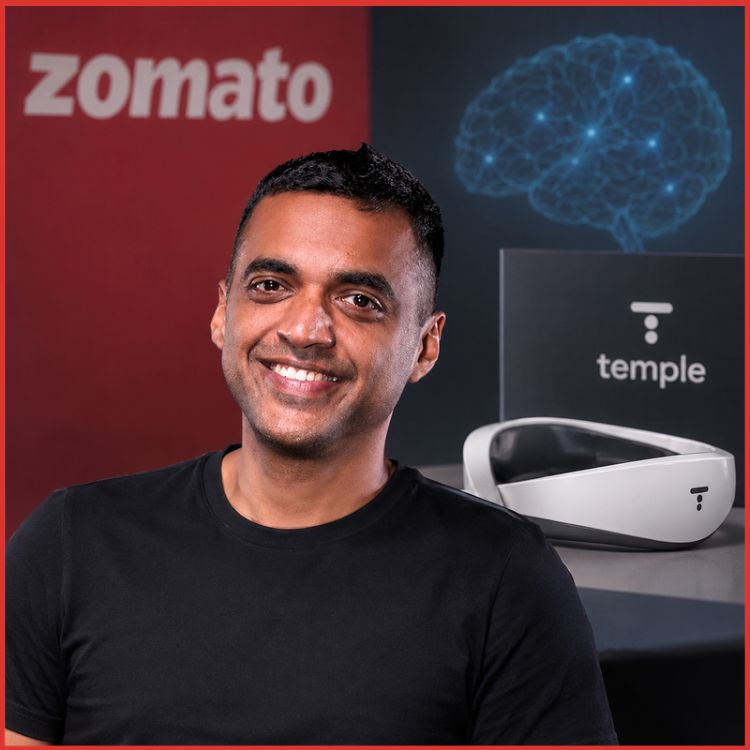
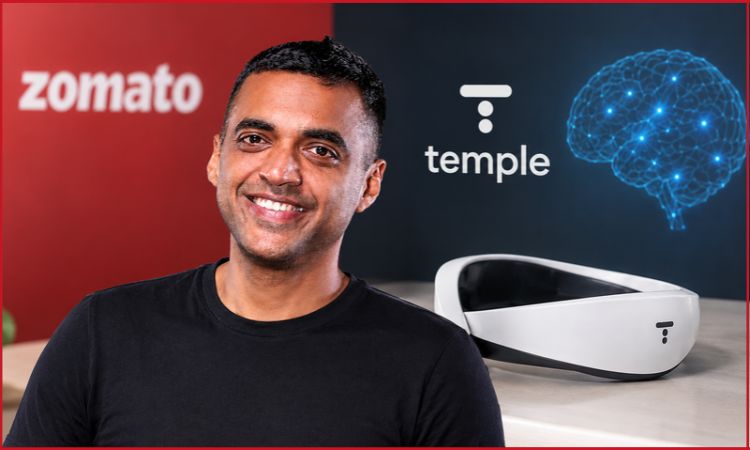
The clearest sign of what Goyal meant by “higher-risk exploration” arrived weeks later. On February 27, 2026, he announced on social media that Temple, a startup he had been quietly building since 2024, had raised $54 million. Temple’s core product is a small wearable patch worn near the temple that continuously tracks cerebral blood flow using non-invasive sensing methods related to near-infrared spectroscopy and EEG. Unlike typical fitness trackers that measure heart rate or sleep, Temple is designed to give users a real-time read on what is happening inside the brain during periods of exertion, focus or recovery.
Goyal has said the company’s goal is to understand what happens inside the brain during peak performance, and this Deepinder Goyal brain technology bet has meant hiring specialists in embedded systems, computational neuroscience and brain-computer interface engineering. Its early target users are elite athletes, high-performance professionals and people interested in longevity and cognitive wellness, a category some industry estimates value at close to $53 billion globally in 2026.
Funding, Investors and a Rapid Re-rating
Temple’s February 2026 round was structured as a friends-and-family raise rather than a conventional venture round. It valued the company at about $190 million post-money and included early Zomato backers such as Kunal Shah, Vijay Shekhar Sharma, Raj Shamani, Abhiraj Singh Bhal, Varun Alagh and Eternal CFO Akshant Goyal, alongside institutional investors Peak XV Partners, Info Edge Ventures, Vy Capital and Steadview Capital. More than 30 Temple employees also invested at the same valuation. By July 2026, industry reports pegged Temple’s valuation closer to $375 million, and in May 2026 the company partnered with manufacturers Zetwerk and Ethereal Machines to scale production of its wearable hardware.
A Broader Portfolio Behind Deepinder Goyal’s New Venture
Every Deepinder Goyal new venture launched since 2024 fits a wider pattern, and Temple is not his only new bet. In October 2025, he committed $25 million of his own money to Continue Research, a venture focused on extending human lifespan. He is also a co-founder of aviation startup LAT Aerospace, which expanded into defence technology in February 2026 through the acquisition of robotics startup Sharang Shakti. Goyal has separately backed wearable-technology maker Ultrahuman and logistics platform Shiprocket as an angel investor, underlining a pattern of interest in health, hardware and deep technology that predates Temple by several years.
What Makes Deepinder Goyal’s Startup Journey Unique
Few founders walk away from a listed company performing well to start over in an unrelated, hardware-heavy category. Viewed as a whole, Deepinder Goyal startup journey now spans food-tech, neurotechnology, longevity science and aviation within the space of two decades. Goyal’s shift from consumer internet to neurotechnology and longevity science is unusual on its own, but so is the way he financed it: a friends-and-family round built on relationships from his Zomato years, with over thirty of his own employees investing alongside billionaire backers. Running three ventures at once, Temple, Continue Research and LAT Aerospace, while keeping a board seat at Eternal, reflects a founder trying to combine an operator’s discipline with a first-time founder’s appetite for risk.
Conclusion
Deepinder Goyal’s career has moved from a cafeteria menu problem at Bain & Company to a company worth tens of billions of dollars, and now to a wearable device that reads brain activity. The Deepinder Goyal brain tech startup chapter is still in its early stages, and Temple’s science and commercial traction will take time to prove out. But for India’s founders and investors, the bigger lesson may already be visible: a proven operator, rather than resting on one success, has chosen to place fresh, higher-risk bets in brain-tech startup India territory at a stage in his career when most founders would simply consolidate.
FAQs
What is Deepinder Goyal’s new brain tech startup called?
It is called Temple, a wearable technology company Goyal has been building since 2024 that focuses on continuous brain and cerebral blood flow monitoring.
When did Deepinder Goyal step down as CEO of Zomato/Eternal?
He stepped down as Group CEO of Eternal Limited effective February 1, 2026, and moved to the role of Vice Chairman on the board, with Albinder Dhindsa taking over as Group CEO.
How much funding has Temple raised so far?
Temple raised about $54 million in a friends-and-family round in February 2026 at a post-money valuation of roughly $190 million, which industry reports later placed near $375 million by mid-2026.
What does Temple’s wearable device actually do?
It is a small patch worn near the temple that continuously measures cerebral blood flow using non-invasive sensing technology, aimed at giving users insight into brain activity during exertion, focus and recovery.
What is Deepinder Goyal’s net worth in 2026?
Wealth trackers such as Forbes have estimated his net worth at between roughly $1.6 billion and $1.9 billion in 2026, based mainly on the market value of his Eternal shareholding. This is a third-party estimate, not a company-disclosed figure.
What other startups is Deepinder Goyal building besides Temple?
He has committed $25 million to Continue Research, a longevity-focused venture, and co-founded aviation startup LAT Aerospace, which also acquired a robotics and defence-technology startup in 2026.