Adani Energy Solutions has reported its strongest September-quarter numbers yet, with profit more than doubling as transmission projects, smart-meter installations and a fast-growing energy-solutions business pushed income sharply higher.
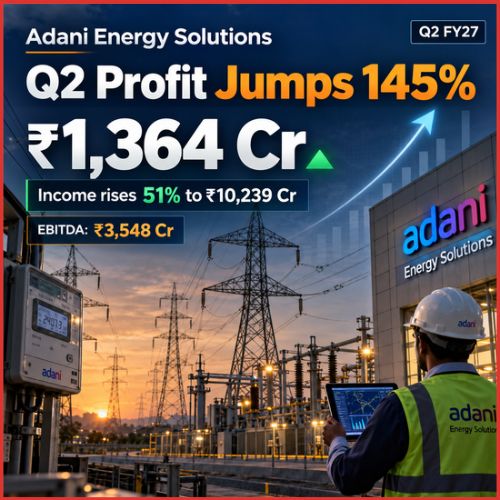
The company posted Adani Energy Solutions Q2 profit of ₹1,364 crore for FY27, up 145% from ₹557 crore in the same quarter last year.
Total income rose 51% to ₹10,239 crore from ₹6,767 crore, while operational revenue also increased 51% to ₹7,167 crore.
The profit growth was considerably faster than revenue, helped by a jump in EBITDA and stronger contributions from newer parts of the business.
EBITDA Reached a Record ₹3,548 Crore
Operating performance strengthened across the quarter.
Total EBITDA increased 67% year on year to a record ₹3,548 crore, compared with ₹2,126 crore in Q2 FY26.
Operating EBITDA, which strips out some other income and one-time items, rose 68% to ₹3,070 crore from ₹1,825 crore.
That gives a clearer picture of how quickly the underlying business is expanding.
For the first half of FY27, EBITDA reached ₹6,726 crore, 62% higher than a year earlier. Profit after tax for the six-month period rose 137% to ₹2,600 crore.
The latest Adani Energy Solutions results therefore reflect more than a single strong quarter.
Momentum has been building across several businesses at the same time.
Transmission Revenue Rose 17%
Transmission remains one of the company’s core operations.
Q2 operating revenue from the segment increased 17% to ₹1,521 crore from ₹1,305 crore a year earlier.
Operating EBITDA rose 15% to ₹1,394 crore.
The segment maintained an EBITDA margin of about 92%, only slightly below the 93% reported a year earlier.
Those margins look unusually high compared with many ordinary industrial businesses because regulated transmission assets operate under a different economic model.
Once infrastructure is commissioned, long-term availability-based revenue can provide relatively predictable cash flows.
The bigger growth question is therefore how quickly Adani Energy Solutions can keep expanding its asset base.
The Transmission Pipeline Has Reached ₹87,000 Crore
That pipeline became substantially larger during the quarter.
AESL won the Vizag Power Transmission and Satara Power Transmission projects, taking the aggregate transmission projects under construction to around ₹87,000 crore.
The company also sees a near-term industry tendering opportunity of roughly ₹1.4 lakh crore.
Winning projects does not translate into immediate revenue.
Transmission assets take time to construct, commission and begin contributing fully to earnings.
But a large order book gives the business visibility over several years.
That is particularly important for Adani Energy Solutions transmission growth, because the existing asset base can generate stable earnings while new projects gradually come online.
Smart Meter Installations Are Scaling Quickly
Smart metering is another business growing from a much smaller base.
AESL had installed approximately 14.8 million smart meters cumulatively by the end of the first half.
The company has an under-implementation order book of 24.6 million meters across 10 projects, with revenue potential of more than ₹29,519 crore.
On an Ind AS accounting basis, smart-metering operating revenue rose 129% year on year during Q2 to ₹267 crore.
Operating EBITDA more than doubled to ₹226 crore.
The segment’s reported operating EBITDA margin reached approximately 85%, compared with 79% a year earlier.
The revenue number is still relatively small compared with distribution or transmission.
Its rate of growth is not.
Energy Solutions Has Become a Major Contributor
The biggest shift in the numbers is the energy-solutions platform.
Q2 operating revenue from the business reached ₹2,197 crore, compared with only ₹201 crore in the year-ago quarter.
Operating EBITDA increased to ₹803 crore from ₹11 crore.
The company’s release separately put energy-solutions platform EBITDA at approximately ₹810 crore for the quarter.
That jump explains a meaningful part of the group’s overall earnings growth.
AESL is moving beyond simply owning electricity networks towards aggregating and supplying energy to large customers.
That expands the addressable market, but it also changes the business mix.
The 2,500 MW Maharashtra Contract Adds Scale
One of the largest new agreements is with Maharashtra State Electricity Distribution Company.
Adani Energy Solutions has entered into a power purchase agreement to supply 2,500 MW of round-the-clock electricity for 25 years.
A long-term contract of that size gives the energy-solutions business significant visibility.
Round-the-clock supply is also more complicated than simply selling renewable power when the sun is shining or the wind is blowing.
It requires energy aggregation across sources so that contracted electricity remains available throughout the day.
Chief Executive Kandarp Patel said the agreement reinforces AESL’s capabilities in multi-source energy aggregation and power-supply optimisation.
Mumbai Electricity Demand Rose 11%
The distribution operation produced steadier growth.
Operating revenue from distribution increased 2% year on year to ₹3,181 crore.
Operating EBITDA, however, rose much faster—up 23% to ₹605 crore.
Electricity sold in the Mumbai distribution area increased about 11% to 2,930 million units during Q2.
Mundra Utility sales grew 26% to 460 million units, supported by industrial and commercial demand.
Distribution losses in the AEML network stood at 4.29% for the first half.
For a utility, controlling those losses is important because electricity lost through technical inefficiency or other leakage reduces the amount ultimately billed to customers.
Capex Is Rising as Projects Move Into Execution
Growth comes with a large construction bill.
Transmission capital expenditure during the first half rose to ₹5,542 crore, about 1.7 times the ₹3,343 crore spent in the comparable period last year.
That increase reflects the size of the development pipeline.
Infrastructure businesses often show a gap between when money is spent and when a new asset begins generating its full revenue.
For AESL, execution will therefore become just as important as winning new projects.
The company needs to commission transmission lines, continue installing smart meters and scale energy-supply contracts without weakening financial discipline.
Q2 Shows How Much the Business Mix Has Changed
The headline number is the 145% increase in profit.
The more important part of the Adani Energy Solutions Q2 FY27 results may be where that profit is coming from.
Transmission is still growing. Distribution remains stable. Smart meters are scaling quickly.
But energy solutions has gone from ₹201 crore in quarterly operating revenue to more than ₹2,100 crore in a year.
That is changing the shape of the company.
AESL now has an ₹87,000 crore transmission pipeline, 24.6 million smart meters under implementation and a 2,500 MW long-term power-supply agreement in Maharashtra.
Those projects provide considerable growth visibility.
They also leave the company with an equally large execution challenge.
For Q2, at least, the numbers show the expansion is already flowing through to earnings.
Source:
Adani Energy Solutions Q2 profit more than doubles to ₹1,364 crore on 51% income growth