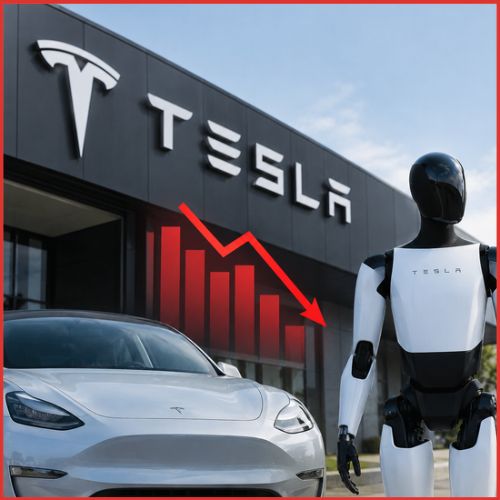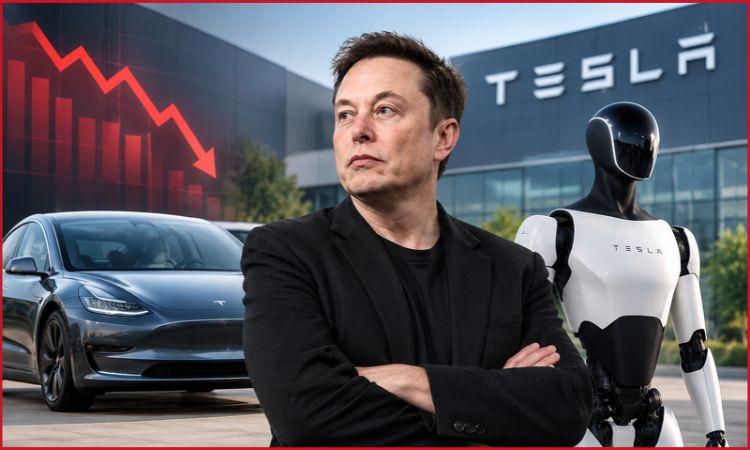
Tesla is spending heavily on a future in which cars may no longer be its most important product. The latest quarter shows how expensive that transition could become.
The electric-vehicle maker reported third-quarter revenue of $28.05 billion, almost unchanged from a year earlier, while Tesla Q3 net profit fell 43% to $787 million. Operating expenses climbed 39% to $4.78 billion as the company continued putting money into artificial intelligence, autonomous vehicles and its Optimus humanoid robot programme.
The contrast is difficult to miss. Tesla’s existing car business is producing billions in revenue, but Elon Musk increasingly argues that much of the company’s future value will come from something else entirely.
He has previously predicted that Optimus could eventually account for around 80% of Tesla’s value.
Revenue Stayed Flat While Profit Took a Hit
Tesla generated $28.05 billion in total revenue during Q3, compared with $28.10 billion in the same quarter last year.
Automotive revenue slipped 3% to $20.56 billion.
Energy generation and storage revenue dropped 16% to $2.88 billion, while services and other revenue increased 33% to $4.61 billion.
The overall top line therefore barely moved.
Profit was a different story.
Tesla net income attributable to common shareholders fell from $1.37 billion a year earlier to $787 million. Operating income dropped 56% to $718 million, while operating margin narrowed sharply from 5.8% to 2.6%.
Those figures show just how much pressure higher spending is putting on the business even when revenue remains relatively stable.
Operating Expenses Jumped 39%
Tesla’s operating expenses reached $4.78 billion during the quarter, up from $3.43 billion a year earlier.
The company is simultaneously funding several expensive programmes.
Cybercab production is ramping. Tesla continues investing in Full Self-Driving technology, AI computing infrastructure and battery manufacturing. It is also preparing for large-scale production of Optimus.
That creates a difficult financial balancing act.
Tesla needs its existing businesses to generate enough cash to support projects that may take years to become meaningful profit contributors.
The Tesla Optimus robot sits at the centre of that strategy.
Musk has increasingly described Tesla as an AI and robotics company rather than simply an EV manufacturer, which means investors are being asked to judge today’s spending against businesses that are still developing.
Musk Thinks Optimus Could Drive 80% of Tesla’s Value
Musk’s prediction about Optimus is unusually ambitious even by Tesla standards.
In September 2025, he said roughly 80% of Tesla’s future value could eventually come from the humanoid robot.
The idea is that Optimus could perform repetitive, dangerous or physically demanding work in factories before expanding into homes and other commercial environments.
Tesla first revealed its humanoid robot programme in 2021.
Since then, Optimus has moved from early prototypes towards increasingly capable development versions.
Tesla is now preparing manufacturing capacity for much larger production.
That makes the Tesla humanoid robot business more than a side project. At least internally, the company is treating it as one of its main long-term growth engines.
Fremont Is Being Prepared for Optimus Production
Tesla has been reshaping parts of its manufacturing footprint around that future.
The company previously announced plans to end production of the Model S and Model X at its Fremont facility and use the space for Optimus manufacturing.
The long-term ambition is substantial.
Tesla has discussed eventually building as many as one million Optimus units annually at the site once production reaches scale.
Getting there will not be simple.
Humanoid robots need actuators, batteries, sensors, AI hardware, software and highly reliable manufacturing processes. Producing a few development machines is very different from manufacturing hundreds of thousands at predictable cost and quality.
That is one reason Musk himself has acknowledged that the path ahead will be difficult.
Tesla Still Delivered Nearly 487,000 Vehicles
The traditional automotive business is not disappearing in the meantime.
Tesla delivered 486,532 vehicles in Q3 after producing 464,391.
Model 3 and Model Y accounted for 478,237 deliveries, while other models contributed 8,295.
The company also ended the quarter with its largest passenger-vehicle backlog in four years.
Musk said demand was running considerably ahead of production.
There were other encouraging numbers too.
Automotive gross margin excluding regulatory credits reached 18.1%, above analysts’ expectations of around 16.7%.
The attach rate for supervised Full Self-Driving in North America also exceeded 75% of new vehicle deliveries.
So the Tesla Q3 results were not weak across every measure.
The problem is that stronger vehicle margins did not stop overall profit from falling sharply.
Capital Spending More Than Doubled
Tesla spent $4.73 billion on capital expenditure during Q3, up 110% from $2.25 billion a year earlier.
That covered investments across manufacturing, AI, batteries, autonomy and new products.
Interestingly, the figure was still far below the roughly $7.5 billion analysts had expected.
Tesla has now reduced its full-year 2026 capital expenditure forecast to around $20 billion from more than $25 billion previously.
That cut has raised a different question.
If Optimus, Cybercab and AI are supposed to determine so much of Tesla’s future value, can the company reduce near-term spending without delaying those plans?
Tesla has not specified which projects will absorb the lower investment.
Free Cash Flow Provided Some Relief
Lower-than-expected spending helped produce one of the quarter’s better surprises.
Tesla generated $1.53 billion in free cash flow.
Wall Street had expected a cash outflow of roughly $4.9 billion.
Operating cash flow reached $6.26 billion, while cash, cash equivalents and short-term investments increased to $45.45 billion.
That gives Tesla considerable financial flexibility even while profits are under pressure.
Free cash flow was still 62% lower than a year earlier, however, so the number needs context.
The company generated cash partly because capital spending came in billions below forecasts.
Investors Are Valuing Tesla on Businesses That Are Still Being Built
This is what makes Tesla unusually difficult to evaluate.
A conventional carmaker would largely be judged on vehicle sales, margins, factories and cash flow.
Tesla’s valuation increasingly depends on assumptions about Tesla robotaxis, Optimus and AI.
Those businesses could become enormous if Tesla executes successfully.
They also require years of development, regulatory progress and substantial capital before that potential is fully tested.
Meanwhile, the current financial numbers still come mainly from cars.
Q3 revenue was flat. Net profit fell 43%. Operating expenses jumped 39%.
Yet Tesla is simultaneously preparing for a future in which Musk believes its most valuable product may walk on two legs rather than four wheels.
That gap between today’s earnings and tomorrow’s ambition is now the central Tesla story.
Optimus may eventually justify the investment. For the moment, the cost of building that future is already visible in the income statement.
Source: