Indian stocks opened Friday with a little relief. It did not last very long.
The Sensex reversed sharply after touching an intraday high of 73,761.51, falling as much as 1,279 points from that level to 72,487. The Nifty followed the same path, dropping roughly 380 points from its high of 22,787 to test 22,407.
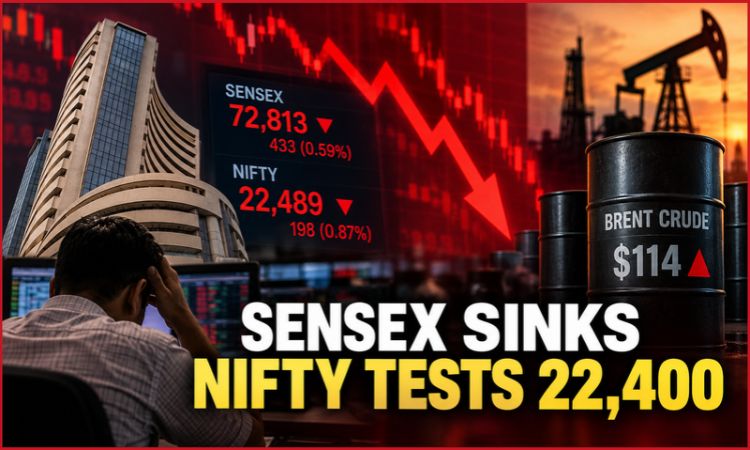
By 10:45 am, the Sensex was down 433 points at 72,813, while the Nifty had fallen 198 points to 22,489. It was the fourth straight session of losses for the benchmarks, which have now dropped roughly 3% during that stretch.
The biggest issue hanging over the Indian stock market today is no longer just weak sentiment. Crude oil has moved above $114 a barrel, creating a much more direct risk for inflation, company costs and the rupee.
Early Gains Disappeared Within the First Hour
Friday had initially looked like it might bring some respite.
GIFT Nifty had pointed to a positive opening, and the Sensex climbed above 73,700 after trading began. That optimism faded quickly once selling spread beyond a handful of stocks.
The Nifty fell through levels that traders had been watching for support, while broader market weakness became considerably worse than the headline indices suggested.
Reuters reported the Nifty down around 0.7% later in the morning, while the Sensex was lower by about 0.4%. Mid-cap stocks fell roughly 2.5%, and small-caps dropped about 3.4%.
That tells a more uncomfortable story than the Sensex alone.
Large IT gains were helping keep the benchmark from falling even faster, while many smaller stocks were facing much heavier selling.
Also Read: Stock Market Crash 2026
Reliance and HDFC Bank Added to the Pressure
Two of India’s biggest index weights were among the main drags.
Reliance Industries and HDFC Bank together accounted for roughly 15% of the Nifty’s losses during the morning session.
Hindalco and Tata Steel dropped around 3% each. HDFC Life, Jio Financial Services, Tata Motors Passenger Vehicles, Titan, Adani Enterprises and NTPC were down more than 2% at one stage.
That made the decline fairly broad.
The Sensex fall today was not being caused by one badly received earnings announcement or one sector-specific problem. Banks, metals, financials and several consumer-facing names were all under pressure.
IT was the clear exception.
TCS and Infosys Managed to Buck the Trend
Technology shares held up surprisingly well.
TCS gained more than 2%, while Infosys rose over 1% ahead of its quarterly results. The Nifty IT index was also one of the few sectoral pockets showing strength.
Part of that resilience comes from the different cost structure of IT exporters.
A higher oil price directly affects airlines, paints, chemicals, logistics companies and manufacturers using petroleum-linked inputs. IT companies have much less direct exposure to crude.
A weaker rupee can also help companies that earn a large share of revenue overseas.
That does not make technology stocks immune to a global slowdown, but it does explain why investors may treat them differently when India’s immediate problem is expensive imported energy.
Brent at $114 Is the Main Problem
Brent crude climbed as high as $114.70 a barrel on Friday, its highest level since May 4.
That is a remarkable change from the July 2 low of $70.14. In less than four months, Brent has risen about 63.5%.
Oil has moved higher amid growing concern about supply disruptions following fresh attacks involving Saudi Arabia’s energy infrastructure.
For India, a sustained move above $110 is particularly uncomfortable.
The country imports most of the crude oil it consumes. Higher international prices therefore raise the cost of those imports and can feed through to transportation, manufacturing and inflation.
That is why Brent crude at $114 is weighing so heavily on Indian equities even when individual companies are delivering decent quarterly results.
High Oil Can Hit Company Margins From Several Directions
The first effect is obvious: fuel becomes more expensive.
But the impact goes further.
Higher crude raises costs for petroleum-derived raw materials, freight and packaging. Businesses can either absorb those costs, which hurts profit margins, or raise prices and risk weakening consumer demand.
Analysts cited by Business Standard warned that oil at current levels is no longer merely a temporary sentiment issue. If it stays elevated, it could keep inflation expectations high and gradually affect consumption and profitability.
Paint makers, aviation companies, tyre manufacturers and consumer businesses can be particularly exposed.
Even businesses that do not directly consume large amounts of crude eventually feel some effect through transportation and supply chains.
The Rupee Is Back Under Pressure Too
The currency adds another layer to the problem.
The rupee had recently recovered to around 94.30 against the dollar, its strongest level in roughly six weeks.
That recovery is being tested as oil prices surge and global investors move towards safer assets.
Reuters reported that the rupee was expected to open around 94.84-94.88 per dollar on Friday.
For India, oil and the rupee can reinforce each other.
Expensive crude creates additional demand for dollars because importers need foreign currency to pay suppliers. A weaker rupee then makes each dollar of imported crude more expensive in local-currency terms.
That combination is one reason investors are treating the current oil rally seriously.
Nifty Has Broken an Important Support Zone
Technical traders are watching 22,700-22,750 closely.
That area had acted as immediate support but has now been broken.
HDFC Securities analyst Nagaraj Shetti said the recent daily chart formed a Doji-type pattern, normally associated with indecision, but the underlying trend remains weak because support has already given way.
If selling continues, the next support zone could sit around 22,300-22,200.
The Nifty tested 22,407 on Friday morning, meaning that lower support area is no longer particularly far away.
For bullish momentum to return, analysts have suggested the index needs to regain roughly 22,800.
Four Losing Sessions Have Changed the Mood
The Sensex and Nifty had already entered Friday after three consecutive declines.
On Thursday alone, the Sensex lost 460 points to finish at 73,249.39, while the Nifty closed 123.7 points lower at 22,687.65. Brent had moved above $112 during that session.
Friday has added another layer of pressure.
The Nifty 50 near 22,400 leaves the market much closer to its recent lows and makes energy prices the trigger traders are likely to watch most closely.
Earnings can still produce sharp stock-specific rallies. Cyient, for example, moved higher after its quarterly numbers even while the broader market fell.
But a sustainable market recovery becomes harder when oil remains above $110, the rupee is under pressure and broad-market stocks are falling much faster than the headline indices.
For now, crude is setting the tone.
And until that changes, every early market rally risks running into the same problem Friday’s did.