For three decades, “made in China” was simply how the world’s electronics, cars and clothes got made. That machine hasn’t broken down. But a growing number of multinational companies no longer want to depend on it alone.
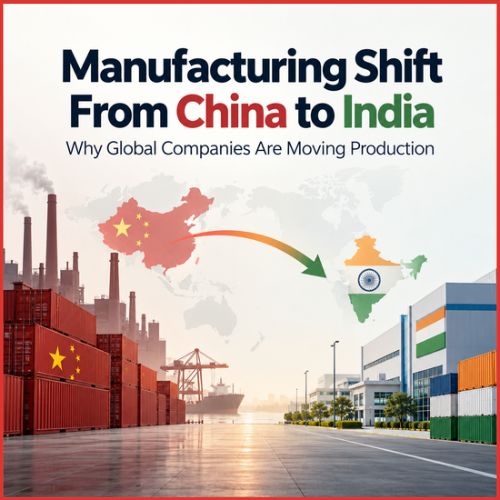
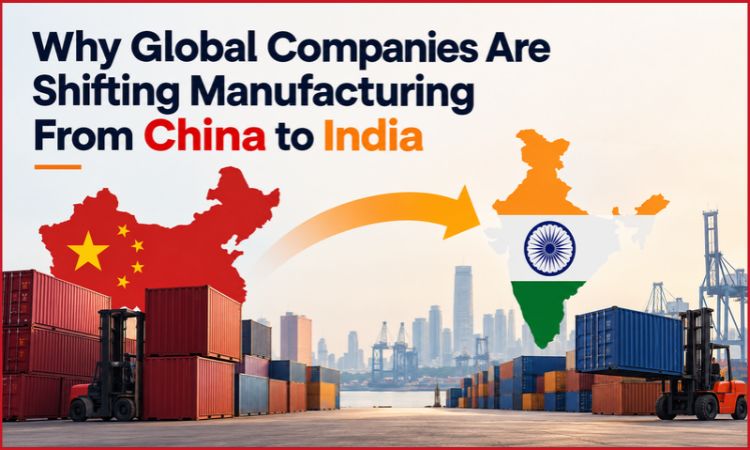
The manufacturing shift from China to India has picked up real pace over the last two years. Tariff shocks, pandemic-era shutdowns and unease about relying on one country for critical production pushed boardrooms to ask a hard question: what if China becomes harder to work with tomorrow? India, with its scale, its incentives and a fast-growing consumer base, has become one of the loudest answers.
This piece looks at why the manufacturing shift from China to India is happening now, and where India still has work to do before it can call itself a genuine alternative.
Quick Glance
| Factor | Why It Matters |
| China Plus One Strategy | Spreads production across more than one country |
| PLI scheme and Make in India | Rewards investment tied to real output |
| Electronics Manufacturing in India | Fastest-growing proof point of the shift |
| Global Supply Chain Diversification | Cuts exposure to any single country’s problems |
| Foreign Direct Investment in India | Signals long-term confidence, not just a trend |
China Plus One Isn’t a Buzzword Anymore
The China Plus One Strategy sounds like consultant-speak, but the logic is simple: keep China operations running, and build a second production base elsewhere so one bad year doesn’t sink the whole supply chain.
Container ships stuck outside ports, factories shut for weeks during COVID-19, components that couldn’t be sourced for months, tariff back-and-forth between the US and China all of it made the case too strong to ignore. Here’s what’s actually pushing the shift:
- Cutting reliance on a single country for critical production
- Managing tariff and geopolitical risk
- Building a backup line that can absorb shocks
- Getting closer to new, fast-growing consumer markets
India isn’t the only beneficiary; Vietnam, Mexico and Indonesia compete for the same investment. But India’s scale gives it an edge smaller economies can’t match, which is why the China Plus One Strategy so often ends with a factory in Gujarat, Tamil Nadu or Uttar Pradesh. It rarely means leaving China entirely; companies are simply refusing to put every egg in one basket.
Government Policy Is Doing the Heavy Lifting
India Manufacturing Growth over the last five years hasn’t happened by accident; deliberate policy has shaped it as much as market forces have.
The Production Linked Incentive (PLI) scheme sits at the centre, with a total outlay of roughly ₹1.91 lakh crore across 14 sectors, tying cash incentives directly to what a company produces and exports. According to the Ministry of Commerce and Industry, as of March 31, 2026, the scheme had drawn actual investments of more than ₹2.40 lakh crore, generated over 14.15 lakh direct and indirect jobs, and pushed exports past ₹15.2 lakh crore since inception. That’s the kind of number that makes Foreign Direct Investment in India look like a working strategy rather than a policy slogan, spanning mobile phones, pharmaceuticals, automobiles and telecom equipment.
The government’s Make in India push has run alongside the PLI scheme since 2014, nudging sectors toward higher local value addition. Neither works alone a company still weighs the incentive against land costs, power, logistics and clearance timelines.
Electronics Manufacturing in India Is Where the Shift Shows Up Most
If one industry proves the manufacturing shift from China to India is real, it’s electronics.
Apple began assembling iPhones in India in 2017, before the PLI scheme even existed, but the scheme accelerated everything after. Apple now runs five iPhone assembly plants in India three under Tata Group entities, two under Foxconn – backed by a supplier network of close to 45 companies, according to Angel One’s February 2026 reporting. India assembled iPhones worth roughly $22 billion in the year to March 2025, up nearly 60% year-on-year, with $17.4 billion exported, per IBEF. By calendar 2025, iPhone exports had climbed to $23 billion, making the iPhone India’s single most valuable export product that year, per Business Today’s April 2026 coverage.
Tariffs pushed this along. Techwire Asia reported in March 2026 that China-assembled iPhones faced US import duties near 55%, against roughly 10% for India-made devices a gap wide enough that Apple reportedly chartered cargo flights in March 2025 to move close to $2 billion worth of India-made iPhones to the US ahead of fresh tariffs.
Competition inside Apple’s own supply chain shows how fast Electronics Manufacturing in India has matured. Tata Electronics, a late entrant that only started assembling iPhones after acquiring Wistron’s India unit in November 2023, has nearly caught up to Foxconn on exports over the five-year PLI period through FY26:
| Metric (FY22–FY26, PLI period) | Figure |
| Tata Electronics: exported iPhone value | $26.3 billion |
| Foxconn: exported iPhone value | $25.6 billion |
| Foxconn: domestic-market iPhone value | $12.4 billion |
| Tata Electronics: domestic-market iPhone value | $6.3 billion |
| Apple India vendor component exports to China (FY26) | ~$2.5 billion, rising toward $3.5 billion |
Source: Business Standard, July 2026; The Week, May 2026. A reversal is underway on that last line India’s component makers are now shipping parts to China rather than the other way round, something that would have sounded far-fetched only a few years ago. China still assembles most of the world’s iPhones, but the direction here is unmistakable.
Diversification, Workforce and Home Demand
Global Supply Chain Diversification answers what the pandemic exposed a single-location supply chain breaks the moment one link fails. A company running plants in both China and India can shift output if a strike, lockdown or tariff hits one location.
India’s other advantages reinforce that logic:
- A large, young workforce and a growing pool of engineers though productivity and technical skill matter more than headcount
- A domestic market for smartphones, cars and appliances large enough to justify local production on its own
- Local manufacturing that feeds Foreign Direct Investment in India by letting companies serve consumers at home while building export capacity in parallel
Automotive and Semiconductors: The Next Frontier
India’s established automotive sector gives it a real shot at fresh investment in EV components, batteries and power electronics.
Semiconductors are the longer game. India is building that ecosystem largely from scratch Tata Electronics alone has committed roughly ₹1.26 trillion toward semiconductor fabrication and ATMP facilities, per Business Standard’s July 2026 reporting. Nobody expects India to rival Taiwan soon, but the investment suggests India Manufacturing Growth is climbing the value chain, not just assembling.
What India Still Has to Fix
The opportunity is real, but so are the gaps:
- Infrastructure – power, roads, ports has improved unevenly across states
- The supplier ecosystem is still thin next to China’s dense clusters of component makers
- Several industries still import raw materials they could eventually make at home
- Vocational training hasn’t kept pace with the ambition behind Make in India
- Regulatory friction – land acquisition, environmental clearances, state-level tax rules still slows decisions on billion-dollar factories, where predictability often matters more than the incentive itself
Is India Actually Replacing China?
Not really, and framing it that way misses the point. China still has a mature supplier network, decades of know-how, and industrial clusters that took generations to build none of that disappears because a few factories move to Gujarat. What’s changing is India’s share of the pie, not China’s position at the top. Some multinationals will keep manufacturing in China while adding India capacity; others will make India their base for specific products, the way Apple has with iPhones bound for the US. The likely outcome, years out, is multiple manufacturing hubs rather than one country doing everything.
Key Takeaways
- The manufacturing shift from China to India runs on the China Plus One Strategy, not a wholesale exit from China.
- The PLI scheme and Make in India have turned Foreign Direct Investment in India into measurable output.
- Electronics Manufacturing in India, led by Apple’s supply chain, is the clearest proof point.
- Global Supply Chain Diversification is a multi-year process, not an overnight switch.
- India still has real gaps in infrastructure, supplier depth, skills and regulation.
Conclusion
The manufacturing shift from China to India isn’t one event it’s the sum of smaller decisions: a tariff calculation here, a PLI application there, a supplier relationship built over two years. Supply chain diversification, government incentives, a large workforce and a genuinely large domestic market have pushed in the same direction at roughly the same time, and that convergence is what makes the shift feel real.
Apple’s expanding iPhone production is the clearest evidence, but automotive components, pharmaceuticals and semiconductors are moving along a similar path, just earlier on. If India keeps attracting investment while closing its supplier, skills and infrastructure gaps, India Manufacturing Growth could become one of the more consequential economic stories of this decade not because India replaced China, but because the world stopped betting everything on one country.
Frequently Asked Questions
1. Why are companies shifting manufacturing from China to India?
Tariff risk, geopolitical uncertainty, pandemic-era disruptions, incentives like the PLI scheme, and India’s large consumer market are the main drivers.
2. What exactly is the China Plus One Strategy?
Keeping China operations running while building a second manufacturing base often in India, Vietnam or Mexico to cut dependence on one country.
3. How big is Apple’s manufacturing operation in India now?
Five iPhone assembly plants via Tata Group entities and Foxconn, with close to 45 supplier companies. India-assembled iPhones were worth about $22 billion in the year to March 2025, and exports alone hit $23 billion in 2025.
4. Which other industries are growing alongside electronics?
Automotive components, pharmaceuticals, textiles and semiconductor-related manufacturing, supported by PLI incentives across 14 sectors.
5. Is India actually going to replace China as the world’s factory?
Not in any near-term sense. China’s supplier scale remains far ahead; India is becoming an additional hub, not a replacement.
6. What’s holding India back from moving faster?
Infrastructure gaps, a thin domestic supplier base, a shortage of specialised technical skills, inconsistent state-level regulation, and continued dependence on imported components.