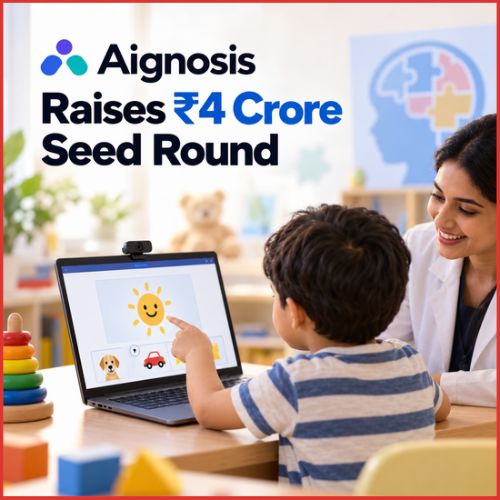
Jaipur-based healthtech startup Aignosis has raised ₹4 crore in seed funding as it prepares to expand its artificial intelligence-assisted autism and developmental screening platform across India.
The round was led by early-stage investment firm Antler and Nikhil Kamath, with participation from investors including Varun Dua and IIMA Ventures.
The Aignosis seed funding will be used to increase the startup’s presence across healthcare networks and bring its screening technology to more clinics, government health centres and schools.
Founded by Raksheet Jain and Divyansh Mangal, Aignosis is trying to address one of the more difficult parts of developmental healthcare: identifying children who may need further assessment at an earlier stage.
Aignosis Uses AI to Screen for Developmental Signals
Aignosis has developed an AI-assisted screening system intended to identify behavioural signals associated with developmental conditions.
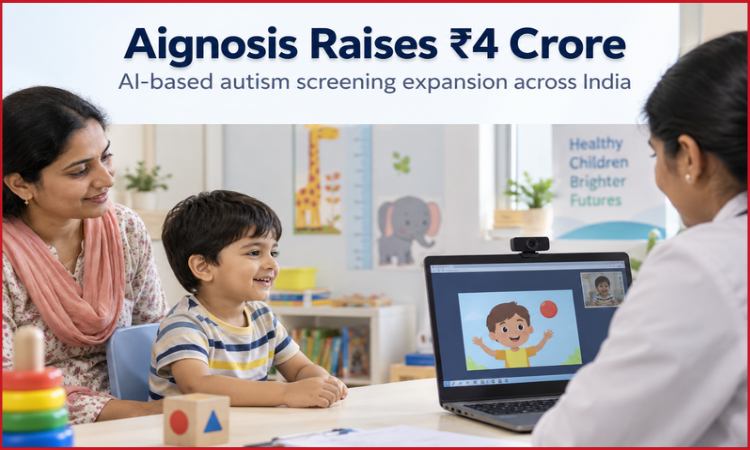
The system uses an ordinary laptop and webcam rather than specialised medical imaging hardware.
It is designed for children between 16 months and nine years of age.
During the assessment, the child watches a short video made up of nine stimulus modules.
Computer-vision models then analyse behavioural information such as gaze patterns, response to name and reactions to facial expressions.
The Aignosis autism screening platform uses those signals to create a risk report that can indicate whether further clinical assessment may be appropriate.
Importantly, the system is a screening tool rather than a diagnostic replacement. Its output is intended to help identify children who may benefit from additional evaluation by qualified healthcare professionals.
The Startup Wants to Make Screening Easier to Access
Developmental screening can be difficult to access consistently, particularly outside larger healthcare centres.
That gap is one of the problems Aignosis is trying to address.
Because the platform works with widely available computer hardware, clinics do not need highly specialised equipment simply to conduct an initial screening.
The idea is to make the first layer of assessment easier to deploy across a wider range of locations.
That can be useful in situations where a paediatrician or family notices potential developmental differences but specialist assessment is not immediately available nearby.
A scalable AI developmental screening system could help decide which children should be referred for further evaluation.
Aignosis Has Already Completed More Than 8,000 Screenings
The company says its system has been used for more than 8,000 screenings so far.
Aignosis is now targeting at least 100,000 screenings by the end of FY2026-27.
Reaching that number would require a substantial expansion from its current footprint.
The startup already operates through what it calls a Clinic-in-Clinic model and has deployed its platform across more than 20 government Primary Health Centres in Rajasthan.
It is also working with Mankind Pharma.
Medical representatives from the pharmaceutical company are supporting screening camps with paediatricians across India, giving the startup another way to reach children outside its existing locations.
Apollo Shines Partnership Could Bring the Platform Into Schools
Schools represent another possible route for developmental screening.
Aignosis is beginning operations with Apollo Shines across roughly 125 schools.
That is important because developmental differences may sometimes become more noticeable when children begin interacting regularly with classmates and teachers.
Schools can therefore become one of the places where parents are first encouraged to seek a professional assessment.
The Aignosis healthtech platform is not intended to replace that professional process, but wider screening could potentially help families recognise when a clinical evaluation should be considered.
The startup’s school expansion will also give it access to a much larger population than clinic-only deployment.
Aignosis Has Completed Its CDSCO Regulatory Process
The startup has also moved through an important regulatory step.
Aignosis has completed its Central Drugs Standard Control Organisation regulatory process and received Class B certification.
Healthtech products involving clinical screening operate in a different environment from ordinary consumer AI applications because accuracy and regulatory compliance matter directly to healthcare use.
Completing the process allows the company to move forward with a clearer regulatory foundation as it expands across different healthcare settings.
Aignosis was also part of the Google for Startups Accelerator: AI First 2025 cohort.
The programme is aimed at startups building businesses around artificial intelligence and gives participating companies access to technical and business support.
The Company Raised Its First Funding in 2024
The new ₹4 crore round is not Aignosis’ first external capital.
The company previously raised funding in 2024 from investors including Rajneesh Bhandari and Amit Jain.
That earlier backing helped the young startup develop and begin deploying its technology.
The latest healthtech seed funding comes as the company shifts towards wider commercial and institutional expansion.
Antler is known for investing at very early stages, while Nikhil Kamath has backed startups across several technology and consumer categories.
Other investors participating in the latest round add further startup and investment experience to the cap table.
Expansion Will Cover Several Indian States
Aignosis plans to expand beyond Rajasthan into multiple new regions.
The startup is targeting Punjab, NCR, Haryana, Tamil Nadu, Jharkhand, Karnataka and Maharashtra.
Rather than relying on one channel, it plans to build access across both government and private healthcare networks.
That could include hospitals, paediatric practices, primary health centres, screening camps and school programmes.
For a developmental screening startup, distribution is especially important.
A technically capable tool has limited impact if families and healthcare professionals cannot access it at the point where concerns first emerge.
Aignosis therefore needs to scale the network around the technology as much as the AI models themselves.
AI in Healthcare Needs a Careful Role
The startup is entering a part of healthcare where AI can be useful but where claims need to be tightly defined.
A screening system can help identify patterns and flag children who may require more attention.
It cannot independently replace a clinical diagnosis.
That boundary is particularly important in developmental healthcare, where assessments can involve specialists, family history, behavioural observation and other information beyond what one short digital screening can capture.
Aignosis’ stated approach reflects that distinction by providing a risk report rather than presenting its system as an autonomous diagnostic tool.
The new Aignosis seed funding will test whether that model can scale across India.
With more than 8,000 screenings already completed and a target of at least one lakh by the end of FY27, the startup is now moving from early validation towards a much larger rollout.
The ₹4 crore round gives Aignosis more capital to build that network, but its longer-term impact will depend on how effectively the technology works alongside paediatricians, clinics and other healthcare professionals as adoption grows.
Source
Entrackr: Antler, Nikhil Kamath back healthtech startup Aignosis with Rs 4 Cr seed round