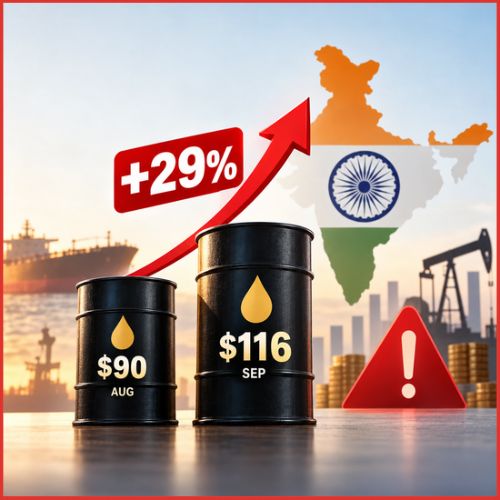
The Indian economy is faced with a new challenge in the form of a sharp rise in global oil prices. The country’s crude basket has increased by almost 29% in just over a month with concerns around inflation, imports and external balances.
The Indian crude oil basket averaged $116.04 per barrel in September, up from $90.19 in August. That represents an increase of $25.85 per barrel, or 28.66%, in one month.
The India crude oil price surge comes while domestic growth remains relatively strong, but the Finance Ministry has identified higher energy costs and uncertainty around global trade as risks that could make the external environment more difficult.
India’s Crude Basket Rose to $116.04 a Barrel
India imports most of the crude oil it consumes, making changes in global prices particularly important for the economy.
The country’s crude basket averaged $116.04 per barrel during September and was at $116.52 per barrel on September 29.
The Indian basket reflects a combination of different crude grades purchased by domestic refiners, including sweet and sour crude benchmarks.
A nearly 29% monthly jump therefore feeds directly into the cost India faces when purchasing energy from overseas.
The effect of higher crude oil prices in India does not stop with fuel.
Oil is closely connected with transport, logistics, chemicals, plastics, manufacturing and several other parts of the economy. When crude becomes more expensive for a sustained period, those additional costs can gradually move through supply chains.
A Higher Oil Import Bill Is the First Pressure Point
The most immediate economic effect comes through imports.
India buys large volumes of crude oil from overseas, so a higher price means more foreign currency is required to purchase the same amount of energy.
If elevated prices persist, the country’s merchandise import bill can increase even without a major rise in the volume of oil being consumed.
That can also affect the current account, which tracks trade in goods and services along with other cross-border payments.
A wider oil-driven trade deficit does not automatically mean the broader economy will weaken. Its effect depends on exports, services income, capital inflows and several other factors.
Still, the India oil import bill becomes more sensitive when crude prices move sharply higher in a short period.
Inflation Pressures Have Started to Increase
Energy prices also matter because transportation touches almost every product sold across the economy.
Higher diesel and logistics costs can increase the expense of moving food, industrial goods and consumer products from one location to another.
The Finance Ministry’s latest economic assessment said price pressures had intensified across retail, wholesale and producer levels amid renewed stress in global oil markets and weather-related volatility.
At the same time, the ministry said overall inflation remained largely anchored.
That distinction is important.
A sharp increase in oil does not instantly translate into an identical increase in consumer inflation. The eventual effect depends on factors including domestic fuel pricing, taxes, supply conditions and how much of the additional cost businesses pass on to customers.
India’s Domestic Growth Remains Strong
The higher oil bill is appearing against a relatively firm domestic growth backdrop.
India’s real GDP expanded 7.8% in the first quarter of FY2026-27.
Industry gross value added rose 7.7% year on year, while manufacturing recorded growth of 9.2%.
Financial services, real estate, information technology and professional services grew 12.1% during the quarter.
Those numbers show that the Indian economy 2026 entered the latest oil-price shock with considerable domestic momentum.
That does not remove the risks created by expensive energy, but it provides context for why policymakers are describing oil as a challenge rather than suggesting that one factor alone determines the broader economic outlook.
Trade Uncertainty Adds Another External Risk
The Finance Ministry has also pointed to greater uncertainty in the global trading environment.
That matters because India’s economic performance depends not only on domestic demand but also on exports, foreign investment and access to international supply chains.
Changes in tariff regimes or trading rules can alter where companies invest, manufacture and source products.
The ministry said developed economies are increasingly competing to attract manufacturing investment, which could make the competition for global capital more intense for developing economies.
For India, the combination of expensive energy and an uncertain trading environment creates two separate external pressures at the same time.
One can raise the cost of imports, while the other can influence exports and investment decisions.
FDI Could Provide Some Support
The ministry’s assessment also included a more positive signal around foreign direct investment.
Indicators suggest that FDI inflows into India could improve during FY2026-27 compared with the previous year.
Capital inflows, including banking capital and net FDI, can support the balance of payments by bringing foreign currency into the economy.
That becomes particularly relevant at a time when the oil import bill is rising.
Foreign investment cannot cancel out every effect of higher energy prices, but stronger inflows can help offset part of the pressure created elsewhere in the external account.
Oil Prices Can Also Affect the Rupee
Another area investors watch during large crude moves is the currency market.
Indian refiners generally need dollars to pay for imported oil. If the value of those purchases rises substantially, demand for foreign currency can increase.
That can place additional pressure on the rupee, although exchange rates are influenced by many other variables including global dollar movements, portfolio investment, exports and central-bank actions.
The Duration of the Oil Surge Will Matter Most
If crude remains around current elevated levels, businesses and policymakers would have to deal with higher energy costs for longer.
That is why the crude oil impact on Indian economy is less about one daily price move and more about how long the current environment continues.
India still has strong domestic growth, manufacturing expansion and potentially improving capital inflows. At the same time, its dependence on imported energy means sustained high crude prices remain an important vulnerability.
September’s nearly 29% rise has made that risk much harder to ignore. The coming months will show whether the oil spike proves temporary or becomes a more persistent test for inflation, trade and India’s wider growth momentum.
Source
NDTV: Crude Oil Surges 29% In A Month: Finance Ministry Flags Risks For Indian Economy