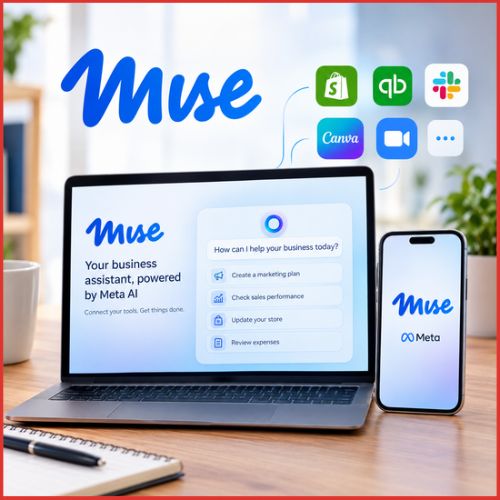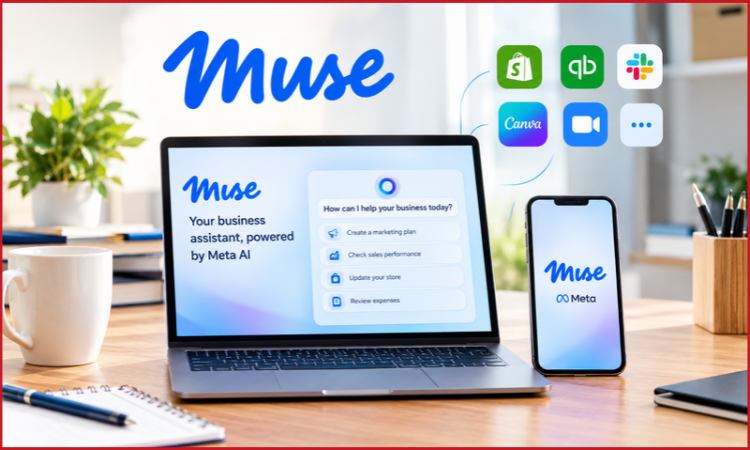
Meta is expanding its Muse AI agent beyond personal tasks and into the daily operations of small companies, giving business owners a way to connect the assistant with software they already use for sales, accounting, advertising and customer communication.
Muse for Small Business can work with services including Shopify, QuickBooks, Stripe, Canva, Slack and Zoom. It can also connect directly with professional Instagram accounts, Facebook Pages and Meta advertising accounts, allowing Muse to understand more about how a company operates before attempting a task.
The move comes only weeks after Meta introduced Muse as a personal AI agent and signals that the company sees agentic AI as a potential business product rather than only another consumer assistant.
Muse Can Work Across Business Apps
Running a small company often means information is spread across several services.
Sales might sit inside Shopify, financial information inside QuickBooks, customer discussions inside Slack and marketing assets inside Canva.
Meta wants Muse AI for business to work across those boundaries.
The company says owners can connect services including Asana, Box, Canva, Dropbox, Figma, Granola, HighLevel, Intuit QuickBooks, Klaviyo, Lovable, Notion, Shopify, Slack, Stripe and Zoom.
Muse can then use information from those systems as context when handling a request.
Instead of manually exporting figures from several apps before asking an AI a question, a business owner could potentially give Muse a broader goal and allow it to collect the relevant information from connected services.
Business Owners Can Give Muse a Goal
Meta is positioning Muse as an agent rather than a chatbot that only answers individual questions.
An owner could ask it to find new customers, prepare a marketing campaign or investigate why sales changed during a particular period.
The Meta Muse AI agent can then work across connected information to break the goal into smaller tasks.
For example, Muse could examine sales activity, review previous advertising performance and look at social engagement before suggesting what a business should try next.
The idea is particularly relevant to smaller companies because they may not have separate employees covering marketing, finance, operations and analytics.
An AI agent capable of moving between those areas could help the owner perform some of the research and administrative work that would otherwise consume a large portion of the day.
Meta Accounts Give Muse More Business Context
Meta naturally has one advantage when pitching Muse to companies already using Facebook and Instagram.
The agent can connect with Instagram professional-account analytics, Facebook Pages and Meta ad accounts.
That allows Muse for Small Business to understand information such as social activity and campaign performance without requiring the owner to manually describe everything that happened.
It could review which advertising campaigns generated better results, examine content performance and help prepare future marketing ideas.
For a small retailer, the context could extend further through Shopify and Stripe.
For another business, QuickBooks could provide financial information while Slack or Zoom provides context around ongoing work.
The value of the agent therefore depends heavily on which tools a company is willing to connect.
Muse Cannot Spend or Publish Without Approval
Giving an AI access to business systems raises an obvious question: what is it allowed to do without asking?
Meta says users remain in control.
Muse will not publish content, send messages or spend money without approval.
That creates a deliberate checkpoint between preparing an action and executing it.
The distinction becomes especially important when the connected software includes advertising accounts, payment platforms and customer communication tools.
An AI might prepare an advertising campaign or recommend a particular budget, for example, but the owner would still need to approve the spending.
Similarly, Muse can draft communication without automatically sending it to customers.
Meta’s approach allows the agent to perform more of the preparation while keeping consequential actions behind a human approval step.
QuickBooks and Stripe Could Make Muse Useful Beyond Marketing
Meta is known primarily for advertising and social media, but the latest integrations push Muse deeper into back-office operations.
QuickBooks can provide financial context, while Stripe can expose payment-related information available through an authorised business connection.
That means Meta Muse for businesses could potentially help identify unusual expenses, analyse cash-flow patterns or understand how changes in sales are affecting the broader company.
Meta is also supporting creative and productivity software.
Canva and Figma can bring Muse closer to design work, while Notion, Slack, Zoom and Asana extend the agent into project management and communication.
The result is less like one specialised marketing assistant and more like a central interface sitting above multiple business tools.
Muse Has Grown Quickly Since Its Consumer Launch
Meta introduced the consumer version of Muse earlier in September.
The personal agent was designed to handle tasks such as online shopping, travel planning, email and payments, moving beyond the question-and-answer format associated with traditional AI assistants.
The app quickly attracted attention in the US and Canada.
Market-intelligence estimates cited in reporting put downloads at roughly 2.8 million during its first two weeks.
Meta is now trying to translate that early consumer interest into a business use case.
The company says around one-third of some early Muse users were already connecting the agent with business accounts, suggesting professional workflows were emerging even before the dedicated small-business push.
Meta Is Looking Beyond Advertising Revenue
The launch also matters strategically.
Advertising remains central to Meta’s business, but AI subscriptions and enterprise tools create opportunities for additional revenue streams.
Muse is free for most uses, while paid subscription options are available for users who need greater access and additional capabilities.
That puts the company into a business software market where Microsoft, Google and numerous AI startups are already trying to convince organisations to adopt AI assistants.
Meta’s angle is different because millions of small businesses already use Facebook, Instagram and WhatsApp to reach customers.
Connecting those existing relationships with accounting, commerce and productivity applications could give Muse AI a natural entry point.
Small Businesses Are the Real Test for AI Agents
There is a large gap between producing a good answer and running part of a real business.
Small-company owners need tools that save time without creating extra work checking incorrect results.
Muse therefore needs to prove it can move reliably between connected systems, understand context correctly and know when human approval is required.
The appeal is easy to see.
A shop owner who spends the morning checking sales, reviewing social posts, updating advertisements and responding to operational issues could potentially ask one agent to prepare much of that work.
Whether that promise holds up will depend on how consistently Muse handles real company data.
For Meta, Muse for Small Business represents an important expansion beyond consumer AI. Rather than simply asking people to chat with another assistant, the company wants Muse to become a layer connecting the software that businesses already use.
If that works, Meta could end up competing for a very different type of customer from the everyday Facebook or Instagram user: the small-business owner looking for an extra pair of digital hands.
Source:
RS Web Solutions: Meta Introduces Muse for Small Businesses as Zuckerberg Expands Beyond Consumer AI Sector