Artificial intelligence is becoming a bigger part of how people decide what to buy online, and the shift is expected to accelerate sharply during the upcoming holiday shopping season.
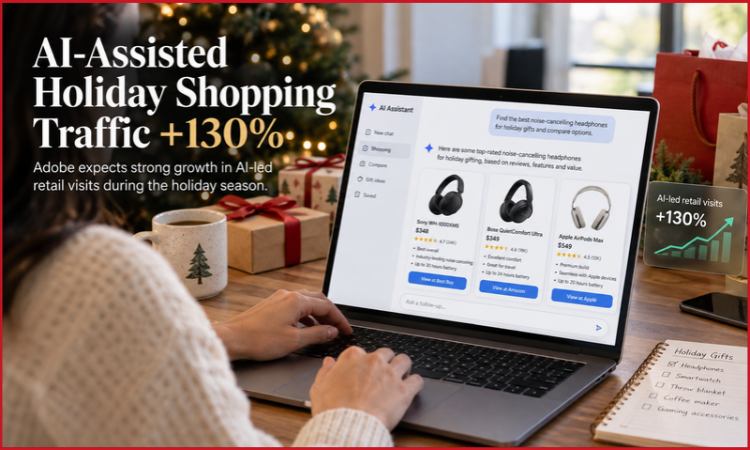
Adobe expects AI-assisted shopping traffic to US retail websites to rise 130% year on year during November and December as more customers turn to services such as ChatGPT and Claude to research products, compare options and find deals.
The forecast comes alongside another record expected for online retail. US consumers are projected to spend $275.1 billion online during the two-month holiday period, an increase of 6.7% compared with last year.
Shoppers Are Using AI Before Visiting Retail Websites
The AI trend Adobe is measuring does not mainly involve bots automatically purchasing products for people.
Instead, consumers are increasingly starting the shopping process inside an AI assistant.
Someone looking for a new laptop might ask a chatbot to compare several models, explain which specifications matter and narrow the list down based on a budget. The user can then follow a link from that conversation to a retailer.
Adobe counts those visits as AI shopping traffic.
The measurement focuses on shoppers arriving at retailers from independent AI services such as ChatGPT or Claude.
It does not include customers using an AI shopping assistant after they are already on a retailer’s own website.
That distinction gives a better picture of how AI is beginning to compete with traditional search engines and other discovery channels at the very beginning of a purchase.
AI Visitors Are More Likely to Buy Something
The volume of traffic remains relatively small compared with conventional search, direct visits and other established sources.
What makes it interesting is how those shoppers behave after reaching a retailer.
Adobe says people arriving through AI-assisted research are more likely to complete a purchase and tend to spend more per transaction than visitors coming through non-AI channels.
One possible reason is that much of the research has already happened before the customer reaches the website.
Instead of opening dozens of product pages and trying to understand the differences, the shopper may arrive with a much shorter list of products.
That could make AI-assisted online shopping particularly valuable to retailers even before it becomes a huge percentage of overall traffic.
Thanksgiving Could See the Biggest AI Jump
The use of AI is expected to rise throughout the holiday period, but several major shopping dates could experience especially sharp increases.
Adobe expects AI-driven traffic to retail websites to climb 159% year on year on Thanksgiving.
Black Friday traffic from AI services is forecast to rise 95%, while Cyber Monday could see an 88% increase.
Those numbers suggest consumers are no longer using chatbots only for occasional product questions.
AI tools are becoming part of the process people use when they are actively hunting for discounts during the busiest shopping period of the year.
Retailers may therefore have to think more carefully about how their products appear when AI systems answer shopping questions.
Online Holiday Spending Could Reach $275.1 Billion
AI is only one part of a much larger increase in US e-commerce.
Adobe expects online spending between November 1 and December 31 to reach $275.1 billion, up 6.7% year on year.
The forecast is based on Adobe Analytics data covering more than one trillion visits to US retail sites, around 100 million products and 18 retail categories.
Cyber Week alone is expected to generate $47.5 billion in online spending.
That five-day period runs from Thanksgiving through Cyber Monday and could account for about 17.3% of all online holiday spending.
Cyber Monday is expected to remain the biggest individual e-commerce day, with sales reaching approximately $15.1 billion.
Black Friday could generate $12.9 billion and is forecast to grow faster than Cyber Monday this year.
Discounts Could Reach 30% in Some Categories
Retailers are expected to compete aggressively on price.
Adobe forecasts discounts of as much as 30% off listed prices in some categories during the season.
The deepest promotions are expected around the period from Thanksgiving through Cyber Monday.
Consumers are also expected to use those discounts for more than expensive electronics and traditional holiday gifts.
Everyday essentials are becoming a bigger part of seasonal online shopping.
Products such as personal-care items and household cleaning supplies could attract buyers who want to stock up while prices are lower.
Electronics and apparel are still expected to remain among the biggest spending categories overall.
Groceries and toys, however, are forecast to grow at a faster pace.
AI Could Change the Digital Advertising Business
The rise of AI shopping assistants matters beyond retail sales.
For years, online shopping discovery has been heavily influenced by Google Search, social media advertising, Amazon and retailer marketplaces.
Companies spend enormous sums to ensure their products appear in front of people when they begin searching.
Chatbots introduce a different route.
Instead of looking through a page of links or sponsored products, a user can ask one detailed question and receive a shortlist.
If that behaviour continues growing, brands may eventually need to think about how products are discovered and recommended inside AI responses as carefully as they currently think about search rankings and social advertising.
The shift could have implications for the roughly $400 billion digital advertising market dominated by companies including Alphabet, Meta and Amazon.
Consumers Say AI Makes Them More Confident
Adobe’s consumer survey also suggests people who already use AI for shopping are beginning to trust the process.
Among respondents who had used AI for online shopping, 77% said it made them feel more confident in their purchase decision.
Another 69% said they were less likely to return a product they had purchased after using AI.
Those numbers could be particularly attractive to retailers.
Returns are expensive because businesses have to handle shipping, inspection and in some cases discounted resale or disposal.
If AI product research helps customers understand an item better before ordering it, fewer unsuitable purchases could reduce some of those costs.
It could also explain why AI-assisted shoppers appear more willing to complete transactions once they reach a retailer.
AI Still Handles Research More Often Than Payment
Despite the growth, fully autonomous shopping remains limited.
Most people using AI are still relying on it to research products rather than handing over the entire buying process.
There are technical and commercial barriers too.
Major retailers do not necessarily allow third-party AI agents to enter their platforms and make purchases automatically. Amazon, for example, has restricted access for some outside AI assistants.
That means the near-term transformation is more likely to happen in product discovery than checkout.
People may increasingly ask a chatbot what they should buy, while still completing the final transaction themselves.
Holiday 2026 Could Show How Quickly Shopping Habits Are Changing
AI remains a small source of retail traffic compared with established channels, so a 130% increase should not be mistaken for AI replacing conventional online shopping overnight.
But the speed of growth is difficult to ignore.
The holiday season offers an unusually useful test because hundreds of billions of dollars are spent within a short period, giving researchers a large amount of consumer behaviour to analyse.
If AI-assisted shopping traffic continues bringing retailers customers who are more confident, spend more and return fewer products, businesses will have a strong incentive to take the channel more seriously.
For now, chatbots are mainly helping shoppers decide.
The larger question is how long it will be before they move from recommending what to buy to handling a much bigger portion of the transaction itself.