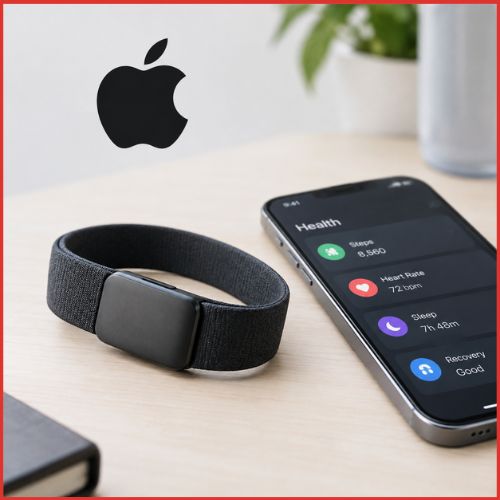
Apple is exploring a new kind of wearable that could sit alongside the Apple Watch rather than replace it. The company is developing prototypes of a thin, screenless health and fitness tracker aimed at the same market currently served by devices such as Whoop.
The proposed Apple fitness tracker would focus far more heavily on health, recovery and continuous body data than the company’s existing smartwatch lineup. Instead of giving users another display for apps, messages and notifications, the device would be built around sensors and long-term fitness tracking.
The project is still at an early stage, and Apple has not decided whether it will ever reach the market. If it does, a launch is unlikely before 2028.
Apple Is Testing a Different Kind of Wearable
The biggest difference between the new device and the Apple Watch is obvious: there is no screen.
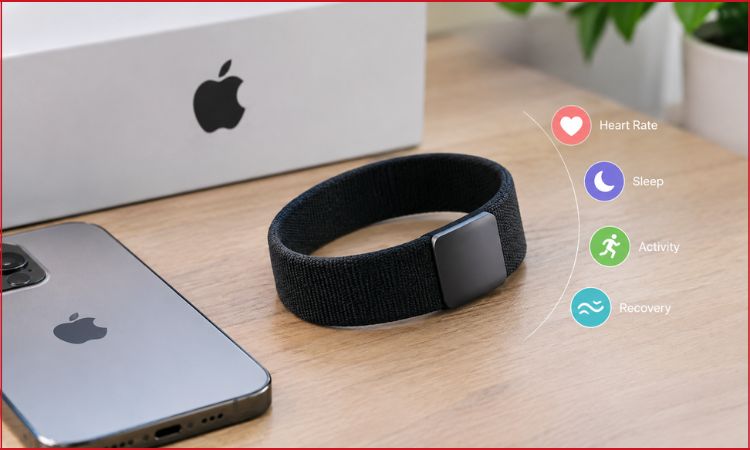
Apple’s prototypes reportedly use a thin fabric band connected to a small computing module containing the required sensors. That design would put the device much closer to a Whoop rival than a conventional smartwatch.
Whoop has built its reputation around always-on fitness data rather than apps or a display. Users wear the band continuously while the system tracks information such as heart rate, sleep, recovery and training strain.
Apple appears interested in the same basic idea.
Removing the screen could allow the company to make the product lighter and less distracting, while encouraging users to keep it on for longer periods. It would also create a clear difference between the new band and the Apple Watch.
The Product Is Still Only a Prototype
Apple is not yet preparing the device for an immediate launch.
The work is currently considered a technology investigation, which means the company is testing whether the idea makes enough sense technically and commercially before committing to a finished product.
Multiple prototypes have reportedly been developed, but Apple could still abandon the project.
That is worth remembering because the company tests many products internally that never appear in stores.
Even if development continues, the screenless fitness tracker is not expected to arrive before 2028. That gives Apple plenty of time to change the hardware, sensors or overall purpose of the device.
The long timeline also suggests the company is not simply trying to rush out a direct Whoop copy.
Tim Cook and Eddy Cue Are Reportedly Interested
The project has attracted attention from senior Apple leadership.
Tim Cook is said to have shown particular interest in the idea, while services chief Eddy Cue has also been involved. Cue took over more responsibility for Apple’s health operations after leadership changes inside the company’s wearable business.
That interest is significant because health has become one of Apple’s most important long-term product areas.
The Apple Watch has steadily gained more health features over the years, while the Health app has become a central place for storing and presenting information collected across Apple devices.
A separate Apple fitness tracker would allow the company to push further into continuous health monitoring without forcing every new capability into the Apple Watch.
Whoop and Oura Are Changing the Wearables Market
Apple remains one of the biggest smartwatch companies in the world, but the health-wearable market is no longer centred only on traditional watches.
Whoop has grown by focusing heavily on training, recovery and readiness rather than everyday smartwatch functions.
Oura has taken another route with its smart ring, giving users detailed sleep and health data from a small wearable that can remain on the body for long periods.
Both companies have attracted millions of users.
Their success shows that many customers do not necessarily want another small smartphone screen on their wrist. Some are happy with a device that quietly gathers data in the background and presents the results later through an app.
That shift appears to be influencing Apple’s thinking.
Apple Watch Is Already Picking Up Similar Features
Apple has not waited for a new device before responding to those trends.
Recent Apple Watch and Apple Health updates have started moving closer to the recovery-focused experience offered by companies such as Whoop.
The newest software includes more detailed heart-rate information, readiness-style metrics and health insights intended to give users a broader picture of how their body is performing.
Apple has also been working on ways to estimate biological age using health information collected over time.
The Health app itself has been redesigned to present data more clearly, reducing some of the complexity that can come with tracking large numbers of health measurements.
A screenless band could take those ideas further by becoming a dedicated source of continuous data rather than another general-purpose device.
Google Is Already Moving Into This Space
Apple would not be entering an empty market.
Google has also moved towards screenless wearables with Fitbit Air, showing that large technology companies see an opportunity beyond conventional smartwatches.
Garmin has been exploring similar ideas while maintaining its strong position among runners and outdoor athletes.
That puts more pressure on Apple to decide whether the Apple Watch alone is enough to cover every type of health-focused customer.
Someone who wants apps, maps, notifications and calls on the wrist may still prefer an Apple Watch.
A user mainly interested in sleep, recovery and fitness trends may see less value in paying for a large display and smartwatch features they rarely use.
A Whoop rival would let Apple serve both groups.
Vision Pro Engineers Are Helping With the Project
Apple’s Vision hardware team has reportedly been involved in the early engineering work.
That group developed the Vision Pro and is also working on other wearable products, including smart glasses and AirPods with cameras.
Bringing those engineers into the fitness project suggests Apple is treating wearables more broadly rather than separating every product into its own category.
The company has several devices under development that are designed to stay on or near the body throughout the day.
A lightweight fitness band fits naturally into that wider strategy.
Apple Could Build a Larger Health Ecosystem
The most interesting part of the project may be how it fits alongside products Apple already sells.
The company does not necessarily need the screenless fitness tracker to replace the Apple Watch.
Instead, it could become a cheaper or more specialised option for people who want health monitoring without a smartwatch.
It could also potentially work alongside other Apple devices, feeding continuous information into the Health app while an iPhone handles the display and analysis.
That approach would give Apple another way to keep users inside its health ecosystem.
Whether the company actually releases the product remains uncertain. The project is still early enough to be cancelled, redesigned or delayed.
But the fact that Apple is building prototypes shows that the company is taking the rise of simpler, health-first wearables seriously.
The Apple Watch will likely remain the centre of Apple’s wearable business for years to come. A smaller, screenless band could give the company a second route into the same market — one focused less on what users can do on their wrist and more on what their body is doing throughout the day.
Source:
The Star: Apple is developing new fitness tracker aimed at rivalling Whoop