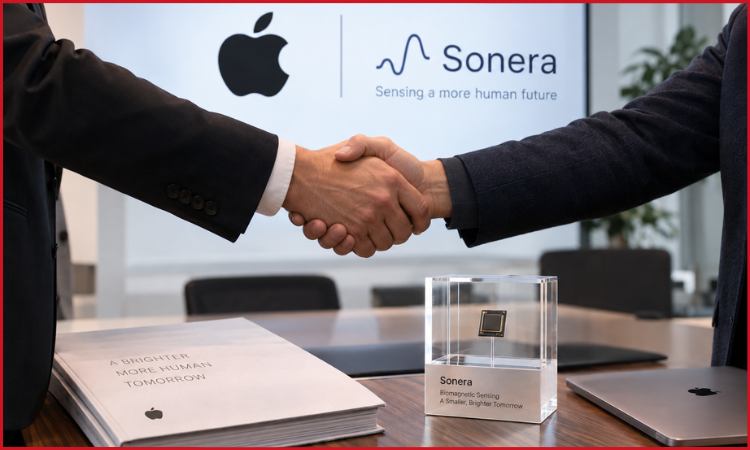
Apple has acquired Sonera, a California startup developing chip-based sensors that can detect magnetic signals produced by brain and muscle activity, potentially adding a new sensing capability to the company’s future wearable devices.
The acquisition was completed in May 2026 but only became public after appearing in the European Commission’s database of transactions disclosed under the Digital Markets Act. Neither Apple nor Sonera has issued a detailed public announcement about the deal.
Financial terms were not disclosed. Apple has also not revealed whether Sonera’s technology will be incorporated into the Apple Watch, AirPods, Vision Pro or another product. Any connection with specific future devices therefore remains speculative.
The confirmed development is Apple’s purchase of a company working on non-invasive biomagnetic sensing, a technology designed to collect information from the body without surgery or direct electrical contact with the skin.
Sonera Uses Magnetic Signals Instead of Electrical Sensors
Most consumer devices that monitor muscle or brain activity rely on electrical signals. Electroencephalography, commonly called EEG, records electrical activity associated with the brain, while electromyography measures electrical signals produced by muscles.
Sonera developed an alternative method that measures the weak magnetic fields created by the electrical currents accompanying neural and muscular activity.
Traditional magnetoencephalography systems used for brain imaging are generally large and expensive. Many depend on highly sensitive equipment, specialised shielding and cooling systems, which makes them unsuitable for everyday wearable products.
Sonera’s approach is based on acoustically driven ferromagnetic resonance, or ADFMR. Its sensors use interactions between acoustic waves and magnetic materials to detect changes in an external magnetic field.
Patents associated with the technology describe a voltage-driven design intended to operate with low power consumption. Sonera’s broader objective was to reduce biomagnetic sensing to a chip-sized system that could work at room temperature and eventually fit inside portable products.
The company’s first announced application was the S1 chip, designed primarily for muscle sensing. Sonera said the sensor could collect high-quality signals without requiring direct skin contact.
Potential applications identified by the startup included prosthetic control, sports-performance analysis, continuous monitoring of neuromuscular conditions and the discovery of health-related biomarkers. These were development goals rather than functions available in an Apple product.
Acquisition Adds Technology and Research Expertise
Sonera was founded in 2018 by Nishita Deka and Dominic Labanowski while they were students at the University of California, Berkeley. Initially known as Sonera Magnetics, the company emerged from stealth mode in 2023.
It announced an $11 million seed-funding round led by Amplify Partners, with Abstract Ventures and existing investors participating. The financing brought Sonera’s total capital raised at the time to $20 million.
Other backers included Spark Capital, Material Impact, Boom Capital and Josh Duyan, co-founder of CTRL-Labs. Meta acquired CTRL-Labs in 2019 to obtain its technology for translating muscle signals into digital commands.
Sonera’s work also attracted support through United States government research programmes. A federal small-business database lists projects involving human-machine interaction and wearable biomagnetic sensors, including work connected with the US Air Force.
The startup’s website has since been taken offline, although its patents and earlier technical material remain available. Apple has not said how many Sonera employees are joining the company or whether the startup will continue operating as a separate organisation.
The acquisition gives Apple access to more than a single experimental sensor. Sonera has developed intellectual property covering ADFMR devices, low-power sensor arrays and wearable systems for detecting biological magnetic fields.
Apple has frequently purchased small technology companies to secure specialised engineering teams and intellectual property before incorporating their work into larger products. PrimeSense’s three-dimensional sensing technology, for example, contributed to the development of Face ID after Apple acquired the company in 2013.
That history does not guarantee that Sonera’s research will become a commercial feature. Moving a sensitive laboratory measurement system into a compact consumer device requires improvements in accuracy, power use, interference protection, manufacturing cost and software interpretation.
Apple Has Not Confirmed a Brain-Controlled Device
The most immediate possibilities involve devices worn close to the head or major muscle groups. AirPods, headsets and smart glasses could provide useful locations for neural or facial-muscle sensors, while the Apple Watch could potentially monitor muscular activity from the wrist.
Such technology might eventually support hands-free controls, accessibility tools or health measurements. A system capable of interpreting reliable muscle signals could allow a user with limited mobility to operate an interface through subtle movements.
More advanced brain-computer interaction is a longer-term possibility. Sonera said its underlying sensing platform could help make brain activity easier to measure, but the S1 was introduced specifically as a muscle-sensing product. Apple has not announced a consumer device that reads thoughts or directly translates brain activity into commands.
Medical uses would also face a higher standard than general wellness features. Any product intended to diagnose, monitor or treat a medical condition could require clinical evidence and clearance from health regulators.
Collecting neural information would additionally create significant privacy questions. Brain- and muscle-signal data could be more sensitive than conventional fitness measurements, making device-level processing, user consent and limits on data access central to any eventual product.
For now, the Sonera acquisition is a strategic technology purchase rather than a product launch. It expands Apple’s research capabilities in health sensing and human-computer interaction, but the company has disclosed no device, release date or commercial plan.