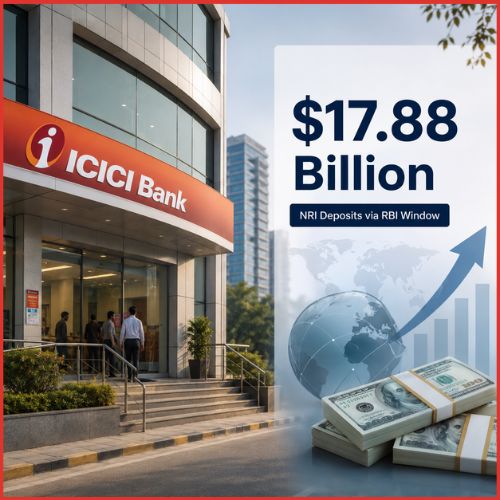
ICICI Bank mobilised approximately $17.88 billion through foreign-currency deposits from non-resident Indians under a special Reserve Bank of India swap facility, highlighting the scale of dollar inflows attracted by the programme before its August 31 closure.
The private-sector lender disclosed the figure in an exchange filing on September 2. At the exchange rate used by the bank, the FCNR(B) deposits were worth about ₹1.70 lakh crore.
ICICI Bank said the information was provisional and unaudited. The figure represents gross mobilisation rather than profit, revenue or money available for unrestricted deployment.
The disclosure also showed that the bank’s international branches and subsidiaries had provided approximately $9 billion, or ₹85,600 crore, in loans backed by these deposits.
It issued another $3.63 billion, equivalent to roughly ₹34,600 crore, in standby letters of credit to other banks for loans connected with the deposits.
How the RBI Facility Worked
Foreign Currency Non-Resident Bank, or FCNR(B), accounts allow eligible non-resident Indians to maintain fixed deposits in designated foreign currencies.
Because the deposit and its interest are repaid in the same currency, the customer does not directly bear the risk of the rupee weakening during the deposit period. For banks, however, accepting foreign-currency funds can create hedging costs when the money is deployed or converted into rupees.
The RBI introduced a concessional swap arrangement in June to reduce that expense and attract overseas currency into India’s financial system.
Under the arrangement, a participating bank could sell eligible US dollars to the RBI at the prevailing reference rate and simultaneously agree to buy the same quantity back when the deposit matured. The swap was offered at a fixed annual rate of 1.5%, compounded half-yearly.
The facility applied to eligible fresh FCNR(B) deposits with maturities of three to five years. It gave banks greater certainty over the cost of converting and later repurchasing the foreign currency.
The window was originally expected to remain available until September 30. The RBI brought the deadline forward to August 31 after the programme attracted stronger-than-expected inflows.
By July 31, banks had mobilised $36.73 billion of eligible deposits under the facility. That amount had increased to $52.3 billion by August 13, prompting the early closure.
ICICI Bank’s final disclosed mobilisation of $17.88 billion therefore represents a substantial contribution to the wider programme. Comparable final figures for the complete banking system had not been published alongside the lender’s announcement.
Deposits Support Overseas Lending
More than half of ICICI Bank’s gross mobilisation was connected with loans provided through its international operations.
The $9 billion of lending against the deposits does not mean that those funds have been distributed as ordinary domestic retail loans. The bank specifically said the loans were provided by its international branches and subsidiaries.
The $3.63 billion of standby letters of credit represents a different form of exposure. These instruments generally provide a payment guarantee to another financial institution if the borrower does not meet an agreed obligation.
Letters of credit are therefore contingent commitments rather than immediate cash advances of the same amount. They still create credit and liquidity considerations for the issuing bank and are monitored as part of its wider risk-management framework.
ICICI Bank did not provide details about the individual borrowers, industries, loan maturities or geographical distribution of these facilities in its disclosure.
The lender also said it had issued an aggregate $3.55 billion of US dollar-denominated bonds during July and August. Using the filing’s convenience conversion, the bonds were worth approximately ₹33,800 crore.
These bond issuances were previously announced separately and are not included as part of the $17.88 billion FCNR(B) deposit figure. Together, however, the deposits and bonds show that ICICI Bank undertook a significant overseas funding exercise during the two-month period.
Dollar Inflows Strengthen RBI’s Position
The special swap window formed part of a broader RBI effort to bring foreign currency into India and support the rupee during a period of pressure from expensive crude oil and elevated global interest rates.
When banks sell the dollars collected through FCNR(B) deposits to the central bank, the RBI receives immediate foreign-currency liquidity. At the same time, it assumes a future obligation to return those dollars when the swaps mature.
This affects the RBI’s forward foreign-exchange position. Its outstanding net forward commitments climbed to a record $136.7 billion in July as deposit inflows increased under the programme.
The swaps can strengthen near-term dollar availability, but they do not represent permanent additions of the same size to foreign-exchange reserves because the transactions must eventually be reversed.
They can also inject substantial rupee liquidity into the banking system. Excess liquidity may push short-term money-market rates below the policy rate, potentially requiring the RBI to absorb funds through other operations.
For ICICI Bank, the disclosure confirms that the special window provided access to a large pool of medium-term foreign-currency funding. The bank must now manage the cost of those deposits, the credit quality of loans made against them and the timing of repayments when the underlying swaps and deposits mature.
The headline figure is significant: ICICI Bank mobilised $17.88 billion, extended $9 billion of related overseas loans and provided $3.63 billion in standby guarantees. However, all amounts remain provisional and should not be interpreted as an equivalent increase in the bank’s earnings or capital.