Ten years ago, most of the companies on this list were slide decks running on founder savings and a handful of angel checks. Today they move salaries, groceries, insurance premiums, and cricket-season bets for hundreds of millions of Indians every single day.
That shift is what makes tracking the most valuable startups in India 2026 more than a leaderboard exercise. It is a read on where investor conviction, consumer habit, and regulatory tailwinds are actually converging.
India’s unicorn count has now crossed 71, with combined valuations exceeding $185 billion, and the ten most valuable startups alone account for more than $61 billion of that figure (Beinsure, 2026).
Rankings here are based on the latest disclosed or credibly estimated private-market valuation for each company as of 2026, cross-checked across funding trackers, investor disclosures, and press filings, not on revenue, user count, or funding raised alone.
How We Ranked
This list isn’t built on funding-round size alone. Beyond valuation, weight was given to market leadership within a company’s own segment, scale of user or merchant base, growth trajectory over the past two years, and how close a company sits to a public listing, since IPO chatter often forces a valuation reset that private markdowns don’t.
The ten companies here span fintech, quick commerce, online gaming, hospitality, edtech, and enterprise AI, so this isn’t a single-sector comparison. It’s a broad view of which privately held, venture-backed businesses currently carry the most weight across the Indian startup ecosystem 2026 has produced, and why.
Quick Glance
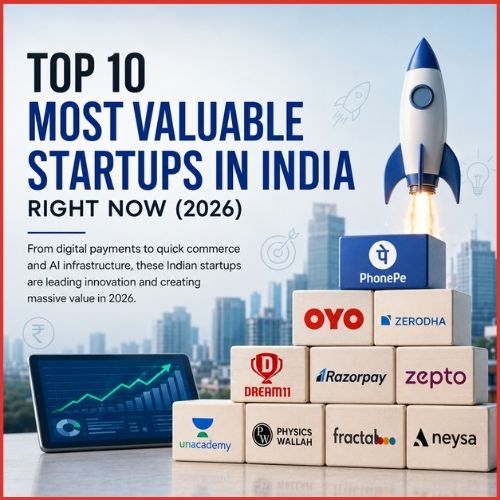
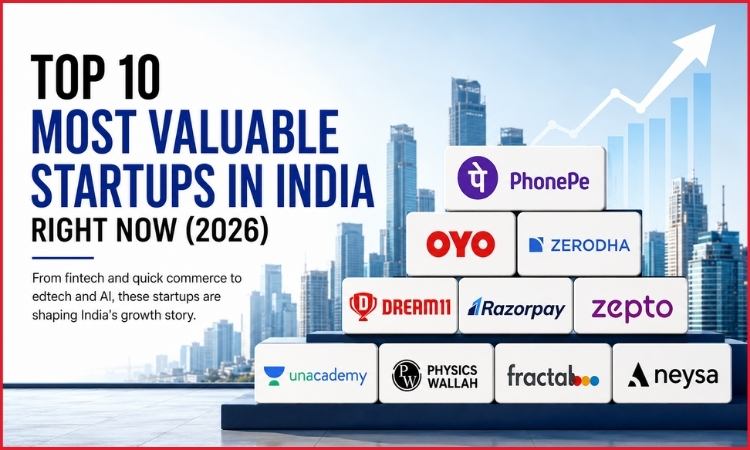
| Rank | Name | Founded | Sector / Focus | Valuation (2026) | Core Strength |
| 1 | PhonePe | 2015 | Fintech / Digital Payments | $12 B | UPI market leadership; payments, insurance, broking, lending in one app |
| 2 | OYO | 2013 | Hospitality / Travel-tech | $9 B | Asset-light hotel network, wide global footprint |
| 3 | Zerodha | 2010 | Fintech / Stockbroking | ~$9 B | India’s largest discount broker, profitable without VC funding |
| 4 | Dream11 | 2008 | Online Gaming / Fantasy Sports | $8 B | Dominant fantasy sports platform, IPL-linked user surges |
| 5 | Razorpay | 2014 | Fintech / Payments Infrastructure | $7.5 B | API-first payment stack built for businesses |
| 6 | Zepto | 2021 | Quick Commerce | ~$7 B | Ten-minute delivery via dense dark-store network |
| 7 | Unacademy | 2015 | Edtech | $3.44 B | Live, video-led classes for competitive exam prep |
| 8 | PhysicsWallah | 2020 | Edtech / Test Prep | $2.8 B | Low-cost pricing model, strong vernacular reach |
| 9 | Fractal Analytics | 2000 | Enterprise AI / Analytics | $1.6-2.4 B | AI consulting for Fortune 500 clients, pre-IPO stage |
| 10 | Neysa | 2023 | AI Cloud Infrastructure | ~$1.4 B | Sovereign, India-first AI cloud, fastest unicorn climb of 2026 |
1. PhonePe
PhonePe tops this list at a $12 billion valuation, the highest among India’s still-private startups (MyGreatLearning, 2026). Founded in 2015 by Sameer Nigam, Rahul Chari, and Burzin Engineer, it built India’s largest UPI payments platform before expanding into insurance distribution, stock broking, and lending. Its scale on UPI rails alone would justify the top spot; the super-app layered on top is what keeps it there. An IPO filing is widely expected later this year, which could either validate or complicate this figure.
2. OYO
OYO holds the number two spot at a $9 billion valuation, built on an asset-light model that franchises budget and mid-range hotels rather than owning them (Beinsure, 2026). Ritesh Agarwal started the company in 2013. Hospitality is a thin-margin business, and OYO’s valuation reflects a bet on network breadth surviving that pressure.
3. Zerodha
Zerodha sits close behind at roughly $9 billion, and it earned that mark without ever raising outside venture capital (Beinsure, 2026). Nithin Kamath and Nikhil Kamath bootstrapped the discount brokerage into India’s largest by active client count, profitable from early on. That combination of scale plus profitability without dilution is rare enough among unicorn startups in India to be worth calling out on its own.
4. Dream11
Dream11’s $8 billion valuation makes it the highest-valued gaming startup in the country (Beinsure, 2026). Harsh Jain and Bhavit Sheth built a fantasy sports platform whose user numbers spike hard around IPL season, then plateau between tournaments, a seasonality pattern few other names here have to manage. It remains the clearest example of a single sport-linked product anchoring a multi-billion-dollar company.
5. Razorpay
Razorpay is valued at $7.5 billion, built on payment infrastructure rather than a consumer-facing app (Beinsure, 2026). Harshil Mathur and Shashank Kumar designed it around APIs that businesses plug into directly, covering everything from checkout to vendor payouts. Its growth has tracked India’s formal digital economy closely.
6. Zepto
Zepto rounds out the upper half at close to $7 billion, reaching that mark just four years after its 2021 founding (MyGreatLearning, 2026). Aadit Palicha and Kaivalya Vohra built the company around ten-minute grocery delivery, backed by a dense network of dark stores in major cities. Few names among the top Indian startups 2026 has produced have compressed a typical fundraising timeline this hard.
7. Unacademy
Unacademy is valued at $3.44 billion, one of the few edtech names to hold a top-ten spot after the sector’s post-pandemic correction (Beinsure, 2026). Gaurav Munjal, Roman Saini, and Hemesh Singh built it around live, video-led classes for competitive exam prep. Investor focus across edtech has shifted hard toward profitability, and Unacademy’s continued presence here says more about staying power than explosive growth.
8. PhysicsWallah
PhysicsWallah trails Unacademy at $2.8 billion, built on a pricing model that undercut the rest of India’s test-prep industry from day one (Beinsure, 2026). Alakh Pandey started it as a YouTube channel before turning it into a full company with Prateek Maheshwari. Its valuation held up better than most edtech peers, partly because the low-cost model never leaned on pandemic-era spending to look attractive.
9. Fractal Analytics
Fractal Analytics carries an estimated valuation between $1.6 billion and $2.4 billion, the most enterprise-facing name on this list (StartupArticle, 2026). Founded by Srikanth Velamakanni and Pranay Agrawal, it sells AI and analytics consulting to Fortune 500 clients rather than chasing a consumer audience. It is also preparing for a public listing, alongside several bigger names above it.
10. Neysa
Neysa closes the list at roughly $1.4 billion after raising $1.2 billion in February 2026, one of the largest single rounds in Indian startup history (MyGreatLearning, 2026). It builds sovereign, India-first cloud infrastructure for AI workloads, an area where most domestic AI companies still lean on foreign providers. Reaching unicorn status this fast makes it the most consequential new entrant this year, and a name worth watching among India’s most valuable unicorns.
What These Companies Have In Common
Beyond venture backing and billion-dollar-plus valuations, most of these companies solved a distribution problem before they solved a product problem. PhonePe, Razorpay, and Zerodha rode UPI and formal financial-market rails that barely existed a decade ago, while Zepto and Dream11 built around consumer habits, impatience and cricket, that don’t translate to other markets. That’s also why this isn’t a strict single-metric ranking: a quick-commerce app and an AI consultancy don’t compete for the same rupee, but both carry real weight in any honest conversation about India’s most valuable unicorns.
Key Takeaways
- Fintech still anchors the top of the table: PhonePe, Zerodha, and Razorpay together account for close to $28.5 billion in disclosed 2026 valuation.
- Zepto’s rise shows quick commerce can now outscale slower-growing sectors in a handful of years rather than decades.
- Edtech valuations have cooled sharply since the pandemic; only PhysicsWallah and Unacademy held on to a spot among unicorn startups in India this cycle.
- Neysa’s emergence signals that AI infrastructure, not just AI applications, is starting to attract serious capital.
- Several companies here, including PhonePe, OYO, and Fractal Analytics, are IPO-track, meaning today’s private valuation may not survive first contact with public markets.
- India’s broader unicorn base has crossed 71 companies worth over $185 billion combined (Beinsure, 2026), so scale alone no longer guarantees a spot at the very top.
Conclusion
None of these ten companies got here by accident, and none are guaranteed to stay. Valuations set in private funding rounds are estimates, not settled facts, and several names on this list will find out how durable their numbers are once public investors get a vote.
What’s clearer is the shape of the ecosystem underneath them. Payments infrastructure, quick commerce, and enterprise AI are pulling ahead of edtech and pure e-commerce as the sectors most likely to produce the next wave of top Indian startups 2026 has to offer.
For founders, CXOs, and investors tracking Indian startup valuations 2026, the more useful question isn’t who’s on this list today. It’s which of the next fifty companies is quietly building toward it.
Frequently Asked Questions
1. Which is the most valuable startup in India right now?
PhonePe holds that position in 2026 at an estimated $12 billion valuation, ahead of OYO and Zerodha, both near $9 billion (MyGreatLearning, 2026). Its lead comes from UPI market share layered with insurance, lending, and broking products.
2. How was this ranking of the most valuable startups in India 2026 decided?
Companies were ranked primarily by their latest disclosed or credibly estimated private-market valuation, cross-checked across multiple funding trackers and investor disclosures. Market leadership, user scale, and proximity to a public listing were used as secondary factors where valuations sat close together.
3. Are any of these startups already listed on a stock exchange?
No. This list is limited to companies still privately held and venture-backed as of 2026; startups that have already completed an IPO were excluded to keep the comparison consistent.
4. Which sector produces the highest-valued startups in India?
Fintech leads by a clear margin, with PhonePe, Zerodha, and Razorpay all appearing in the top five. Quick commerce, gaming, and enterprise AI follow behind it in this year’s Indian startup valuations 2026 landscape.
5. Why have edtech valuations dropped compared to a few years ago?
Investor appetite shifted toward profitability and sustainable unit economics once pandemic-era demand for online learning normalized. PhysicsWallah and Unacademy still hold billion-dollar-plus valuations, but both trail well behind the fintech and quick-commerce names above them.
6. Will these valuations change once companies like PhonePe or OYO go public?
It’s likely. Private valuations are set in funding rounds negotiated between a company and a small group of investors, while a public listing exposes that number to the full market, sometimes upward and sometimes downward, as seen with other recent Indian startup IPOs.