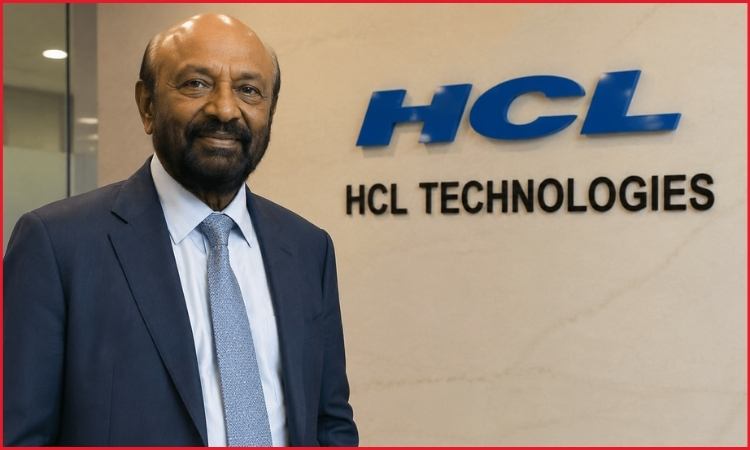
A leaking-roof barsati in Delhi is not where you’d expect to find the birthplace of a company that now earns close to fifteen billion dollars a year. But that’s exactly where Shiv Nadar and five friends started, at the precise moment multinational computer makers were leaving India behind. Their venture, Hindustan Computers Limited, opened its doors on August 11, 1976 — right as that exodus created a gap nobody local had the confidence to fill.
This is the story of an engineer who read that gap correctly and spent five decades building around it: the garage, the near-misses, the pivot that could have sunk the company, and the succession plan that didn’t.
Quick Glance
| Founder | Shiv Nadar |
| Company | HCL Technologies (originally Hindustan Computers Limited) |
| Founded | August 11, 1976, in a garage in Delhi |
| Sector | Information Technology Services and Engineering |
| Key Stat | Consolidated revenue of $14.8 billion for the twelve months ending June 2026 (HCLTech Investor Relations, 2026) |
| Current Status | Publicly listed; chaired by Roshni Nadar Malhotra, with Shiv Nadar as Chairman Emeritus |
| Founder | Shiv Nadar |
Shiv Nadar’s Early Life and the Road to Entrepreneurship
Shiv Nadar grew up in a middle-class household in Moolaipozhi, a small village in Tamil Nadu’s Thoothukudi district. He wasn’t born into money or connections, and by his own account, didn’t speak fluent English until his early twenties — a detail he has repeated often, as a reminder that none of this was handed to him.
He studied Electrical and Electronics Engineering at PSG College of Technology in Coimbatore, then joined Cooper Engineering, part of the Walchand Group, as a management trainee. It was steady, respectable work. For Nadar, that was exactly the problem. In 1976, he walked away from it. Along with colleagues including Ajai Chowdhry and Arjun Malhotra, he pooled together roughly ₹1.87 lakh — a modest sum even for the time — and set out to build computers in a country that barely had any. There was no formal business plan, just a rented room, a handful of engineers who understood hardware, and a bet that India’s technology gap wasn’t going to stay empty for long.
The Birth of HCL, and Its First Breakthrough
Computers were still a novelty in India then; most people had never touched one. The new company had no factory, no brand recognition, and no waiting customers — just import restrictions pushing foreign computer makers out of the country, and an opening nobody local had claimed yet.
The founders rented a small workspace and taught themselves hardware assembly from scratch, starting with calculators before moving into microprocessor-based devices. Crucially, they didn’t just import and reassemble foreign kits — they designed their own machines, giving the company an engineering identity from day one rather than a reseller’s identity.
That identity was tested through the late 1970s and 1980s, when India’s regulatory environment was tightly controlled and building indigenous computing capability meant solving problems that competitors in the US or Japan never faced. HCL pushed through it anyway, establishing itself as a genuine Indian technology pioneer rather than just another importer with a local sticker on the box — a base without which there would have been nothing to pivot from later.
The Turning Point: From Hardware to Software
Every founder-led company hits a moment where the thing that built it stops being enough to sustain it. For HCL, that moment was India’s 1991 economic liberalisation, which dismantled several restrictions that had defined its hardware business while exposing a much bigger opportunity: global demand for Indian software talent, cheaper and increasingly well-trained thanks to institutions like the IITs. HCL made the shift, carving out HCL Technologies as a distinct, services-focused entity — timed almost perfectly to catch the outsourcing wave that defined the rest of the 1990s.
It’s worth pausing on how uncomfortable that decision must have been; the company was, in effect, deprioritizing the hardware identity it had spent fifteen years building. But staying tied to hardware margins as software took over the industry would have left HCL competing in a shrinking category — and hardware’s declining relevance became a real setback, costing it time relative to rivals that had started in software from day one.
Building a Global IT Services Business
HCL didn’t wait until it was large to think internationally. Its first step outside India came in 1980, with entry into Singapore — long before “global expansion” was a phrase companies used casually. Growth from there came through partnerships and joint ventures rather than pure organic expansion, letting HCL move into the US and other major markets without building every capability from zero.
The 1999 IPO was the next inflection point. Listing on Indian stock exchanges opened access to public capital markets, funding the acquisitions, delivery centres, and partnerships that turned HCL from an Indian IT exporter into a genuine multinational.
Growth and Global Expansion
The numbers today reflect five decades of that compounding strategy: $14.8 billion in consolidated revenue for the twelve months ending June 2026, operations across roughly 60 countries, and a workforce of more than 220,000 people. What started as six people in a rented room is now one of India’s largest private employers.
Milestones at a glance
| 1976 | Hindustan Computers Limited founded in a Delhi garage |
| 1980 | First international entry, into Singapore |
| 1991 | Shift toward software and IT services accelerates after liberalisation |
| 1999 | HCL Technologies lists on Indian stock exchanges |
| 2020 | Shiv Nadar steps down as chairman; Roshni Nadar Malhotra takes over (Forbes, 2026) |
| 2026 | Consolidated revenue reaches $14.8 billion across 60 countries (HCLTech Investor Relations, 2026) |
Shiv Nadar’s Leadership Philosophy
Founder-led companies are notoriously fragile at the leadership-transition point. Nadar handed the chairmanship to his daughter, Roshni Nadar Malhotra, in 2020, while staying on as Chairman Emeritus and strategic advisor — a transition that was gradual and telegraphed, not sudden, which is exactly why it didn’t destabilize the company.
Scale alone doesn’t explain fifty years of continuity. A few habits recur:
- Identity: treated engineering and innovation as the core of the business, not something bolted on later.
- Time horizon: thought in decades, not quarters — the hardware-to-software pivot alone took most of a decade.
- People: invested heavily in technical talent as the company’s real asset, well before “talent-first” became a cliché.
He also planned for succession years before it became urgent. Founder-led companies are notoriously fragile at the leadership-transition point; plenty of promising businesses have stumbled right there. Nadar handed the chairmanship to his daughter, Roshni Nadar Malhotra, in 2020, while staying on as Chairman Emeritus and strategic advisor. The transition was gradual and telegraphed, not sudden — exactly why it didn’t destabilize the company.
Key Takeaways
These lessons run through the entire HCL business growth story.
- A regulatory gap, not a five-year plan, gave HCL its opening in 1976.
- Diversifying revenue away from a single product line protected the company once hardware margins thinned.
- Early, deliberate international entry, Singapore in 1980, built the muscle needed for later global scale.
- Going public in 1999 mattered less for prestige and more for the capital it unlocked.
- Succession planning, handled years in advance, kept leadership disruption to a minimum in 2020.
- This Indian IT company success story still depends on quarter-by-quarter execution, not the founding story alone.
Conclusion
None of HCL’s scale was inevitable. It’s tempting to look at a $14.8 billion company operating in 60 countries and assume the outcome was predictable from the garage days — it wasn’t. Founders control more of the outcome than luck usually gets credit for, and HCL’s history backs that up: a gap spotted correctly in 1976, a hardware business diversified before it could stall out, international entry timed a decade before the company was actually “global,” and a leadership transition planned years ahead of the deadline.
A garage isn’t a limitation. It’s simply the first office nobody expects a company to leave from — and the real lesson here is everything that happened after they did.
Frequently Asked Questions
When was HCL Technologies founded, and by whom?
It traces back to Hindustan Computers Limited, founded on August 11, 1976, by Shiv Nadar and five colleagues in a Delhi garage, originally making calculators and microprocessor-based devices.
What is HCL Technologies’ business focus today?
IT and business services, engineering and R&D, enterprise software, and cloud, cybersecurity, and AI-driven digital transformation, serving clients in over 60 countries.
How big is the company now?
$14.8 billion in consolidated revenue for the twelve months ending June 2026, with a global workforce of more than 220,000.
What can other founders take from this?
Spot a genuine market gap, diversify revenue before a single line stalls, and plan succession years before it’s urgent.