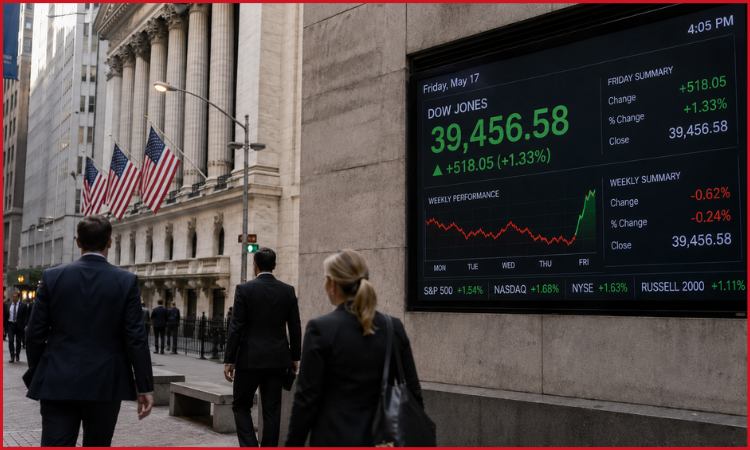
Wall Street closed higher on Friday, August 21, as easing anxiety around US government bond yields helped stocks recover from the previous session’s losses. The rebound was not enough to prevent all three major indexes from ending the week in negative territory.
The Dow Jones Industrial Average gained 517.80 points, or 0.98%, to close at 53,277.01. The S&P 500 rose 33.21 points, or 0.43%, to 7,674.37, while the Nasdaq Composite added 113.29 points, or 0.44%, to finish at 26,180.46.
Friday’s advance capped a volatile stretch in which investors repeatedly shifted positions in response to movements in Treasury yields. Stocks fell on Thursday when yields moved higher, after gaining a day earlier as borrowing costs eased.
For the week, the S&P 500 declined 1.43% and the Nasdaq lost 2.05%, ending three consecutive weeks of gains for both indexes. The Dow slipped 0.85%, recording its second weekly decline in a row.
The Russell 2000, which tracks smaller US companies, fell 1.65% for the week. It was the index’s steepest weekly decline since the beginning of June.
Bond Yields Set the Direction
Bond-market moves remained the main influence on equity trading.
Higher Treasury yields can put pressure on stock valuations by increasing borrowing costs and making government debt more attractive relative to shares. Growth and technology companies are often particularly sensitive because much of their market value is based on earnings expected several years into the future.
The market steadied after the US Treasury Department signalled that it could increase its purchases of government securities. The department had already surprised markets by saying it would spend twice the expected amount on bond buybacks.
The announcement reduced fears that yields would continue rising without interruption. That helped restore some risk appetite on Friday, though concerns about government borrowing and long-term interest costs have not disappeared.
Economic data added to the calmer mood. Growth in the US services sector accelerated to its strongest pace in nearly two years during August, lifting overall business activity. The reading helped offset weaker manufacturing growth, which continued to face pressure from slower inventory building and supply-chain disruptions.
UBS Global Wealth Management raised its year-end target for the S&P 500 to 8,100, pointing to stronger corporate earnings and profit growth. The index closed Friday at 7,674.37.
Materials, Healthcare and Financial Stocks Lead
Most of the S&P 500’s 11 major sectors finished Friday higher.
Materials stocks led the session with a 2.2% gain. Healthcare rose 1.3%, while financial companies advanced 1%. Banks and other financial businesses can benefit when market conditions stabilise and economic activity remains firm.
Utilities were the weakest group, falling 2.3%. The sector often competes with bonds for income-focused investors and can come under pressure when yields remain high. Energy declined 0.2%, making it the second of only two sectors to end lower.
Oil prices continued to rise amid concerns about future supply. Brent crude gained 6.39% over the week, while US crude advanced 5.66%. The increase added to inflation worries because higher energy prices can feed into transport, production and consumer costs.
Among individual companies, Ross Stores gained 4.4% after the discount retailer reported quarterly results above expectations and raised its full-year profit forecast.
Crypto-linked shares posted some of the strongest moves of the session. Robinhood rallied 13.7%, while Coinbase Global rose 8.2%. Strategy, formerly known as MicroStrategy, added 6%.
The gains followed a 6.4% jump in bitcoin, which reached its highest level since mid-May. The move renewed interest in publicly traded businesses whose earnings or balance sheets are closely linked to digital assets.
Market breadth was positive. Gaining stocks outnumbered decliners by 1.68 to one on the New York Stock Exchange and 1.85 to one on the Nasdaq.
The NYSE recorded 214 new highs and 118 new lows. On the Nasdaq, 3,186 shares advanced and 1,725 declined. The Nasdaq Composite registered 91 new 52-week highs and 76 new lows.
Trading activity remained below its recent average. About 14.91 billion shares changed hands across US exchanges, compared with the 20-session average of 16.62 billion.
Nvidia Earnings and Inflation Data Come Next
Technology earnings will return to the centre of market attention in the coming week.
Nvidia is scheduled to report its quarterly results, giving investors a fresh look at demand for artificial-intelligence chips and data-centre infrastructure. The company’s performance and guidance can influence semiconductor stocks as well as the wider technology market.
Software companies Intuit, Salesforce and CrowdStrike are also due to report. Their updates will offer more evidence on corporate technology spending, subscription growth and demand for cybersecurity services.
Markets will also receive the July Personal Consumption Expenditures price index. The PCE index is the Federal Reserve’s preferred inflation measure and could influence expectations for the next interest-rate decision.
Recent consumer and producer inflation readings have reduced expectations of an immediate rate increase. A softer PCE report may ease pressure on bond yields, while an unexpected rise could put stocks back under strain.
Investors will also follow comments from Federal Reserve Chair Kevin Warsh at the Jackson Hole symposium. The speech may provide further direction on inflation, economic growth and the path of interest rates.
What Next?
Friday’s recovery showed that buyers returned once pressure from Treasury yields eased. The Dow gained nearly 1%, while the S&P 500 and Nasdaq both rose more than 0.4%.
The weekly picture was less positive, with all three indexes closing lower. Bond yields remain the market’s main pressure point, and the next test will come from Nvidia’s results, major software earnings and fresh US inflation data.