The global robotics industry is moving closer to a breakthrough that could allow machines to understand simple instructions and perform everyday tasks in unfamiliar surroundings, according to Unitree Robotics founder and chief executive Wang Xingxing.
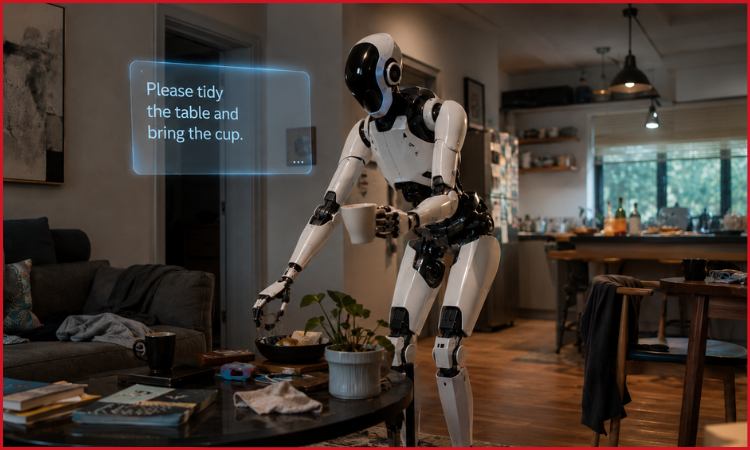
Speaking at the World Robot Conference in Beijing, Wang said the sector’s defining moment would arrive when a robot could enter an unfamiliar home and complete most assigned tasks using only spoken or written instructions. He described an 80% success rate as an important benchmark for the technology.
Reaching that level would represent what Wang called a “ChatGPT moment” for robotics, a point at which the technology becomes capable and accessible enough to support wider commercial adoption. His remarks referred to the scale of the potential breakthrough rather than any direct link between humanoid robots and OpenAI’s chatbot.
Despite rapid progress in robot hardware, Wang said a major advance in artificial intelligence software could still be several years away. Under an optimistic scenario, the breakthrough could happen within two to three years. A more cautious estimate places it between five and ten years away.
Software Remains the Main Constraint
Robotics companies have made visible progress in mechanical design. Recent humanoid models can walk, run, maintain balance, carry objects and perform coordinated movements. Unitree has drawn global attention with robots capable of dancing and demonstrating martial arts-style routines.
The larger challenge is enabling those machines to make decisions independently in unpredictable environments.
A robot working inside a factory usually operates within a controlled setting. Its movements, workspace and responsibilities are carefully defined. A household presents a more difficult problem because furniture, objects, people and instructions can vary continuously.
For robots to become useful across homes and workplaces, they must be able to interpret their surroundings, understand broad instructions and adjust their actions without being programmed separately for every task.
Wang said artificial intelligence responsible for decision-making and interaction remains the biggest obstacle to mass deployment. Current humanoid systems can demonstrate impressive individual abilities, but they are not yet reliable or efficient enough for widespread commercial use.
Unitree is directing much of its investment and technical workforce towards world models, which are designed to help AI systems build an internal understanding of physical environments. Such models could allow robots to predict how objects will respond, plan movements and adapt when conditions change.
Wang acknowledged that Unitree still has ground to cover in applying physical AI to real-world situations. The comment highlighted the gap between controlled demonstrations and robots that can operate consistently without close supervision.
Commercial Use Remains Limited
Founded in Hangzhou, Unitree has become known internationally for its quadruped robots and lower-cost humanoid machines. It is regarded as the world’s largest manufacturer of robot dogs and the second-largest humanoid robot maker by shipments.
However, the company’s current customer base shows that the industry is still in an early stage. Universities and research organisations account for a large portion of Unitree’s customers, according to information disclosed by the company. Broader use across homes, factories and service businesses remains limited.
Investor demand for the sector has nevertheless been strong. Unitree priced its Shanghai initial public offering at 150.80 yuan per share and sought to raise about 6.1 billion yuan, or roughly $904 million.
The retail portion of the offer was subscribed more than 8,000 times. Unitree’s shares rose sharply during their market debut, reflecting intense investor interest in humanoid robotics and embodied AI. The stock subsequently fell 11% after its debut-day surge, showing the volatility surrounding highly valued technology listings.
At the IPO price, Unitree was valued at about 219 times its 2025 earnings and 36 times annual sales. The valuation places considerable expectations on the company’s ability to move beyond research customers and develop practical commercial applications.
China Leads Global Humanoid Shipments
China is currently the dominant producer of humanoid robots. Industry executives are offering different timelines for the expected breakthrough. Galbot founder Wang He has said the robotics industry could reach its defining AI moment by 2028. His benchmark is similar: robots should be able to complete between 70% and 80% of common tasks without specialised training.
The sector also faces growing geopolitical pressure. The United States has moved to block future imports of certain foreign-made humanoid and quadruped robots on national security grounds. Such restrictions could complicate overseas expansion for Chinese manufacturers and increase competition between domestic robotics ecosystems.
What To Expect Next?
Unitree’s vision is clear: the robotics industry will enter a new phase when machines can follow ordinary instructions and handle most tasks in places they have never encountered before.
Hardware is advancing quickly, but reliable decision-making software remains the decisive challenge. The industry’s next major step will not be another carefully choreographed demonstration. It will be a robot that can enter a real home or workplace, understand what needs to be done and complete the job safely without extensive programming.
Whether that happens within three years or closer to a decade will depend on progress in physical AI, world models and the ability of robotics companies to turn laboratory capabilities into dependable products.
Reference:
https://egyptian-gazette.com/technology/robots-poised-for-chatgpt-moment-unitree-ceo-says/