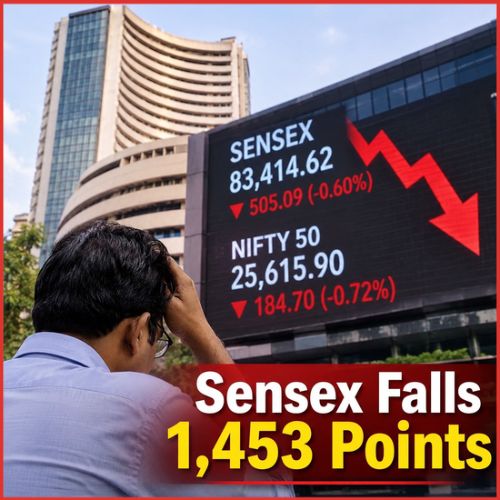
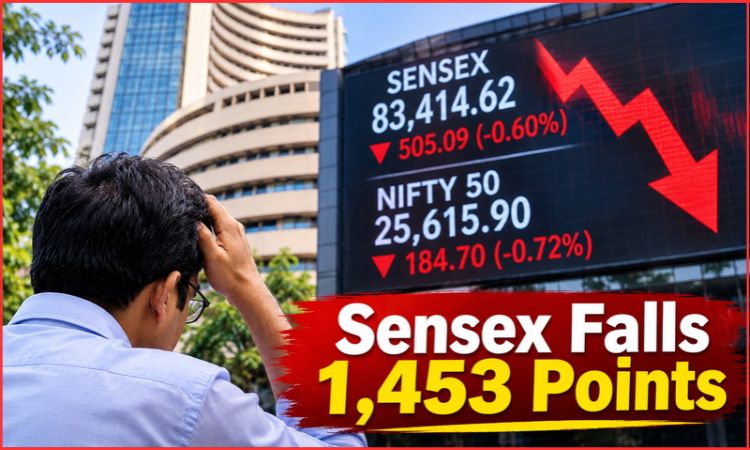
Indian equities surrendered their opening gains on November 23, with the Sensex falling roughly 1,453 points from its intraday high as selling intensified in banking and metal shares.
The Nifty 50 also reversed sharply, dropping about 425 points from its early high to a morning low of 25,567.30.
Those figures measure the movement from the day’s high, rather than the decline against the previous close.
At 10:15 am, the Sensex stood at 83,414.62, down 505.09 points, or 0.60%, from Friday’s close. The Nifty was at 25,615.90, lower by 184.70 points, or 0.72%.
The distinction is important: the morning saw a steep reversal, but the headline high-to-low swing was larger than the loss measured against the previous session.
Opening Gains Failed To Hold
The benchmarks began positively before selling gathered pace during the first hour.
For traders, that sequence can feel different from a market that opens lower and stays there. Buyers entering during the initial rise quickly face prices below their purchase levels.
The changing direction can also encourage shorter-term participants to adjust positions, adding to the movement.
However, the price pattern alone does not reveal every investor’s reason for selling.
Profit-taking after a rally was part of the reported explanation. It should not be treated as proof that all transactions reflected the same motive.
The confirmed development was a loss of early momentum, followed by a recovery from the morning lows that still left both indices below their previous closes.
Banking Shares Apply Pressure To The Benchmarks
The banking stock decline was a major feature of the session.
Axis Bank, ICICI Bank, Kotak Mahindra Bank, HDFC Bank and State Bank of India were among the lenders trading lower.
Weakness across several large banks matters because those companies influence the direction of the main indices.
It also gives the movement a broader character than a decline concentrated in one lender.
Still, a sector-wide price fall does not establish that each bank’s operating outlook changed overnight. Investors can reduce exposure because of valuation, positioning or wider market concerns.
The morning quotations show where selling occurred. Subsequent company disclosures are needed to judge changes in underlying business performance.
Metals Add To The Selling
Metal shares supplied another source of weakness, with Tata Steel among the prominent decliners.
The report linked the stock’s fall to investor reaction around its proposed investment in APL Apollo Tubes. APL Apollo also faced heavy selling.
Corporate transactions can create competing interpretations.
An acquisition may offer future opportunities while raising immediate questions about the price paid, financing and expected returns.
The market’s first reaction does not settle those questions. It shows how investors assessed the available information at that moment.
For readers following metal stocks, separating the transaction-specific response from the wider sector movement helps avoid attributing every decline to one announcement.
Broader Shares Also Move Lower
The selling extended beyond the largest companies.
The Nifty Midcap 100 and Nifty Smallcap 100 were each down approximately 0.54% in the reported morning snapshot.
That suggests the weakness was not confined entirely to heavyweight banking and metal names.
However, a broad-market index remains an aggregate. Individual shares can rise within it, and the size of their moves can vary substantially.
For an investor checking a portfolio, the benchmark provides context rather than a complete explanation of performance.
The particular companies held, their weights and the price paid determine the actual result.
A market-wide decline can therefore produce very different outcomes across portfolios.
India VIX Rises As Trading Becomes Less Settled
India VIX rose 5.49% to 18.27 during the reported period.
The India VIX increase accompanied the sharp change in index direction, signalling a rise in expected market volatility.
It should not be read as a prediction that shares must continue falling.
Volatility and direction are related but different ideas. A market can experience large upward and downward moves while producing a smaller net change.
For participants managing short-term positions, that distinction matters. A narrow stop, leveraged exposure or an order entered during a fast move can behave differently from an unleveraged holding maintained over a longer period.
The higher VIX reading therefore adds information about uncertainty, rather than supplying a straightforward forecast.
High-To-Low Moves Need Careful Interpretation
The Sensex’s approximately 1,453-point reversal is the most striking number in the morning report.
But it answers a different question from the 505-point decline recorded at 10:15am.
The first compares two points within the session. The second compares the current level with the previous close.
Both can be accurate simultaneously.
This is especially relevant when headlines circulate without their supporting figures. A reader could otherwise assume that the Sensex was down 1,453 points from Friday.
The Nifty figures require the same care. Its 425-point move from the early high was larger than its decline against the previous close in the later snapshot.
A Morning Recovery Does Not Establish The Closing Result
The benchmarks had moved above their lows by 10:15am, but that partial recovery did not restore the opening gains.
It also did not establish how the session would end.
Intraday reports capture a developing market. Buying can strengthen, selling can resume or leadership can shift between sectors.
A closing assessment requires closing figures, rather than treating a morning low or rebound as the final outcome.
For the November 23 session, the clearest early conclusion was that the market had rejected higher opening levels, with banks and metals contributing heavily to the reversal.
Investors Face A More Selective Session
The morning’s movement showed how quickly a positive opening can give way to selling.
It also highlighted the importance of index composition. Pressure in several large banking shares can affect the benchmark even when some other businesses remain resilient.
For investors assessing the Indian stock market sell-off, the useful evidence is specific: which stocks fell, how broad the weakness became and whether buying returned later.
The headline swing captures the intensity of the reversal. The final significance depends on whether the market can sustain a recovery beyond the opening volatility.